The Police Data Challenge - Where Next?
by Cognyte
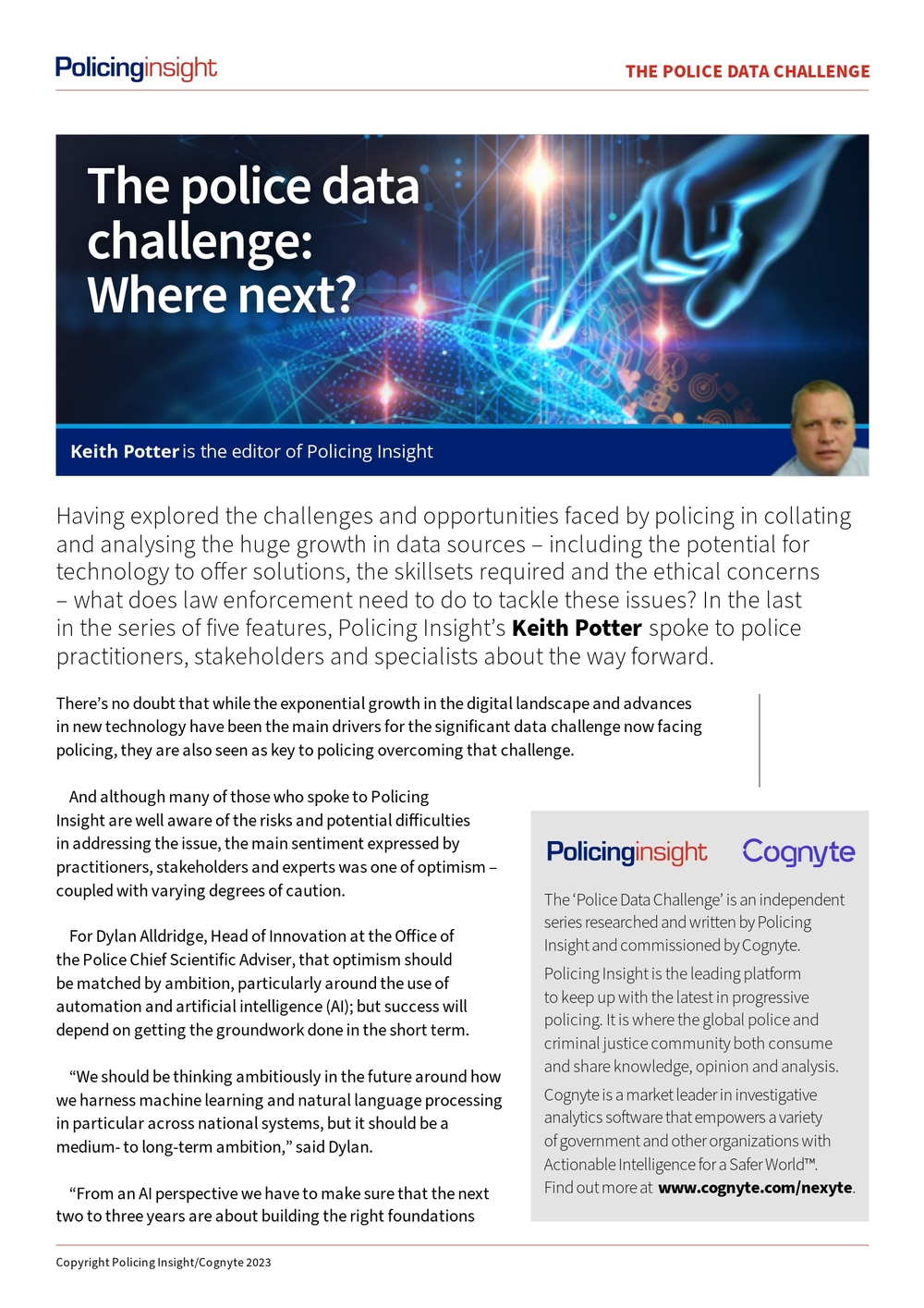
THE POLICE DATA CHALLENGE Copyright Policing Insight/Cognyte 2023 There’s no doubt that while the exponential growth in the digital landscape and advances in new technology have been the main drivers for the significant data challenge now facing policing, they are also seen as key to policing overcoming that challenge. And although many of those who spoke to Policing Insight are well aware of the risks and potential difficulties in addressing the issue, the main sentiment expressed by practitioners, stakeholders and experts was one of optimism – coupled with varying degrees of caution. For Dylan Alldridge, Head of Innovation at the Office of the Police Chief Scientific Adviser, that optimism should be matched by ambition, particularly around the use of automation and artificial intelligence (AI); but success will depend on getting the groundwork done in the short term. “We should be thinking ambitiously in the future around how we harness machine learning and natural language processing in particular across national systems, but it should be a medium- to long-term ambition, ” said Dylan. “From an AI perspective we have to make sure that the next two to three years are about building the right foundations The police data challenge: Where next? Having explored the challenges and opportunities faced by policing in collating and analysing the huge growth in data sources – including the potential for technology to offer solutions, the skillsets required and the ethical concerns – what does law enforcement need to do to tackle these issues? In the last in the series of five features, Policing Insight’s Keith Potter spoke to police practitioners, stakeholders and specialists about the way forward. The ‘Police Data Challenge’ is an independent series researched and written by Policing Insight and commissioned by Cognyte. Policing Insight is the leading platform to keep up with the latest in progressive policing. It is where the global police and criminal justice community both consume and share knowledge, opinion and analysis. Cognyte is a market leader in investigative analytics software that empowers a variety of government and other organizations with Actionable Intelligence for a Safer World™. Find out more at www.cognyte.com/nexyte. Keith Potter is the editor of Policing Insight
THE POLICE DATA CHALLENGE Copyright Policing Insight/Cognyte 2023around our people and our structures, because we will benefit at far greater scale from AI in the long term if we get it right in the short term. “If we rush to try and get policing onto the AI bandwagon too quickly, we’ll probably lose more ground than we gain in the long term; it’s the boring stuff, but it’s so incredibly important that we get it right. ” He believes that investing now in robotic process automation “to improve data quality” and work on the “structure and integrity of that data and our systems” could be an “enormous accelerator” in building the bedrock for the introduction of AI: “Although robotic process automation isn’t in itself really AI, it’s an important precursor towards what I consider to be transformative in policing. ” Speed and accuracy Dylan is certainly far from alone in his enthusiasm for the potential of AI in policing, and in collating, extracting and analysing data in particular. Paul Williamson, a former Regional Head of Investigations for the NCA and now Programme Leader for Policing at the University of the West of England (UK), can see huge advantages in terms of the speed and accuracy offered by the new technology. “Artificial intelligence and machine learning is going to be rapid, so our ability to analyse large amounts of data – which we did on Operation Venetic – will become a lot more common and will advance very, very quickly. “That includes video footage, social media posts, and identifying patterns and anomalies that can be relevant to a criminal investigation; I think all of that is going to be more rapid. ” Indeed, AI is not just viewed as a ‘nice to have’ , but is seen by many – including NPCC National Intelligence Portfolio Lead, Chief Constable Lisa Winward, and former West Midlands Chief Constable Sir David Thompson – as an essential policing tool. “Just the sheer volume and breadth of data out there, we need technology to be part of the solution to this, ” CC Winward told Policing Insight. “It doesn’t matter how skilled your workforce are, we’ll need to use modern technology and some form of artificial intelligence to decipher that level of information into something that is manageable and meaningful, and be able to join the dots up. ” Sir David, previously the UK lead for developing the National Common Intelligence Application, is equally adamant about the importance of new technology: “I think the threat North Yorkshire Chief Constable Lisa Winward, the National Police Chiefs’ Council (NPCC) Intelligence Portfolio Lead “It doesn’t matter how skilled your workforce are, we’ll need to use modern technology and some form of artificial intelligence to decipher that level of information into something that is manageable and meaningful, and be able to join the dots up. ” CC Lisa Winward NPCC National Intelligence Lead

THE POLICE DATA CHALLENGE Copyright Policing Insight/Cognyte 2023identification – all the command and control logs, all the intel that’s coming through – I cannot see a way that policing would be able to function if it wasn’t using some form of AI to look at patterns, issues, socials, and make better informed responses to emerging threats. ” He is also well aware of some of the ethical concerns around AI that have been covered in this series, but added: “I think the worst thing policing could do is take a big step back from it and say ‘crikey, we can’t get involved in this stuff’ . I think policing has got to be in this space because if we’re not, then one, we won’t be as effective, and two, other people will be using it. ” Analytics for the frontline Alongside challenges of scale, turning data into usable information and intelligence for officers and staff who themselves may not have analytical skills will be crucial going forwards. At an operational level, this underlines the need for in-force decision intelligence platforms that offer both advanced data fusion and analytics capabilities, and which can generate insights automatically, making data accessible to users in an intuitive way. Iain Donnelly, the former West Midlands Police lead for Digital Investigations and Intelligence, and the police project manager who delivered the foundation phase of the National Data Analytics Solution, argues that putting the digital investigation and data technology tools in the hands of frontline officers – “completely neglected in terms of crime investigation technology” – would also be a huge step towards addressing some of the current volume pressures on specialists. “What you’ve got at the moment are bottlenecks within digital forensics units (DFUs) and digital media investigator (DMI) units, but everyone else has nothing in terms of technology, ” said Iain. “So a DC investigating multiple burglaries, or maybe rapes, needs to locate and gather evidence from a whole plethora of digital devices such as Ring doorbell footage, telecoms data, CCTV and so on. “What’s needed is the capability for every investigator in a force to do the lion’s share of relatively straightforward digital evidence investigation, so that the DFUs and DMIs can just get on and deal with the really, really serious stuff. “At the moment you’ve got cops going out doing ridiculous things like videoing someone’s mobile phone with their body-worn video, or using their own personal mobile phones to conduct internet inquiries into a suspect.“I cannot see a way that policing would be able to function if it wasn’t using some form of AI to look at patterns, issues, socials, and make better informed responses to emerging threats. ” Sir David Thompson former West Midlands Chief ConstableFormer West Midlands Chief Constable Sir David Thompson

THE POLICE DATA CHALLENGE Copyright Policing Insight/Cognyte 2023“All of which potentially leaves them wide open to compromise from criminals, evidentially is almost of zero value because it’s been gathered unlawfully using an unapproved piece of technology, and is probably straying into the realms of direct surveillance, requiring a direct surveillance authority. “In five years’ time we should be in a situation where every frontline officer and every investigator of both volume crime and serious crime has both the skills, knowledge and technical tooling to be able to conduct relatively straightforward digital investigations without having to go to a DFU or a DMI. ” Collaboration and capability Providing some of that capability, and sharing the outcome of the analytics process, is part of the work already underway within the Tackling Organised Exploitation (TOEX) team, which is working to develop and provide a cloud-based suite of tools – similar to a policing app store – that can improve the technical capability of forces as well as the availability of technical advantage to operational officers. Early packages created include a translate app that can work with foreign language phone downloads (and at the time Policing Insight spoke to the team, had already translated 1.5 million lines of text), a transcription app, and an ANPR ‘find and profile’ tool; potential apps for the future include a dashboards tool, and a data bulk search app. The team has also developed the TOEX Data Platform, an operational model which combines local, regional and national data to support and enhance the focus on both high-harm victims and offenders, aid investigations, and support effective tactical interventions. In what is a first for UK policing, the platform uses predictive analytics to identify hidden harm, which is then assessed by officers and staff to decide on further actions. Currently the platform is used to create three TOEX ‘Force Profiles’ – for violence against women and girls (VAWG), missing persons, and the Violence and Sex Offender Register (ViSOR). These are developed using analytical tools to conflate the crime, intelligence and custody data held by nine forces (Norfolk, Suffolk, Hertfordshire, Bedfordshire, Cambridgeshire, Essex, Kent, West Mercia, and Warwickshire), with strategic and tactical actionable products then fed back into forces. And while TOEX is already proving invaluable to the forces it works with, the potential to Former West Midlands Police Superintendent Iain Donnelly“What’s needed is the capability for every investigator in a force to do the lion’s share of relatively straightforward digital evidence investigation, so that the DFUs and DMIs can just get on and deal with the really serious stuff. ” Iain Donnelly Former project manager, National Data Analytics Solution

THE POLICE DATA CHALLENGE Copyright Policing Insight/Cognyte 2023expand the approach to a national level, linking all 43 police forces – something of a holy grail in data analytics – is not being overlooked. TOEX Strategic Lead, Detective Chief Supt Kate Thacker, is not ignorant to those opportunities, but is keener to emphasise the collaboration that has brought the project to the stage it is now, and underline the importance of forces working together and sharing data. “The benefit we’ve had is saying, look, here is a vessel for us to demonstrate multi-force data modelling. So stop trying to do this on your own – and frankly, you’re doing it with one of your eyes shut if you do it with just your own data, ” said Det Ch Supt Thacker. A sense of direction That collaboration message was echoed by Chief Constable Lisa Winward, the NPCC National Intelligence Portfolio Lead, who told Policing Insight: “It’s the ambition of all the strategic leads to work collectively, and where we see intelligence has got an absolutely critical role to play, data technology has to be at the forefront really for us to reduce harm and keep communities safe. ” An advocate of increased use of AI and ML in collating, extracting and analysing data, CC Winward recognises how far policing has come in a short space of time, from the days of “collator cards” and a collator “sitting in a little office surrounded by filing cabinets” . But that doesn’t mean the human input will be a thing of the past: “I truly believe in policing we will always have to have human intervention. There’ll always have to be somebody with professional knowledge who can make sense of the things that the automated process spits out the other end of the sausage machine. ” Collaboration on tackling the data challenge also extends outside of police forces to the service’s work with partner agencies, something that Thames Valley Supt Lewis Prescott-Mayling is well aware of, having played a lead role in establishing the Thames Valley Together multi-agency platform as part of his work with the force’s Violence Reduction Unit (VRU). He has the same sense of optimism around policing’s improving ability to analyse data and extract relevant information, as well as the opportunities and obligations for multi-agency data sharing – particularly around prevention. “I think we’ll move quite quickly in the next two to three years, ” he told Policing Insight. “The main blockages to us not doing it are around political will, right from our senior leaders to government, to make sure that the law is implemented as it’s written, and particularly around the data sharing side.“The benefit we’ve had is saying, look, here is a vessel for us to demonstrate multi-force data modelling. So stop trying to do this on your own – and frankly, you’re doing it with one of your eyes shut if you do it with just your own data. ” DCS Kate Thacker TOEXDetective Chief Superintendent Kate Thacker

THE POLICE DATA CHALLENGE Copyright Policing Insight/Cognyte 2023“Technology is not an inhibitor now, and it’s not huge amounts of cost once you understand what you’re doing; now it’s just around driving it forward across the professional partnerships and making sure we’re all willing to do this. “I do think the opportunities outweigh the risks, although they are big risks. People think that AI will be predicting, but we’re not Minority Report. It’s almost ridiculous – and slightly lazy – that it keeps getting used as a narrative, because it doesn’t allow us to have an actual debate about what’s possible, which is way beyond the headline. And we, and communities, and the wider public, all need to be talking more nuanced than that headline. ” Those conversations also need to include suppliers; for Dylan Alldridge, having a clear idea of where policing wants to be in the next few years is essential both for local forces and industry, which will be crucial to local innovation. “You have to have that clear sense of this is where we want to be in one year, this is where we’ll be in three years, this is where we want to be in 10 years, ” said Dylan. “It needs to be a balance of ambitious and pragmatic, and then work with industry and local policing to say how do we get there? “I think within two years ideally we should be in a place where we’ve really broken the back of our data quality issue. We can’t keep talking about it; it’s a difficult one, but actually we need to really push on and get to a place where our data quality is of a sufficient standard. “I think we should have enough evaluated evidence around what machine learning, natural language processing, large language models could and should do across policing data. “But the one thing I think that policing doesn’t need any more of is strategies; what we need now are the road maps to operationalise those strategies. ”“In policing we will always have to have human intervention. There’ll always have to be somebody with professional knowledge who can make sense of the things that the automated process spits out the other end of the sausage machine. ” CC Lisa Winward NPCC National Intelligence Lead
