Cognyte LEA Survey Report 2025
by Cognyte
| Law Enforcement Outlook1 Law Enforcement Outlook: Navigating Evolving Threats, Investigation Challenges & Technology Innovations

| Law Enforcement Outlook2Table of Contents Introduction and Key Findings Survey Report Findings Top Technologies Enabling Criminals to Accelerate Crime and Evade Detection Top Threats Tackled by Law Enforcement Ability to Successfully Resolve Investigations Within Reasonable Timeframes Top Technology Pain Points Top Non-Tech Causes for Investigation Delays Challenges in Leveraging Digital Data During Investigations Top Technologies to Accelerate Investigations Use of Blockchain Analytics Tools Demographics About Cognyte 3 7 8 9 10 11 12 13 14 15 16 19
| Law Enforcement Outlook3 Introduction We commissioned a survey of 300 law enforcement stakeholders, both senior decision-makers as well as hands-on practitioners. The survey is based on responses from respondents who are actively working in law enforcement organizations, public safety agencies, financial intelligence units, border police units, maritime police units, as well as SWAT, special forces, and search and rescue units. This report was administered online by Global Surveyz Research, an independent global research firm. Respondents hail from organizations across a total of 32 countries in North America, Europe, Central and South America, Asia Pacific and the Middle East. The respondents were recruited through a global B2B research panel and invited via email to complete the survey. The answers to most of the non-numerical questions were randomized to prevent order bias in the answers. As criminal landscapes evolve in response to geopolitical and technological shifts worldwide, Law Enforcement Agencies (LEAs) must stay a step ahead and continually strengthen their capabilities in order to confront an increasingly complex array of threats and challenges. It’s not only the expanding range and variety of crimes being committed — it’s also the rapidly advancing techniques of criminals and bad actors, who are quick to adopt cutting-edge technologies to carry out their malicious activities. With many technologies becoming increasingly commoditized, their ubiquitous use isn’t limited to just law-abiding citizens, but also to criminals. From GenAI chatbots and drones to satellite internet, advanced technologies of all types are now increasingly accessible, providing criminals with powerful tools to both expand their criminal activities and more easily avoid detection by authorities. Using these technologies, the crimes they commit can now be executed faster, on a much larger scale, and with more destructive impact. At the same time, these same technologies hold the potential to do good, by equipping LEAs with more powerful capabilities to fight back against crime. To carry out their roles effectively, LEAs must broaden their technological readiness in order to successfully combat crime and resolve investigations faster. The purpose of this survey is to offer a unique view of the current state of law enforcement, and to shed light on how LEAs expect technology to impact their strategies and capabilities in the coming year. The report should be of particular interest to law enforcement personnel serving in investigations, intelligence analysis, field operations and other hands-on roles, as well as IT professionals who set the priorities, budgets and technology roadmaps for their organizations.Methodology 3
| Law Enforcement Outlook4 Introduction and Key Findings 4

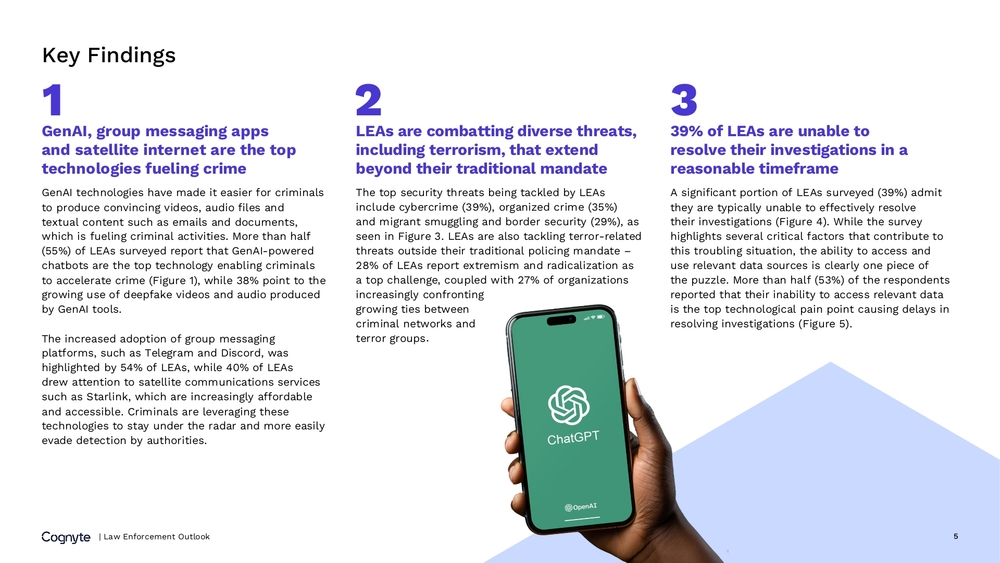
| Law Enforcement Outlook5 Key Findings 1 2 3 GenAI technologies have made it easier for criminals to produce convincing videos, audio files and textual content such as emails and documents, which is fueling criminal activities. More than half (55%) of LEAs surveyed report that GenAI-powered chatbots are the top technology enabling criminals to accelerate crime (Figure 1), while 38% point to the growing use of deepfake videos and audio produced by GenAI tools. The increased adoption of group messaging platforms, such as Telegram and Discord, was highlighted by 54% of LEAs, while 40% of LEAs drew attention to satellite communications services such as Starlink, which are increasingly affordable and accessible. Criminals are leveraging these technologies to stay under the radar and more easily evade detection by authorities. A significant portion of LEAs surveyed (39%) admit they are typically unable to effectively resolve their investigations (Figure 4). While the survey highlights several critical factors that contribute to this troubling situation, the ability to access and use relevant data sources is clearly one piece of the puzzle. More than half (53%) of the respondents reported that their inability to access relevant data is the top technological pain point causing delays in resolving investigations (Figure 5). The top security threats being tackled by LEAs include cybercrime (39%), organized crime (35%) and migrant smuggling and border security (29%), as seen in Figure 3. LEAs are also tackling terror-related threats outside their traditional policing mandate – 28% of LEAs report extremism and radicalization as a top challenge, coupled with 27% of organizations increasingly confronting growing ties between criminal networks and terror groups . GenAI, group messaging apps and satellite internet are the top technologies fueling crimeLEAs are combatting diverse threats, including terrorism, that extend beyond their traditional mandate39% of LEAs are unable to resolve their investigations in a reasonable timeframe 5
| Law Enforcement Outlook6 Key Findings Modern investigations require gathering and analyzing volumes of digital data such as communications records, images, videos, documents, social media and more. 46% of LEAs report challenges with both gathering data for court-admissible evidence as well as then analyzing it to generate intelligence and insights, while an additional 33% of LEAs specifically say that analyzing the data is the most challenging part of the process for them (Figure 7). We took a closer look at LEAs reporting that generating intelligence and insights is most challenging aspect for them by their ability to successfully resolve investigations in a reasonable time frame (Figure 8). We see that analyzing the data is most challenging for those organizations who are never or rarely able to resolve their investigations (48%). Clearly, analyzing data is a key stumbling block, and the more effectively LEAs are able generate intelligence and insights from digital data, the more successfully they succeed in resolving investigations.LEAs report that the leading non-technological roadblocks leading to delays in investigations is the lack of cooperation with other agencies (37%), tied closely with the lack of collaboration within organizations (30%), as seen in Figure 6. In today’s world, crime knows no limits, with criminal organizations not only committing a wider range of crimes, but also increasingly conducting their illicit schemes across international borders. This is proving challenging for agencies used to operating within fixed borders, both within their own organizations – due to siloed teams and data – and when it comes to sharing information with other domestic and foreign security organizations in a timely manner. LEAs also report that their investigations are delayed due to staffing issues, including lack of staff with relevant skills (33%) and staff shortages in general (32%). LEAs anticipate that the technologies that will be most impactful in accelerating their investigations in the coming year are AI-powered predictive analytics (48%) and GenAI for data exploration and analysis (47%), as seen in Figure 9. Unsurprisingly, it’s the largest organizations that see the most value in AI (Figure 10), because they typically have more data at their disposal, and are generally better equipped to adopt and successfully use advanced technologies. 4 5 6 Gathering data isn’t enough - 79% of LEAs struggle to unlock the insights they needLack of cooperation and collaboration top the list of non-tech barriers to effective investigationsLEAs see predictive analytics and GenAI as game-changers for accelerating investigations
| Law Enforcement Outlook7 Survey Report Findings 7

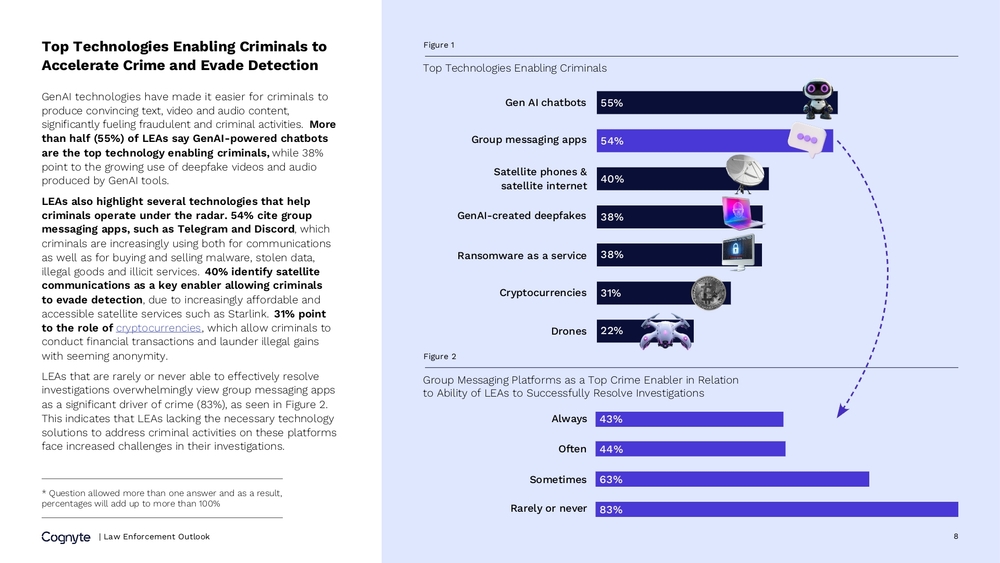
Top Technologies Enabling Criminals to Accelerate Crime and Evade Detection GenAI technologies have made it easier for criminals to produce convincing text, video and audio content, significantly fueling fraudulent and criminal activities. More than half (55%) of LEAs say GenAI-powered chatbots are the top technology enabling criminals, while 38% point to the growing use of deepfake videos and audio produced by GenAI tools. LEAs also highlight several technologies that help criminals operate under the radar. 54% cite group messaging apps, such as Telegram and Discord, which criminals are increasingly using both for communications as well as for buying and selling malware, stolen data, illegal goods and illicit services. 40% identify satellite communications as a key enabler allowing criminals to evade detection, due to increasingly affordable and accessible satellite services such as Starlink. 31% point to the role of cryptocurrencies, which allow criminals to conduct financial transactions and launder illegal gains with seeming anonymity. LEAs that are rarely or never able to effectively resolve investigations overwhelmingly view group messaging apps as a significant driver of crime (83%), as seen in Figure 2. This indicates that LEAs lacking the necessary technology solutions to address criminal activities on these platforms face increased challenges in their investigations.Top Technologies Enabling Criminals Group Messaging Platforms as a Top Crime Enabler in Relation to Ability of LEAs to Successfully Resolve InvestigationsFigure 1 Figure 2Gen AI chatbots Group messaging apps Satellite phones & satellite internet GenAI-created deepfakes Ransomware as a service Cryptocurrencies Drones Always Often Sometimes Rarely or never* Question allowed more than one answer and as a result, percentages will add up to more than 100%43% 44% 63% 83% | Law Enforcement Outlook 8 55% 54% 40% 38% 38% 31% 22%
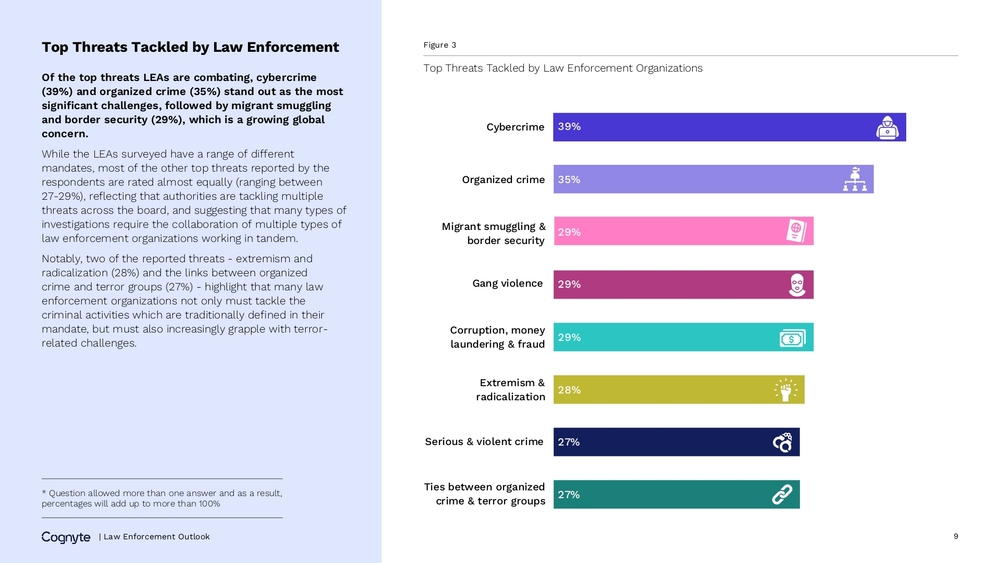
Top Threats Tackled by Law Enforcement Of the top threats LEAs are combating, cybercrime (39%) and organized crime (35%) stand out as the most significant challenges, followed by migrant smuggling and border security (29%), which is a growing global concern. While the LEAs surveyed have a range of different mandates, most of the other top threats reported by the respondents are rated almost equally (ranging between 27-29%), reflecting that authorities are tackling multiple threats across the board, and suggesting that many types of investigations require the collaboration of multiple types of law enforcement organizations working in tandem. Notably, two of the reported threats - extremism and radicalization (28%) and the links between organized crime and terror groups (27%) - highlight that many law enforcement organizations not only must tackle the criminal activities which are traditionally defined in their mandate, but must also increasingly grapple with terror- related challenges.Top Threats Tackled by Law Enforcement OrganizationsFigure 3 Cybercrime Organized crime Migrant smuggling & border security Gang violence Corruption, money laundering & fraud Extremism & radicalization Serious & violent crime Ties between organized crime & terror groups* Question allowed more than one answer and as a result, percentages will add up to more than 100%39% 35% 29% 29% 29% 28% 27% 27% | Law Enforcement Outlook 9
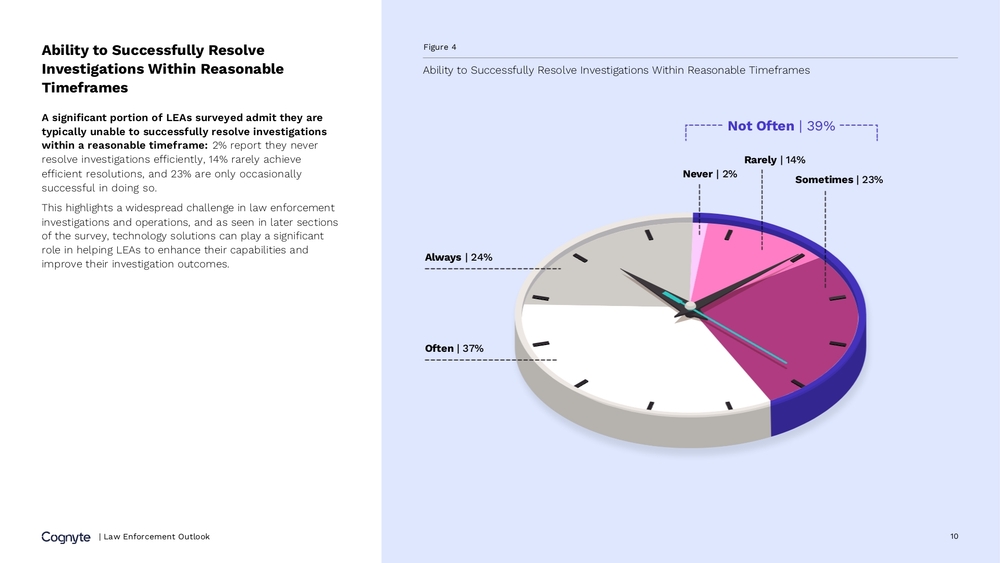
Ability to Successfully Resolve Investigations Within Reasonable Timeframes A significant portion of LEAs surveyed admit they are typically unable to successfully resolve investigations within a reasonable timeframe: 2% report they never resolve investigations efficiently, 14% rarely achieve efficient resolutions, and 23% are only occasionally successful in doing so. This highlights a widespread challenge in law enforcement investigations and operations, and as seen in later sections of the survey, technology solutions can play a significant role in helping LEAs to enhance their capabilities and improve their investigation outcomes.Ability to Successfully Resolve Investigations Within Reasonable TimeframesFigure 4 Always | 24% Often | 37%Sometimes | 23%Rarely | 14% Never | 2% Not Often | 39% | Law Enforcement Outlook 10
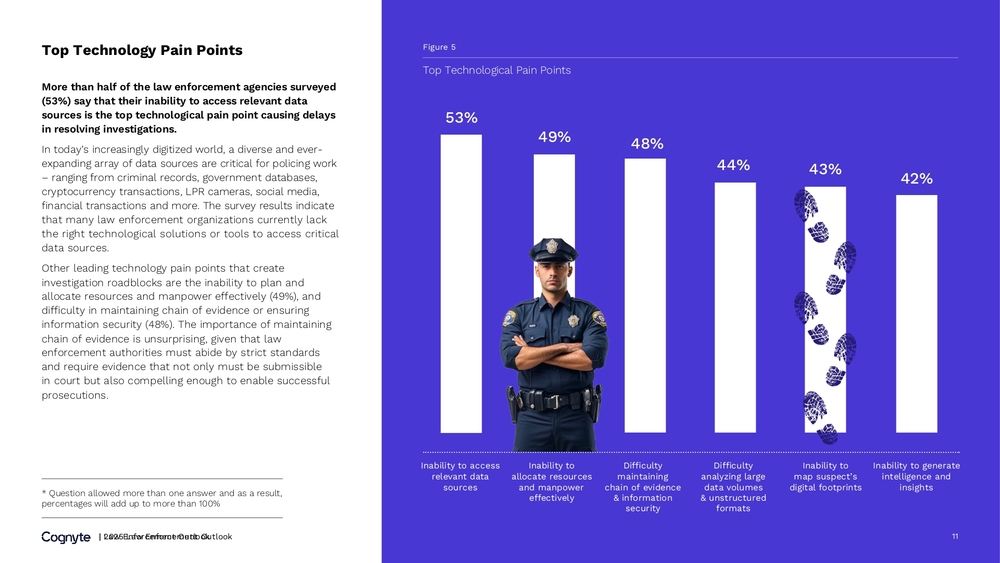
| 2025 Law Enforcement OutlookTop Technology Pain Points More than half of the law enforcement agencies surveyed (53%) say that their inability to access relevant data sources is the top technological pain point causing delays in resolving investigations. In today’s increasingly digitized world, a diverse and ever- expanding array of data sources are critical for policing work – ranging from criminal records, government databases, cryptocurrency transactions, LPR cameras, social media, financial transactions and more. The survey results indicate that many law enforcement organizations currently lack the right technological solutions or tools to access critical data sources. Other leading technology pain points that create investigation roadblocks are the inability to plan and allocate resources and manpower effectively (49%), and difficulty in maintaining chain of evidence or ensuring information security (48%). The importance of maintaining chain of evidence is unsurprising, given that law enforcement authorities must abide by strict standards and require evidence that not only must be submissible in court but also compelling enough to enable successful prosecutions.Top Technological Pain Points Figure 5 53% 49%48% 44% 43%42% Inability to access relevant data sourcesInability to allocate resources and manpower effectivelyDifficulty maintaining chain of evidence & information securityDifficulty analyzing large data volumes & unstructured formatsInability to map suspect’s digital footprintsInability to generate intelligence and insights* Question allowed more than one answer and as a result, percentages will add up to more than 100% | Law Enforcement Outlook 11
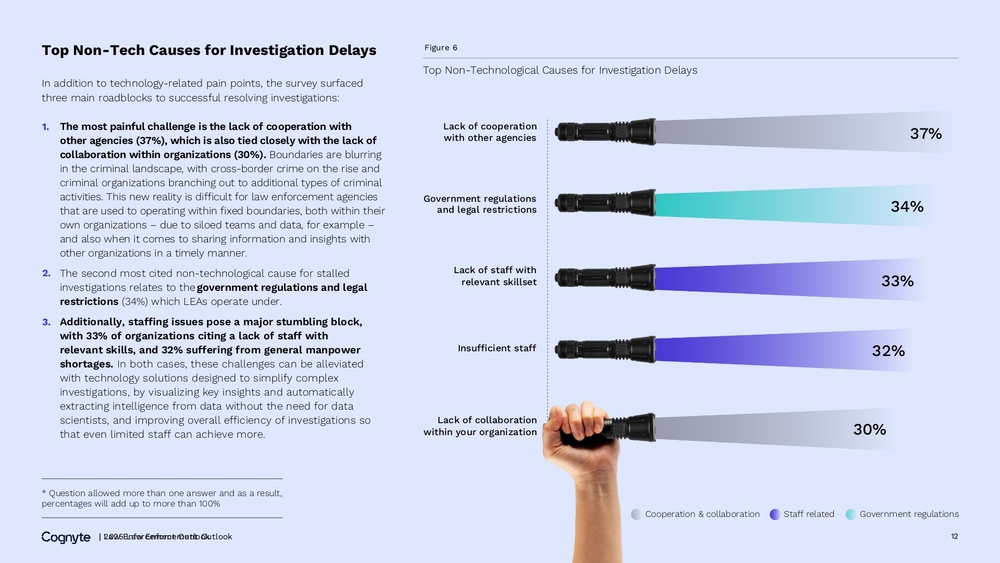
| 2025 Law Enforcement OutlookTop Non-Tech Causes for Investigation Delays In addition to technology-related pain points, the survey surfaced three main roadblocks to successful resolving investigations: Top Non-Technological Causes for Investigation DelaysFigure 6 Lack of cooperation with other agencies Government regulations and legal restrictions Lack of staff with relevant skillset Insufficient staff Lack of collaboration within your organization37% 34% 33% 32% 30% Cooperation & collaboration Staff related Government regulations
- Question allowed more than one answer and as a result, percentages will add up to more than 100%The most painful challenge is the lack of cooperation with other agencies (37%), which is also tied closely with the lack of collaboration within organizations (30%). Boundaries are blurring in the criminal landscape, with cross-border crime on the rise and criminal organizations branching out to additional types of criminal activities. This new reality is difficult for law enforcement agencies that are used to operating within fixed boundaries, both within their own organizations – due to siloed teams and data, for example – and also when it comes to sharing information and insights with other organizations in a timely manner. The second most cited non-technological cause for stalled investigations relates to the government regulations and legal restrictions (34%) which LEAs operate under. Additionally, staffing issues pose a major stumbling block, with 33% of organizations citing a lack of staff with relevant skills, and 32% suffering from general manpower shortages. In both cases, these challenges can be alleviated with technology solutions designed to simplify complex investigations, by visualizing key insights and automatically extracting intelligence from data without the need for data scientists, and improving overall efficiency of investigations so that even limited staff can achieve more.1.
| Law Enforcement Outlook 12
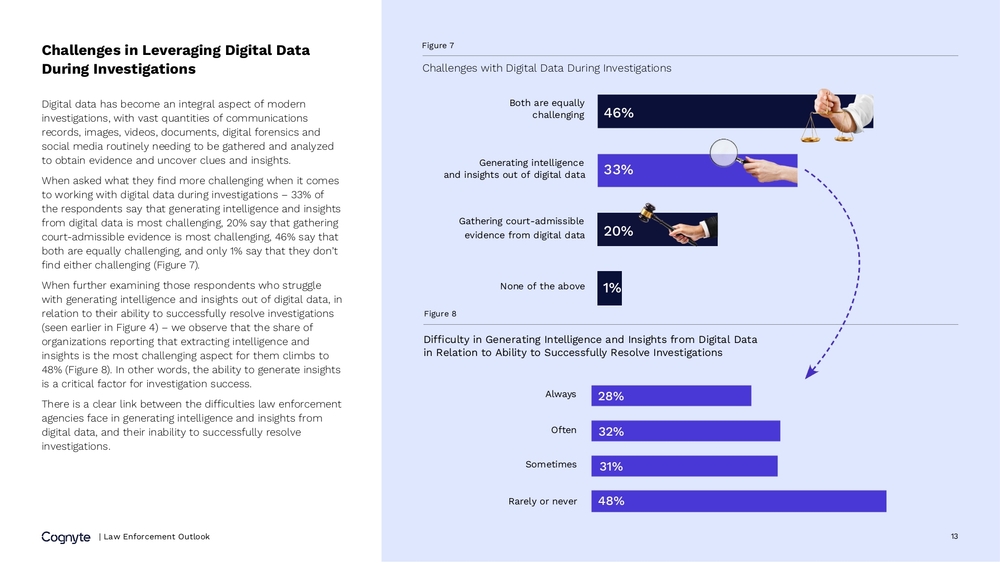
Challenges in Leveraging Digital Data During Investigations Digital data has become an integral aspect of modern investigations, with vast quantities of communications records, images, videos, documents, digital forensics and social media routinely needing to be gathered and analyzed to obtain evidence and uncover clues and insights. When asked what they find more challenging when it comes to working with digital data during investigations – 33% of the respondents say that generating intelligence and insights from digital data is most challenging, 20% say that gathering court-admissible evidence is most challenging, 46% say that both are equally challenging, and only 1% say that they don’t find either challenging (Figure 7). When further examining those respondents who struggle with generating intelligence and insights out of digital data, in relation to their ability to successfully resolve investigations (seen earlier in Figure 4) – we observe that the share of organizations reporting that extracting intelligence and insights is the most challenging aspect for them climbs to 48% (Figure 8). In other words, the ability to generate insights is a critical factor for investigation success. There is a clear link between the difficulties law enforcement agencies face in generating intelligence and insights from digital data, and their inability to successfully resolve investigations.Challenges with Digital Data During Investigations Difficulty in Generating Intelligence and Insights from Digital Data in Relation to Ability to Successfully Resolve InvestigationsFigure 7 Figure 8 46% 28% 32% 31% 48%33% 20% 1%Generating intelligence and insights out of digital dataBoth are equally challenging Gathering court-admissible evidence from digital data None of the above Always Often Sometimes Rarely or never1% | Law Enforcement Outlook 13
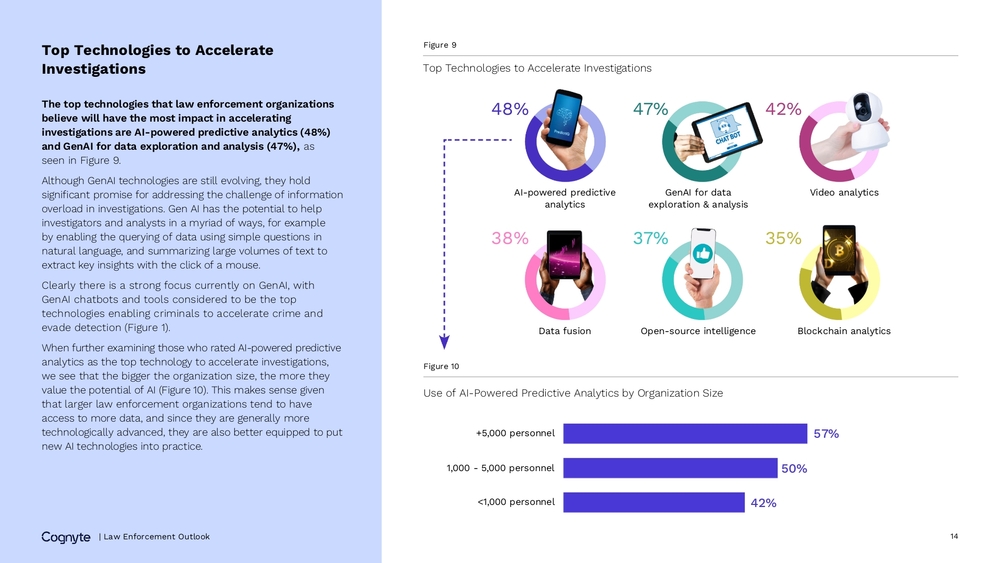
Top Technologies to Accelerate Investigations The top technologies that law enforcement organizations believe will have the most impact in accelerating investigations are AI-powered predictive analytics (48%) and GenAI for data exploration and analysis (47%), as seen in Figure 9. Although GenAI technologies are still evolving, they hold significant promise for addressing the challenge of information overload in investigations. Gen AI has the potential to help investigators and analysts in a myriad of ways, for example by enabling the querying of data using simple questions in natural language, and summarizing large volumes of text to extract key insights with the click of a mouse. Clearly there is a strong focus currently on GenAI, with GenAI chatbots and tools considered to be the top technologies enabling criminals to accelerate crime and evade detection (Figure 1). When further examining those who rated AI-powered predictive analytics as the top technology to accelerate investigations, we see that the bigger the organization size, the more they value the potential of AI (Figure 10). This makes sense given that larger law enforcement organizations tend to have access to more data, and since they are generally more technologically advanced, they are also better equipped to put new AI technologies into practice.Top Technologies to Accelerate Investigations Use of AI-Powered Predictive Analytics by Organization SizeFigure 9 Figure 1048% 47% 42% 35% 37% 38% 57% 50% 42%AI-powered predictive analytics Data fusionGenAI for data exploration & analysis Open-source intelligenceVideo analytics Blockchain analytics +5,000 personnel 1,000 - 5,000 personnel <1,000 personnel | Law Enforcement Outlook 14
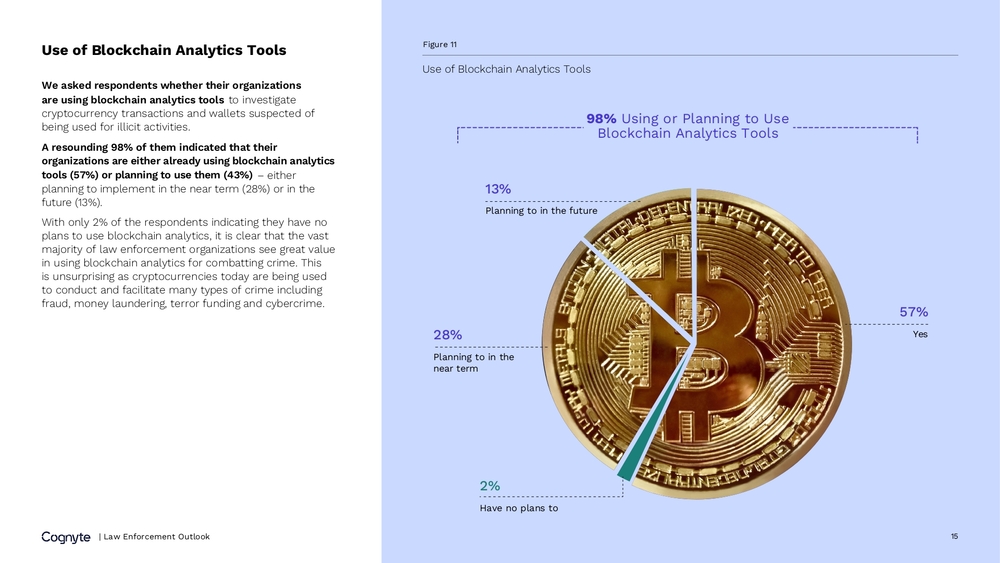
Use of Blockchain Analytics Tools We asked respondents whether their organizations are using blockchain analytics tools to investigate cryptocurrency transactions and wallets suspected of being used for illicit activities. A resounding 98% of them indicated that their organizations are either already using blockchain analytics tools (57%) or planning to use them (43%) – either planning to implement in the near term (28%) or in the future (13%). With only 2% of the respondents indicating they have no plans to use blockchain analytics, it is clear that the vast majority of law enforcement organizations see great value in using blockchain analytics for combatting crime. This is unsurprising as cryptocurrencies today are being used to conduct and facilitate many types of crime including fraud, money laundering, terror funding and cybercrime.Use of Blockchain Analytics ToolsFigure 11 Planning to in the future Planning to in the futureYes13% 28%57%98% Using or Planning to Use Blockchain Analytics Tools Have no plans to2%Planning to in the near term | Law Enforcement Outlook 15
Demographics 16 | 2025 Law Enforcement Outlook

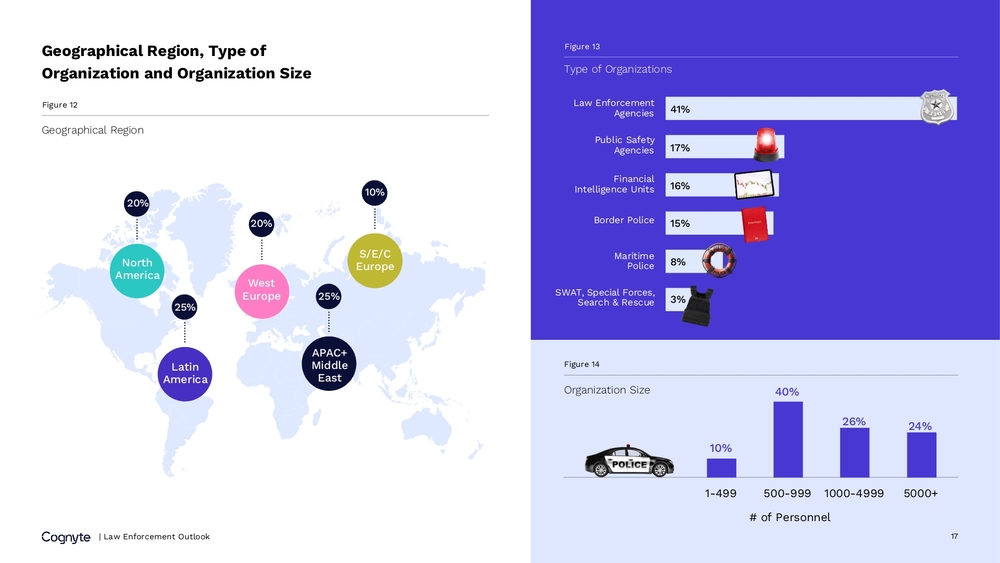
Geographical Region, Type of Organization and Organization Size 10% 25% 25%20%20% North America Latin AmericaWest EuropeS/E/C Europe APAC+ Middle EastGeographical RegionFigure 12Type of OrganizationsFigure 13 Organization SizeFigure 14 10% 1-499 500-999 1000-4999 5000+40% 26%24%Law Enforcement Agencies Public Safety Agencies Financial Intelligence Units Border Police Maritime Police SWAT, Special Forces, Search & Rescue
of Personnel
41% 17% 16% 15% 8% 3% | Law Enforcement Outlook 17
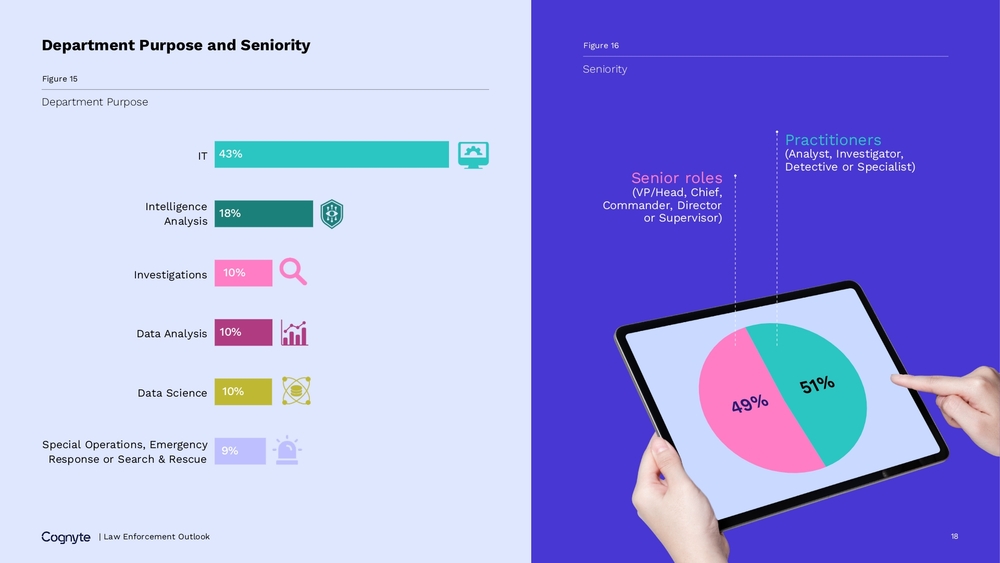
Department Purpose and Seniority SeniorityFigure 16 IT Intelligence AnalysisSenior roles (VP/Head, Chief, Commander, Director or Supervisor)Practitioners (Analyst, Investigator, Detective or Specialist) Investigations Data Analysis Data Science Special Operations, Emergency Response or Search & Rescue43% 18% 10% 10% 9%49%51%10%Department PurposeFigure 15 | Law Enforcement Outlook 18
Want to learn more? The Power of Wide OSINT Analysis: From Web-Centric to Multi-Source Intelligence Discover a practical framework that helps law enforcement and national security teams expand OSINT beyond web intelligence.Crime Goes Digital Native: The Impact of Gen Z & Alpha on Law Enforcement Learn how digital-first generations like Gen Z & Alpha are changing crime and what law enforcement needs to know to keep up. GenAI co-pilots: The New Face of Investigations Explore how GenAI co-pilots can help analysts and investigators uncover hidden connections and speed up investigations.Webinar: From Covert Ops to Crime Stoppers – Navigating Data in Law Enforcement Shane Britten, former senior official in Australia national security and law enforcement, shares insights to help law enforcement agencies take control of their data.Read Now Read Now Read Now About Cognyte Cognyte is a leading software-driven technology company, focused on solutions for data processing and investigative analytics that allow customers to generate Actionable Intelligence for a Safer World™. Cognyte’s solutions empower law enforcement, national security, national intelligence and military intelligence agencies, and other organizations to navigate an increasingly complex threat landscape. With offerings that leverage state-of-the- art technology, including Artificial Intelligence (AI), big data analytics and advanced machine learning, Cognyte helps customers make smarter, faster decisions with their data for successful outcomes. Hundreds of customers rely on Cognyte’s investigative analytics solutions to uncover critical insights from past events and anticipate emerging threats. By harnessing AI-driven intelligence, Cognyte accelerates investigations with exceptional speed and accuracy while enabling customers to better investigate, anticipate, predict and mitigate risks with greater precision Visit the Cognyte website today!Read Now 19