Crime Goes Digital Native
by Cognyte
Crime Goes Digital Native
The Impact of Gen Z & Alpha on Law Enforcement

Introduction
Welcome to the future — where your avatar gets mugged, your crypto wallet is drained in seconds and a crime scene can exist entirely in the cloud.
Crime has moved into spaces that law enforcement struggles to police: group chats, gaming platforms and your DMs. And while regulators are still figuring out how to combat crypto crime and AI-generated deepfakes, younger generations are already embracing digital ecosystems.
Say hello to Gen Z, Gen Alpha and soon, Gen Beta.
These aren't just "young people on their phones." They're digital-first, AI-fluent and deeply immersed in online worlds where identities are anonymous; new platforms are multiplying and everything, from scams to social movements, happens at warp speed.
Their digital habits are more than a lifestyle choice. It's a wakeup call for public safety. The way younger generations use technology is reshaping crime itself and forcing law enforcement to rethink how investigations and prevention are carried out.

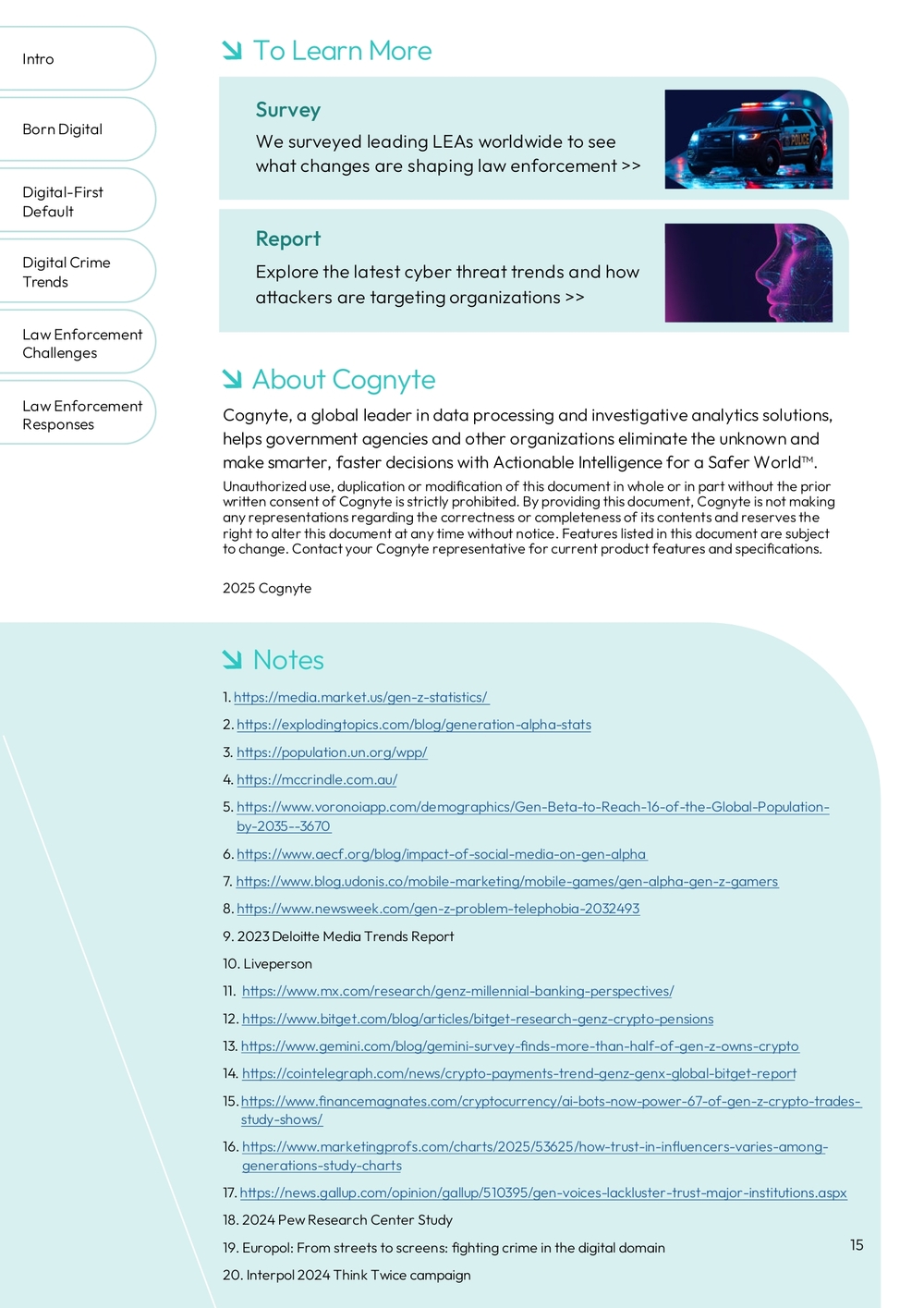
The Rise of Digital Native Generations
GEN Z
+2B people globally today 28% of global population by 2035
GEN ALPHA
+2B people globally today 23% of global population by 2035
GEN BETA
140M children worldwide today 16% of global population by 2035
Sources: Market.us, Intelpoint, McCrindle, Voronai, Exploding Topics, UN WPP (Our World in Data)
Born Digital: The First Truly Digital Native Generations
Unlike Millennials, who adapted to online platforms as they emerged, or Gen X, who witnessed the internet's rise when they were older, Gen Z, Gen Alpha and Gen Beta were born into it. For them, digital life isn't something you log into, it's the default setting.
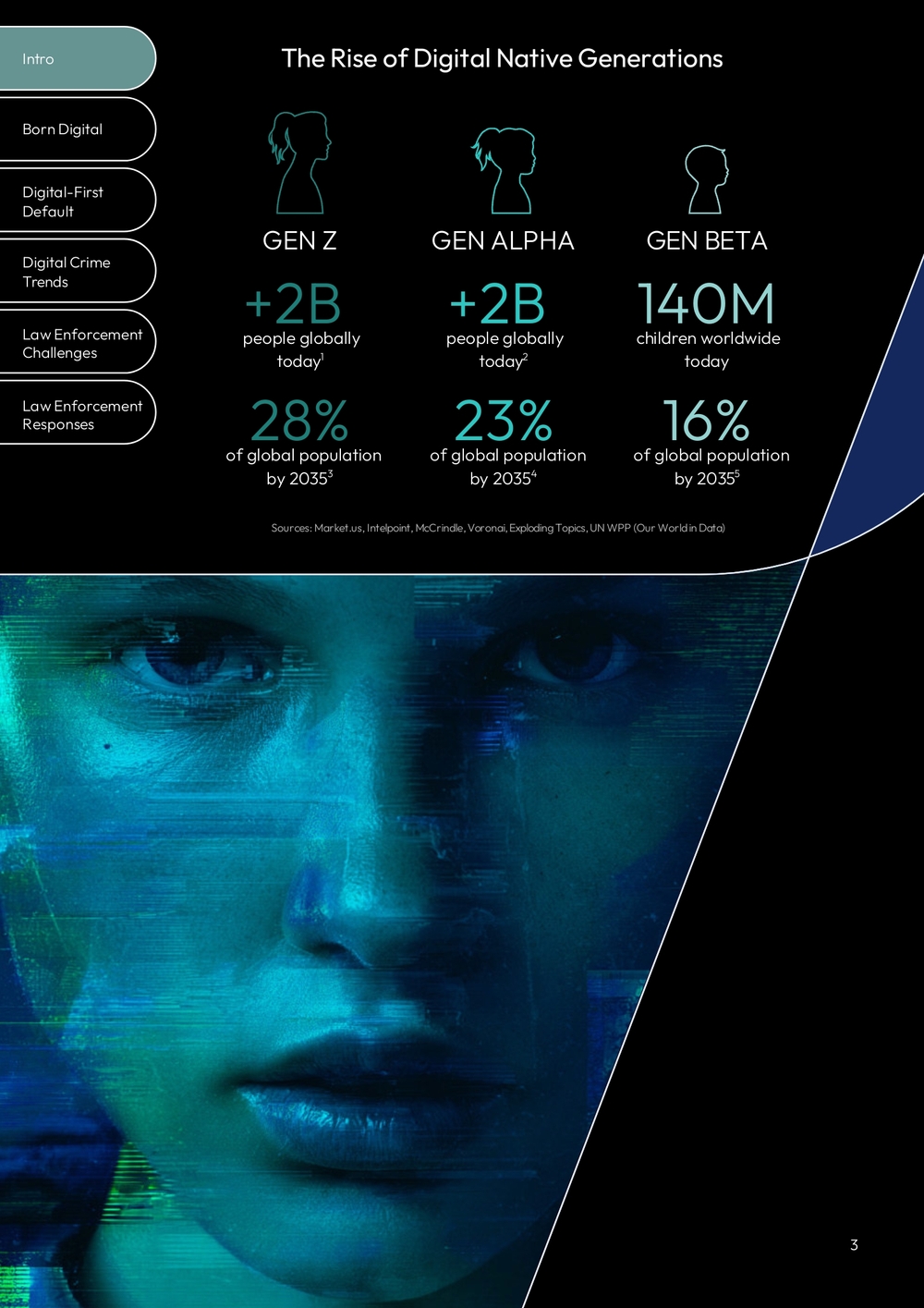
Meet the Digital Natives
Gen Z
1995-2009
Relationship with Tech: Digital native
Communication Style: Mobile-centric
Preferred Platforms: Instagram, YouTube, TikTok, Snapchat, WhatsApp, Discord, Twitch
Gen Alpha
2010-2024
Relationship with Tech: Hyper-connected, multi-device, AI-assisted
Communication Style: Video-first, interactive
Preferred Platforms: YouTube, TikTok, Roblox, WhatsApp, Minecraft, Fortnite
Gen Beta
2025-2039
Relationship with Tech: AI-integrated, fully immersive
Communication Style: Voice-activated, conversational, smart speakers
Preferred Platforms: AR/VR, AI assistants, wearables
Gen Z
Born between 1995 and 2009, Gen Z has grown up with social media apps and video streaming platforms. They're tech-savvy, visually oriented and prefer communicating by text rather than voice calls. Despite being more privacy-aware than older generations, and fluent in tools like encrypted chats and vanish modes, they may overshare in group chats and public posts, leaving themselves exposed to privacy breaches and identity theft.
Gen Alpha
Born between 2010-2024, Gen Alpha is the first generation raised in an AI-assisted world, where intelligent tools are part of daily routines from an early age. A 2024 survey reveals that nearly 49% of Gen Alpha children are already using AI tools daily. Gen Alpha are not just consumers, they're creators, making short-form videos and digital content from an early age. With 94% identifying as "game enthusiasts", they're immersed in avatar-based worlds and virtual economies. On platforms like Roblox, a virtual world with over 110 million daily active users and where over 67% of players are under 16, users build, play, socialize and transact, blurring lines between the virtual and the real world.
Gen Beta
Born in 2025 and beyond, Gen Beta will come of age in a world where AI co-pilots, augmented reality glasses and ambient intelligence are woven seamlessly into daily life. Already, smart home ecosystems like Amazon Alexa, Google Nest and Samsung SmartThings anticipate needs and respond to voice, motion and predictive patterns without prompting. As these technologies become more seamless and embedded, Gen Beta won't view AI as a tool, they'll experience it as a constant presence.

Digital-First is the Default
According to a Uswitch survey, nearly 70% of young adults in the UK said they prefer texting to calling, with a quarter admitting they never answer phone calls at all. Text, direct messages and voice notes are the new default.
A Deloitte Media Trends report revealed that half of Gen Z now see online experiences as valid substitutes for in-person ones. Nearly 40% socialize more through gaming than face-to-face and almost half now say social media is their primary way of connecting.
Additional surveys show how younger generations are reshaping what communication, connection and "real-life" interaction mean today.
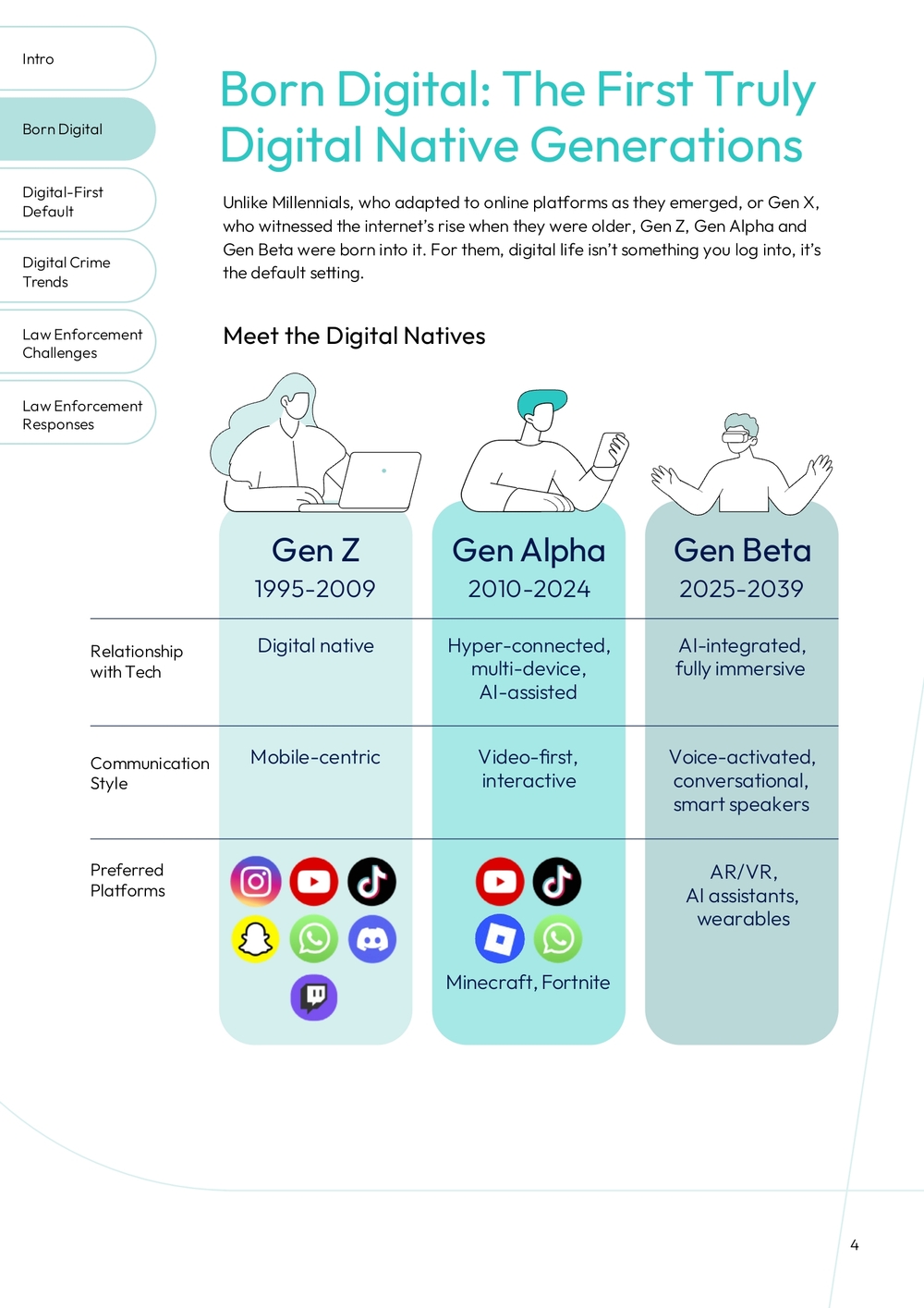
Digital Habits of Gen Z
65% communicate more online than in person
62% would rather forget their wallet than their phone
70% sleep with their phone
65% use their phone in the bathroom
69% can imagine a future of all-online shopping
Source: Liveperson
Crime Trends in a Digital Native World
Understanding generational tech habits is essential but so is recognizing how those habits translate into criminal activity. Digital native behaviors are influencing not just what types of crimes are being committed, but where, how fast and how visible they are to law enforcement.
Digital Fraud & Cybercrime
The always-on digital lifestyle of Gen Z and Alpha means financial activity increasingly happens through apps, peer-to-peer platforms and virtual marketplaces, with little regulation and fast-moving threats.
- Peer-to-peer payment fraud – scams on Cash App, Venmo and Zelle
- Social media marketplace scams – fake concert tickets, sneakers or game accounts sold to steal money from young buyers
- Crypto "pig butchering" scams – disguised as online romance or business opportunities
- AI-powered phishing and deepfakes – impersonating relatives, friends or even police to steal funds
A 2023 survey found that when it comes to personal finance Gen Z prefers digital channels, especially live chat, over phone or in-person banking, making them more vulnerable to fraudsters in low-verification environments.
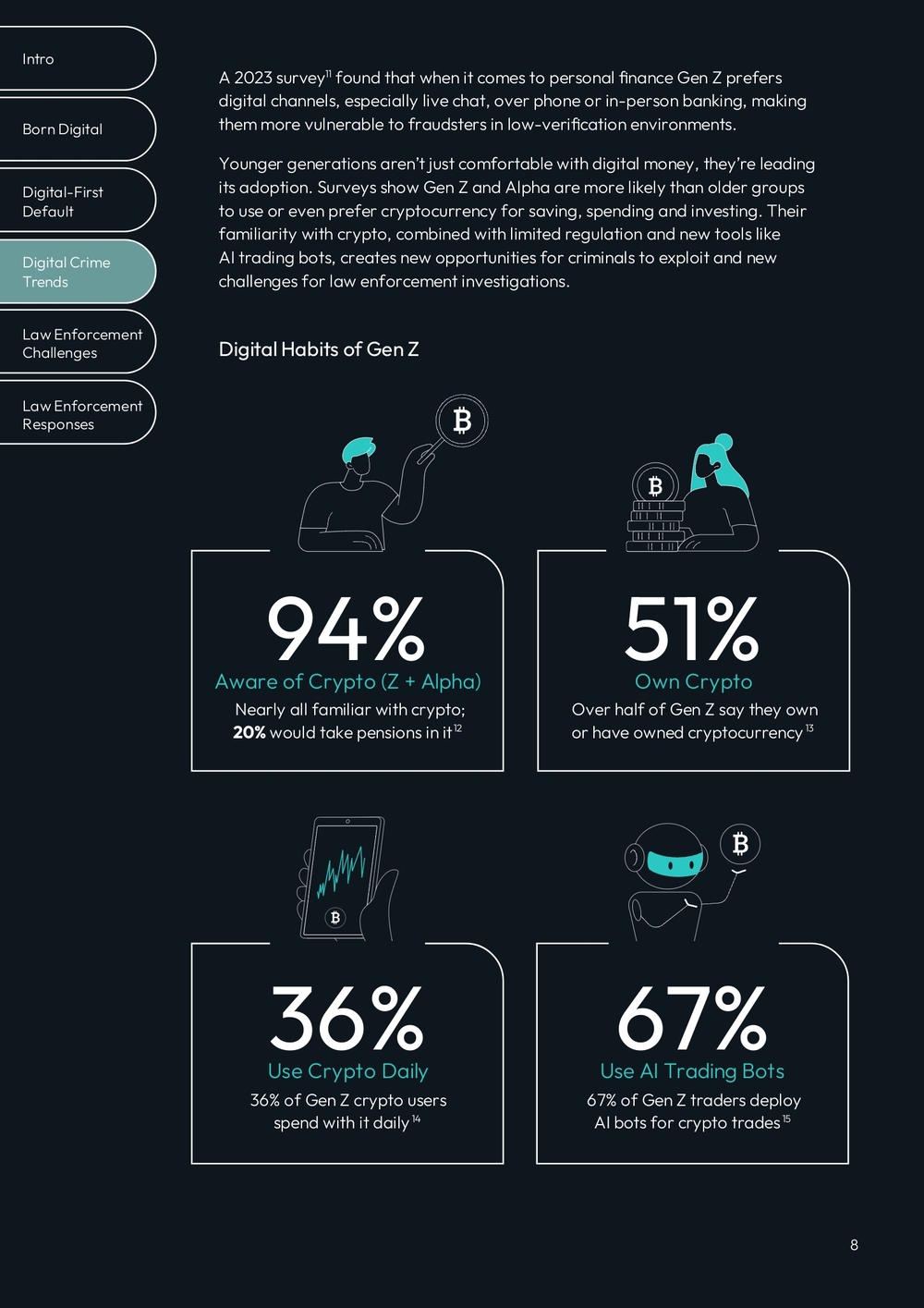
Younger generations aren't just comfortable with digital money, they're leading its adoption. Surveys show Gen Z and Alpha are more likely than older groups to use or even prefer cryptocurrency for saving, spending and investing. Their familiarity with crypto, combined with limited regulation and new tools like AI trading bots, creates new opportunities for criminals to exploit and new challenges for law enforcement investigations.
Digital Habits of Gen Z
94% Aware of Crypto (Z + Alpha) Nearly all familiar with crypto; 20% would take pensions in it
51% Own Crypto Over half of Gen Z say they own or have owned cryptocurrency
36% Use Crypto Daily 36% of Gen Z crypto users spend with it daily
67% Use AI Trading Bots 67% of Gen Z traders deploy AI bots for crypto trades
Disinformation
Social media is a catalyst for spreading disinformation. Researchers suggest that engagement-based algorithms on platforms- like TikTok and YouTube, may unintentionally limit exposure to diverse viewpoints by repeatedly promoting similar or provocative content.
While this phenomenon affects people of all ages, younger generations can be more susceptible due to certain factors.
Digital natives are often more trusting of online influencers and peers versus government and traditional institutions. Surveys show more than half of Gen Zers polled trust influencer recommendations, compared with far fewer who express trust in traditional institutions.
A Pew Research study found that roughly 1 in 5 Americans of all ages now regularly receive their news from social media influencers. For Americans under 30, 1 in 3 turn to influencers for news. This means younger users are more vulnerable to disinformation.
Disinformation can cause real-world harm. TikTok trends and viral misinformation can trigger disturbances, hoaxes and threats targeting schools or protests. Coordinated campaigns can incite violence and hate crimes against vulnerable groups. Without proactive monitoring, disinformation can escalate into public safety threats and overwhelm response systems.
Digital Harassment
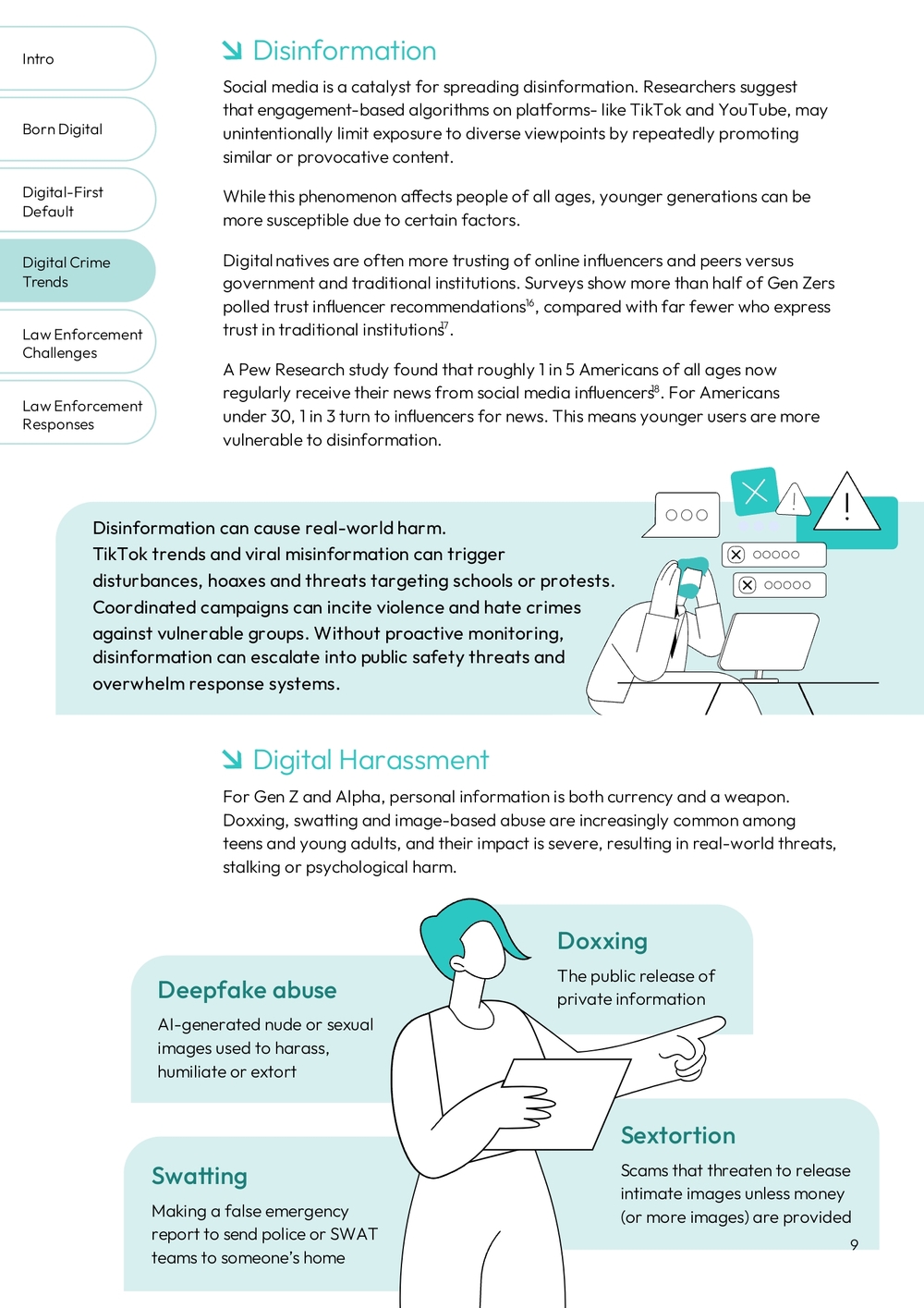
For Gen Z and Alpha, personal information is both currency and a weapon. Doxxing, swatting and image-based abuse are increasingly common among teens and young adults, and their impact is severe, resulting in real-world threats, stalking or psychological harm.
Doxxing The public release of private information
Deepfake abuse AI-generated nude or sexual images used to harass, humiliate or extort
Swatting Making a false emergency report to send police or SWAT teams to someone's home
Sextortion Scams that threaten to release intimate images unless money (or more images) are provided
New Challenges for Law Enforcement
As crime moves deeper into immersive, borderless digital ecosystems, traditional policing techniques and models are being challenged by the digital behaviors of Gen Z, Gen Alpha and soon, Gen Beta.
1. Tech-fueled crime moves faster than ever
Peer-to-peer payments, crypto wallets and mobile-first finance apps are increasingly being used by criminals for fraud, money laundering and scams. Younger users, often eager to transact quickly, may not recognize red flags, especially in decentralized platforms with little oversight.
→ Younger users prioritize speed and convenience over caution. Digital natives expect financial transactions to be instant, seamless and mobile-first, from splitting lunch via Venmo to buying Roblox currency or crypto with a few taps.
→ Gamified scams are tricking teens into becoming unwitting accomplices. In multiplayer games, teens are lured into seemingly innocent tasks, like "helping with a trade" or "testing a mod", only to find themselves handling stolen goods or laundering in-game currency. A report from Lloyds Bank found that 1 in 5 gamers have encountered such scams, yet nearly 3 in 10 couldn't recognize the tactics, and only 8% had seen any safety guidance.
2. Jurisdiction has borders, but digital crimes don't
Digital crimes committed in virtual spaces or via decentralized platforms transcend geographic boundaries. Offenses can originate from anywhere and target victims globally in real time. This creates serious challenges for law enforcement because jurisdictional authority stops at national borders, but the platforms where crimes occur (like Discord, Telegram or blockchain apps) operate globally, without a clear physical location.
Legal gray zones emerge when:
→ It's unclear which country's laws apply.
→ The platform is hosted in one jurisdiction, the perpetrator is located in another and the victim in a third.
→ Crimes like VR-based harassment or online sextortion don't involve physical contact or physical evidence.
Even when platforms cooperate with authorities, delays in international evidence requests and lack of harmonized cyber laws make it difficult to prosecute offenses that never "reach" the physical world.
3. Anonymous offenders are harder to trace
On platforms built for anonymity and speed, tracing the identity of offenders becomes a game of digital cat and mouse.
Pseudonyms, avatars and burner accounts let users hop between platforms and make it difficult for investigators to track their "digital footprints".
Decentralized apps, or tools built on blockchain or peer-to-peer protocols, remove the middleman.
Encrypted messaging and ephemeral content (like auto-deleting messages on Snapchat or WhatsApp) add another layer of obfuscation.
4. Immersive worlds, real-world threats
As more young people spend time in virtual environments, the risks they face increasingly mirror, and sometimes exceed, those of the physical world.
Digital assets such as virtual goods, NFTs and in-game currencies are prime targets for theft, fraud and money laundering.
Virtual worlds like Roblox, Minecraft and other metaverse platforms are already prone to harassment, grooming and scams.
5. IoT and connected devices are entry points for crime
The rapid spread of IoT devices, from household gadgets to connected cars and AR glasses, expands convenience but also widens the attack surface for criminals.
Smart toys, wearables and home devices can be hacked or misused to track, manipulate or surveil children and teens.
Connected cars and AR glasses open new avenues for digital stalking, unauthorized data collection and real-time tracking of users' movements.
3 Ways Law Enforcement Can Respond
The criminal landscape is changing fast. Traditional policing models focused on physical locations, tangible property assets and face-to-face interactions no longer match today's criminal landscape.
As Gen Z and Gen Alpha grow up, the gap between how they experience the world and how authorities try to police it will only widen. To keep pace, agencies need advanced tools and new approaches.
Equip teams with advanced investigative solutions
Agencies need advanced capabilities including open-source intelligence, blockchain intelligence, threat intelligence, decision intelligence and digital forensics to track illicit activity across fragmented and fast-moving online platforms.
Open-source intelligence (OSINT)
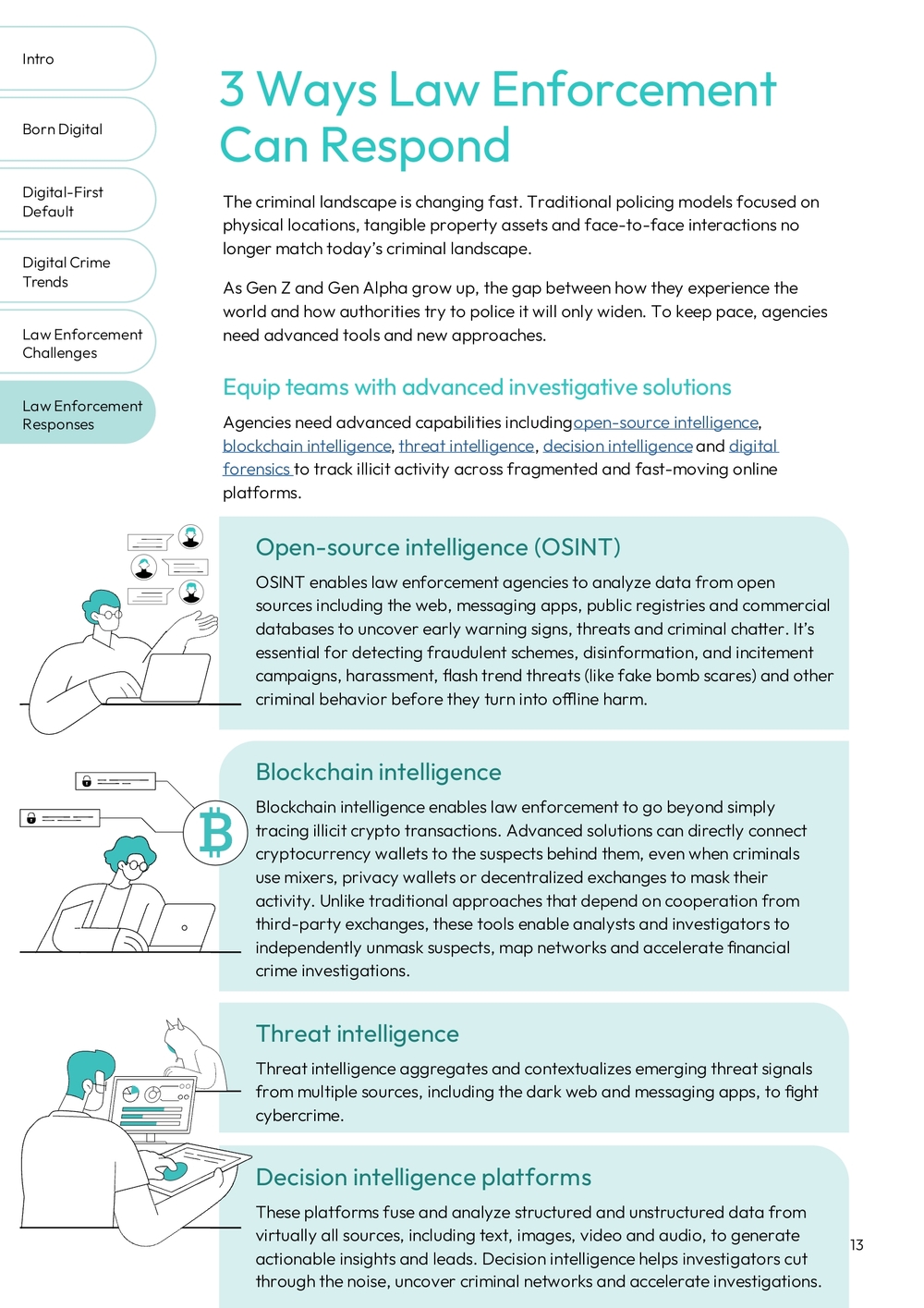
OSINT enables law enforcement agencies to analyze data from open sources including the web, messaging apps, public registries and commercial databases to uncover early warning signs, threats and criminal chatter. It's essential for detecting fraudulent schemes, disinformation, and incitement campaigns, harassment, flash trend threats (like fake bomb scares) and other criminal behavior before they turn into offline harm.
Threat intelligence
Threat intelligence aggregates and contextualizes emerging threat signals from multiple sources, including the dark web and messaging apps, to fight cybercrime.
Blockchain intelligence
Blockchain intelligence enables law enforcement to go beyond simply tracing illicit crypto transactions. Advanced solutions can directly connect cryptocurrency wallets to the suspects behind them, even when criminals use mixers, privacy wallets or decentralized exchanges to mask their activity. Unlike traditional approaches that depend on cooperation from third-party exchanges, these tools enable analysts and investigators to independently unmask suspects, map networks and accelerate financial crime investigations.
Decision intelligence platforms
These platforms fuse and analyze structured and unstructured data from virtually all sources, including text, images, video and audio, to generate actionable insights and leads. Decision intelligence helps investigators cut through the noise, uncover criminal networks and accelerate investigations.
Build digital fluency
Law enforcement agencies must promote and develop digital fluency at all levels of their organization. Recruiting tech-savvy personnel and providing training on cybercrime, digital evidence management and cryptocurrencies throughout investigative units is critical.
Modernize public safety communications
Modern public safety communication is about having a trusted presence in the online spaces where digital natives spend their time.
Europol has defined a strategy for law enforcement to combat the growing threat of cybercrime by establishing a visible and trustworthy online presence to safeguard citizens and counter lawless online spaces.
Digital-first awareness campaigns can shape behavior of younger people more effectively than relying on traditional media or outdated messaging formats. INTERPOL's Think Twice, Don't Get Scammed campaign demonstrates this in action. Deployed across social platforms, it helped younger users recognize fraud tactics by promoting pause-and-verify behaviors before clicking or sharing.
Conclusion
Gen Z is already in the workforce. Gen Alpha is reaching their early teens with AI in their hands. Gen Beta will grow up never knowing a world without AR, AI co-pilots and fully immersive digital environments.
The next generation of crime isn't coming — it's already here. Law enforcement must evolve just as fast, or risk irrelevance.
To Learn More
Survey
We surveyed leading LEAs worldwide to see what changes are shaping law enforcement
Report
Explore the latest cyber threat trends and how attackers are targeting organizations
About Cognyte
Cognyte, a global leader in data processing and investigative analytics solutions, helps government agencies and other organizations eliminate the unknown and make smarter, faster decisions with Actionable Intelligence for a Safer World™.
Notes
- https://media.market.us/gen-z-statistics/
- https://explodingtopics.com/blog/generation-alpha-stats
- https://population.un.org/wpp/
- https://mccrindle.com.au/
- https://www.voronoiapp.com/demographics/Gen-Beta-to-Reach-16-of-the-Global-Population-by-2035--3670
- https://www.aecf.org/blog/impact-of-social-media-on-gen-alpha
- https://www.blog.udonis.co/mobile-marketing/mobile-games/gen-alpha-gen-z-gamers
- https://www.newsweek.com/gen-z-problem-telephobia-2032493
- 2023 Deloitte Media Trends Report
- Liveperson
- https://www.mx.com/research/genz-millennial-banking-perspectives/
- https://www.bitget.com/blog/articles/bitget-research-genz-crypto-pensions
- https://www.gemini.com/blog/gemini-survey-finds-more-than-half-of-gen-z-owns-crypto
- https://cointelegraph.com/news/crypto-payments-trend-genz-genx-global-bitget-report
- https://www.financemagnates.com/cryptocurrency/ai-bots-now-power-67-of-gen-z-crypto-trades-study-shows/
- https://www.marketingprofs.com/charts/2025/53625/how-trust-in-influencers-varies-among-generations-study-charts
- https://news.gallup.com/opinion/gallup/510395/gen-voices-lackluster-trust-major-institutions.aspx
- 2024 Pew Research Center Study
- Europol: From streets to screens: fighting crime in the digital domain
- Interpol 2024 Think Twice campaign