NEXYTE: Maritime Intelligence Case Study | Cognyte
by Cognyte
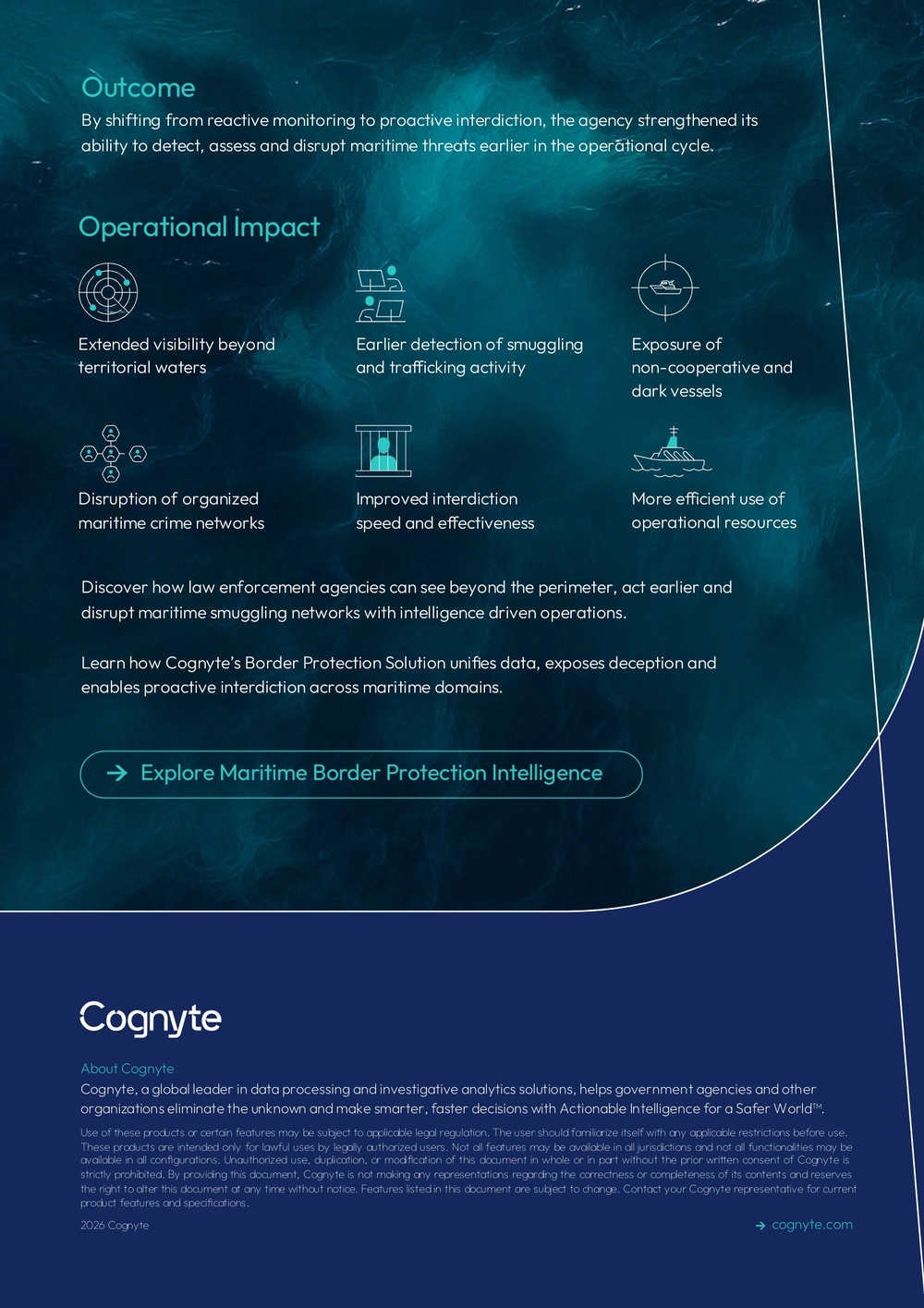
How an APAC Law Enforcement Agency Disrupted Maritime Smuggling Networks
Case Study
Key Takeaways
- A large law enforcement agency in Asia Pacific needed to improve its ability to detect suspicious maritime activity from smugglers and bad actors.
- Smugglers and bad actors are exploiting blind spots from AIS spoofing, identity masking and signal silence to carry out trafficking, illegal fishing, sanctions evasion and other illicit activities.
- The core challenge was intelligence fragmentation, not lack of data.
- The agency deployed Cognyte's maritime intelligence solution, leveraging multi-source data fusion, network analysis, behavioral analytics and anomaly detection capabilities.
As a result, the agency achieved:
- Earlier threat detection beyond territorial waters
- Detection of deceptive routing and covert rendezvous activity
- Improved detection of non-cooperative and dark vessels
- Accelerated interdiction speed and resource efficiency
- Increased success rates of uncovering illicit behavior and disrupting maritime smuggling operations.
Challenges
Operating in complex maritime environments, a large law enforcement agency in Asia Pacific faced adversaries that deliberately manipulated signals and identities to evade detection by authorities.
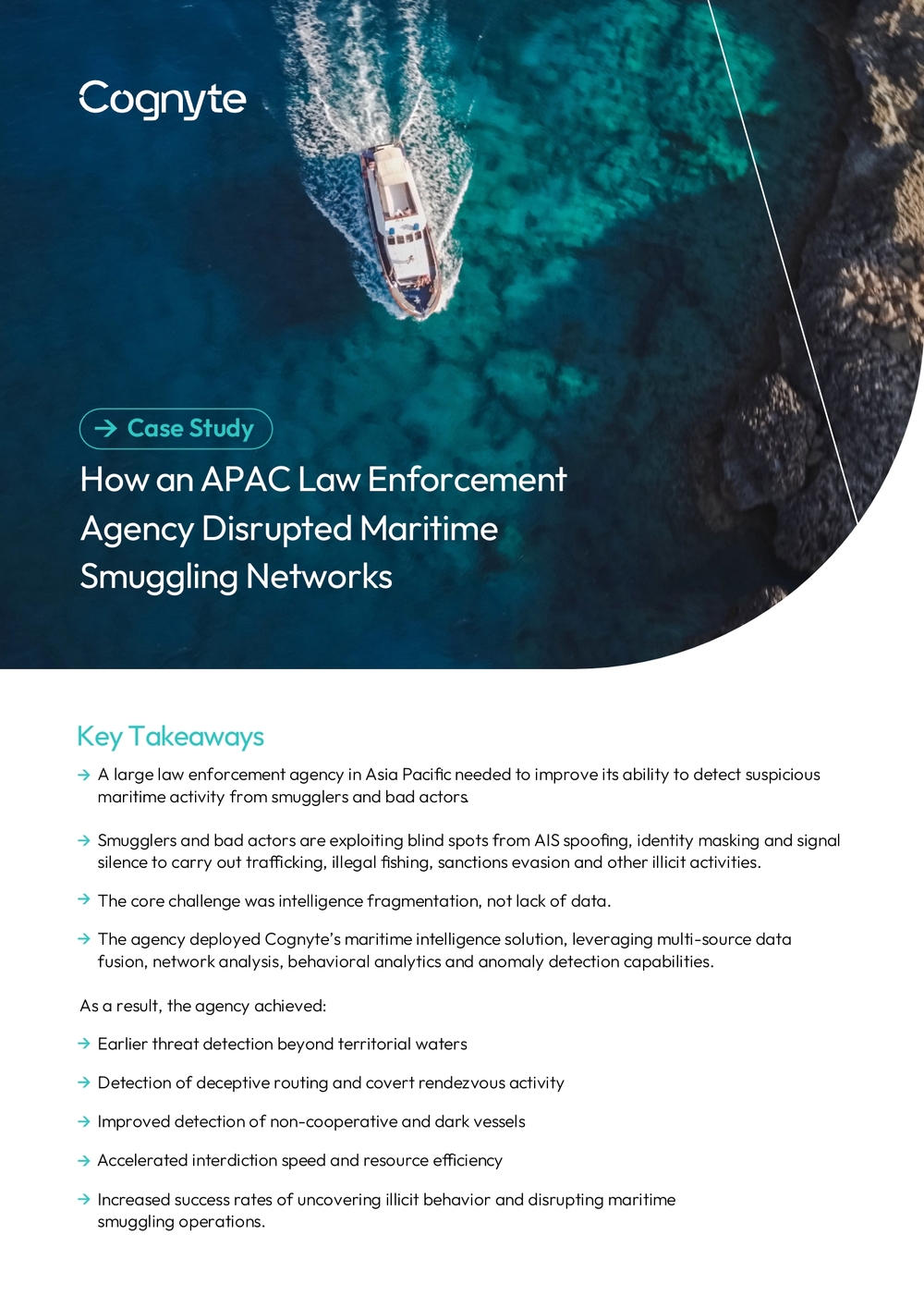
Undetected vessels were engaging in illicit activities including: narcotics trafficking, illegal fishing and resource exploitation, crew transfer for criminal networks, sanctioned goods transport and dark port-to-port shipments.
The overall challenge was not data availability, rather the ability to rapidly identify deceptive behavior across fragmented intelligence sources. To enable effective maritime domain awareness and proactive interdiction, the agency needed to address three core challenges:
1. Lack of unified maritime domain awareness
Fragmented maritime, communications and intelligence data acquired from:
- SATCOM metadata
- AIS vessel identifiers and movement logs
- Maritime watchlists and previous arrest records
- Open-source vessel tracking platforms
- Geospatial and port-of-call logs
- Intelligence reports from allied forces
2. Difficulty detecting non-cooperative or dark vessels due to data deception and deliberate concealment
- AIS spoofing, identity masking and false vessel identifiers
- Intentional transponder silencing and communications blackouts
- Temporary identity changes during port approaches
- Deceptive routing and vessel-to-vessel rendezvous activity
3. Operational blind spots
- Limited visibility beyond AIS monitoring
- Missed indicators of coordinated smuggling routes
Solution
To address these challenges, the agency deployed Cognyte's Border Protection Solution to unify its existing border, communications and investigative data into a single intelligence environment. The solution correlates AIS signals, maritime tracking data, SATCOM, radar sensors, communications metadata, open-source intelligence (OSINT) and historical case data to expose suspicious behavior and enable faster intelligence driven intervention.
Multi-source data fusion
Correlation of maritime, communications, sensor and wide OSINT data into a single intelligence picture
Detection of deceptive behavior and anomalies
Identification of AIS spoofing, transponder silencing, irregular routes, dark-zone activity and suspicious rendezvous behavior
Vessel identity resolution and confidence scoring
Validation of vessel identities by correlating movement patterns, signals and historical behavior
Acceleration and automation of manual work
Analysts leveraged Cognyte's automated models for risk scoring, entity resolution, route anomaly detection and link analysis, significantly accelerating their work
Network and link analysis
Mapping relationships between vessels, crews, ports, financiers and shore-based criminal networks
Operational visualization and alerting
Delivery of prioritized, risk-based insights to support real-time decision making and interdiction planning
Outcome
By shifting from reactive monitoring to proactive interdiction, the agency strengthened its ability to detect, assess and disrupt maritime threats earlier in the operational cycle.
Operational Impact
- Extended visibility beyond territorial waters
- Earlier detection of smuggling and trafficking activity
- Exposure of non-cooperative and dark vessels
- Disruption of organized maritime crime networks
- Improved interdiction speed and effectiveness
- More efficient use of operational resources
Discover how law enforcement agencies can see beyond the perimeter, act earlier and disrupt maritime smuggling networks with intelligence driven operations.
Learn how Cognyte's Border Protection Solution unifies data, exposes deception and enables proactive interdiction across maritime domains.
Explore Maritime Border Protection Intelligence