Police Data Challenge: Staff skillsets
by Cognyte
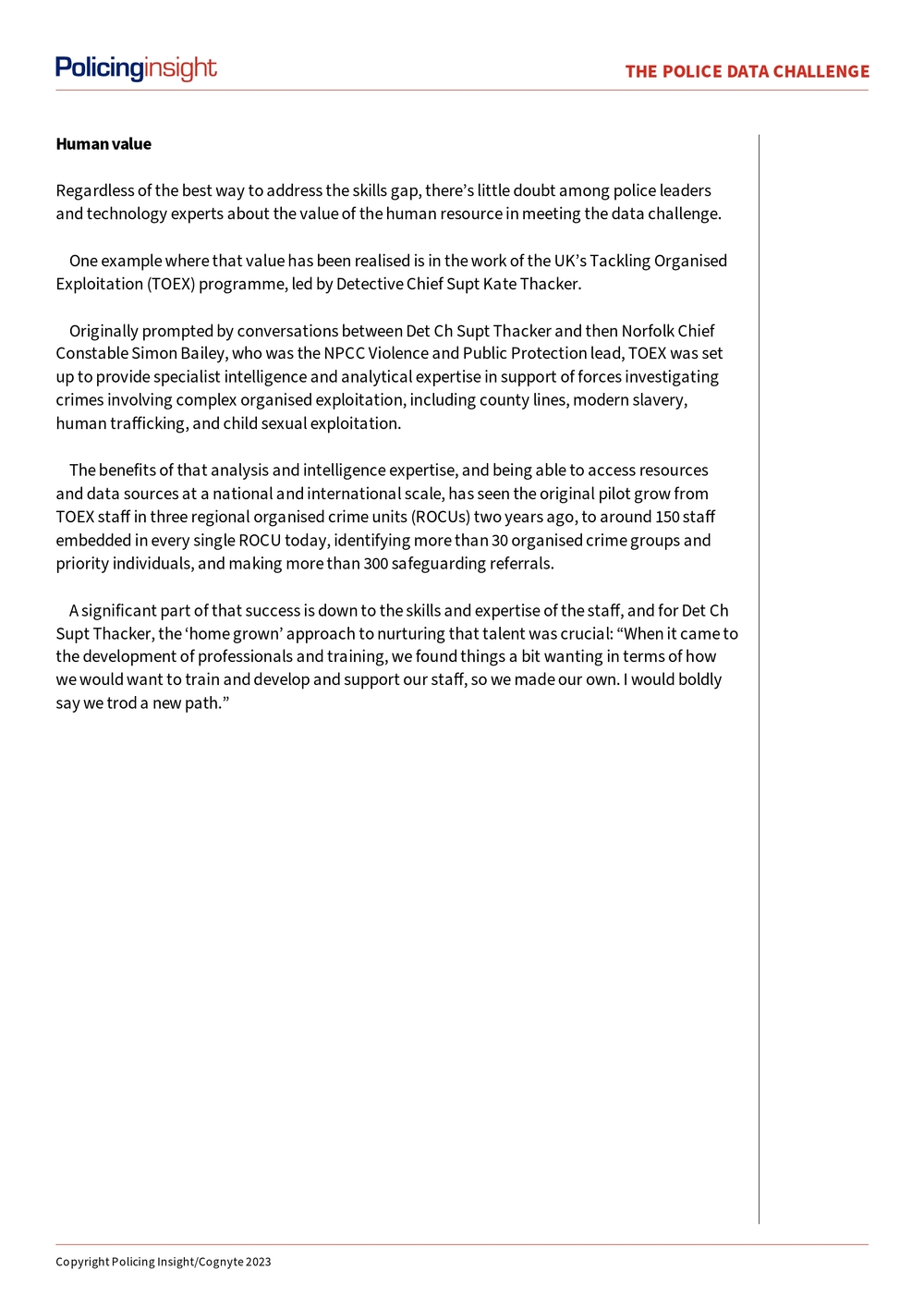
THE POLICE DATA CHALLENGE Copyright Policing Insight/Cognyte 2023 Rapid advances in technology and the exponential growth of data – both in volume and complexity – are creating major challenges and opportunities for policing around the ability to gather intelligence and successfully undertake investigations. But those challenges and opportunities aren’t limited to hardware, software and digital transformation. The ever- changing skillset required of officers and staff involved in those policing processes, together with the technology understanding of law enforcement leaders and decision makers, mean that human resources present an equally complex conundrum for law enforcement. It’s an issue well understood by Chief Constable Lisa Winward, National Police Chiefs’ Council (NPCC) Intelligence Portfolio Lead, who told Policing Insight: “Having grappled with the size of the data, the challenge is the skills to analyse that data in a way that is meaningful, whether to prevent or detect crime, safeguard a vulnerable person, or assist in tackling serious and organised crime or tackling organised exploitation. Describing analysts as “rare as hen’s teeth” , CC Winward acknowledged that the changing employment landscape has The police data challenge: Staff skillsets and leadership literacy Having previously considered some of the wider issues around policing’s approach to the exponential growth in volume and complexity of data sources for investigations and intelligence gathering, in this latest in a series of features on the police data challenge, Policing Insight’s Keith Potter looks at the concerns around staffing – from skills gaps and accreditation to leadership literacy and implementation The ‘Police Data Challenge’ is an independent series researched and written by Policing Insight and commissioned by Cognyte. Policing Insight is the leading platform to keep up with the latest in progressive policing. It is where the global police and criminal justice community both consume and share knowledge, opinion and analysis. Cognyte is a market leader in investigative analytics software that empowers a variety of government and other organizations with Actionable Intelligence for a Safer World™. Find out more at www.cognyte.com/nexyte. Keith Potter is the editor of Policing Insight
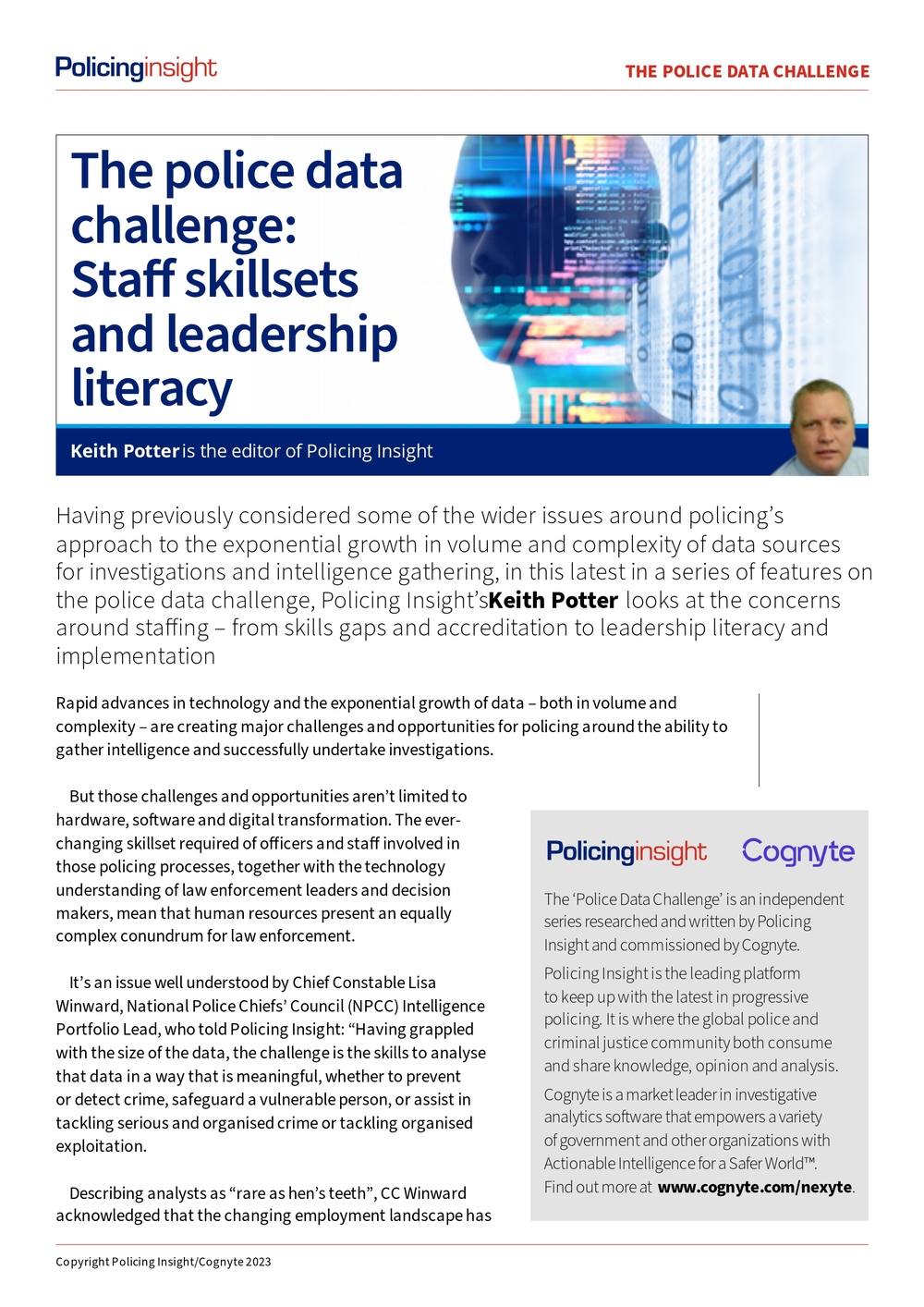
THE POLICE DATA CHALLENGE Copyright Policing Insight/Cognyte 2023created significant demand for a prized skillset: “Years ago, it was great – we wanted police analysts and nobody else was really interested in stealing them. “But the labour market has changed; those analysts are skilled individuals who are now more and more valuable across other sectors, public and private. Analytics are now such a fundamental part of a lot of people’s business that we struggle to retain them within the law enforcement environment. “Public service pay and conditions are not as favourable as some private sector companies, so providing those skills, professionalising that skill as an analytical capability, and then retaining those skills is a real challenge. ” New skills It’s a particular challenge that has been recognised across policing for some time, including in a number of reviews and reports. The Getting a Grip report published in July by HM Inspectorate of Constabulary and Fire & Rescue Services identified investment in analytical capability as a “national priority” , but inspections had revealed “limited investment in IT systems and analysts” . The report states: “We found many forces needed to invest in both the number and the skills of their data analysts. The State of Policing 2022 report highlighted the issue of police pay in recruiting and retaining officers, and we recognise the effect of the pay gap between the public and the private sector for analysts. ” Similarly, in her review of the Metropolitan Police Baroness Casey highlighted that “local policing has been fractured by the loss of skilled civilian staff, especially crime analysts and support staff” , and that “analysts have been subject to drastic efficiency cuts as a result of austerity, ” adding: “Now, analysts can only achieve a fraction of what they used to. ” But it’s not only analysts and their skills that are in short supply. “To be able to do everything that is possible, and understand how to get there, we need skills in our organisation to deliver that, ” explained Thames Valley Supt Lewis Prescott- Mayling, “and that needs data science skills, it needs data engineering skills, it needs coding skills, it needs statistical skills, all of which we do lack. “We just think we need a lot more analysts; we do, but we need more of these other skills that aren’t old school analysts – these are new skills. ” However, Supt Lewis Prescott-Mayling, who played a key role in establishing the Thames Valley Together platform, said that while those new skills were necessary, the traditional “Having grappled with the size of the data, the challenge is the skills to analyse that data in a way that is meaningful, whether to prevent or detect crime, safeguard a vulnerable person, or assist in tackling serious and organised crime or tackling organised exploitation. ” CC Lisa Winward NPCC National Intelligence LeadNorth Yorkshire Chief Constable Lisa Winward, the National Police Chiefs’ Council (NPCC) Intelligence Portfolio Lead
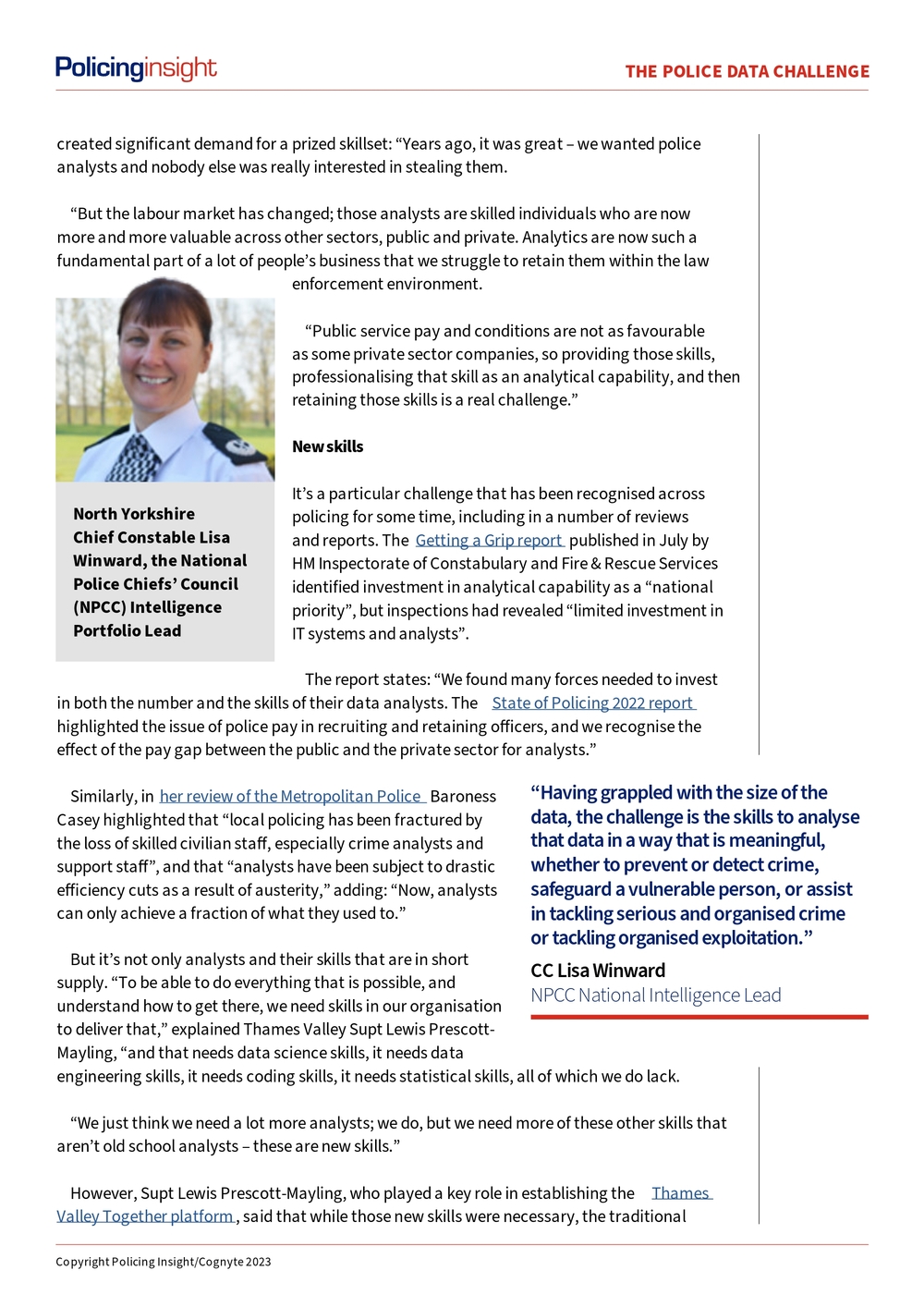
THE POLICE DATA CHALLENGE Copyright Policing Insight/Cognyte 2023analyst skills were still essential to understand the “nuances of police data” . That skills shortage appears to be a challenge for law enforcement agencies globally, not just in the UK, and has an operational impact, as Inspector Carla Gilmore, Manager of Emergent Technologies for New Zealand Police, explained. “This is one of the issues that we’re finding within the police; we have a set number of resources, and the public want to see our people, our staff, out on the street – they want visibility. But there’s so much in the back end of the organisation that needs [to be done] to support that work. ” One of the struggles around new technology, said Insp Gilmore, is equipping the staff with the knowledge and training to get the greatest benefits from that technology – something which can present its own challenges. “We want to be innovative, and we want to get ahead of the game… but what comes with that is knowledge that we don’t necessarily have in the policing organisation; trying to find where that knowledge is, who can inform us, and then using these tools comes with training requirements. ” Insp Gilmore added that while NZ Police was able to train people up, those tools would also “keep evolving” with the force needing to keep across the “new iterations” , which added to the “whole push and pull of where we place our resources” . Growing our own So how does policing address that skills shortage at an operational level? For CC Winward, one answer is that, through much closer connections with universities, policing can work with institutions to create degree courses and study opportunities that enable forces to “grow their own” , rather than relying on recruiting analysts and other data specialists direct from the turbulent labour market. “It means that we gain all of that immediate, fresh knowledge from a university course that is absolutely up to date, and where people have got the latest knowledge. The benefit of them coming to us is that we help them to gain qualifications, and the return on that investment is that they stay with us for four or five years while they gain that experience and those qualifications. “As long as you understand that the churn will come at that point; you then take the freshly qualified people, again, from university who have got the latest up-to-date knowledge into the organisation. ”Inspector Carla Gilmore New Zealand Police “We want to be innovative, we want to get ahead of the game… but what comes with that is knowledge that we don’t necessarily have in the policing organisation; trying to find where that knowledge is, who can inform us, and then using these tools comes with training requirements. ” Inspector Carla Gilmore New Zealand Police
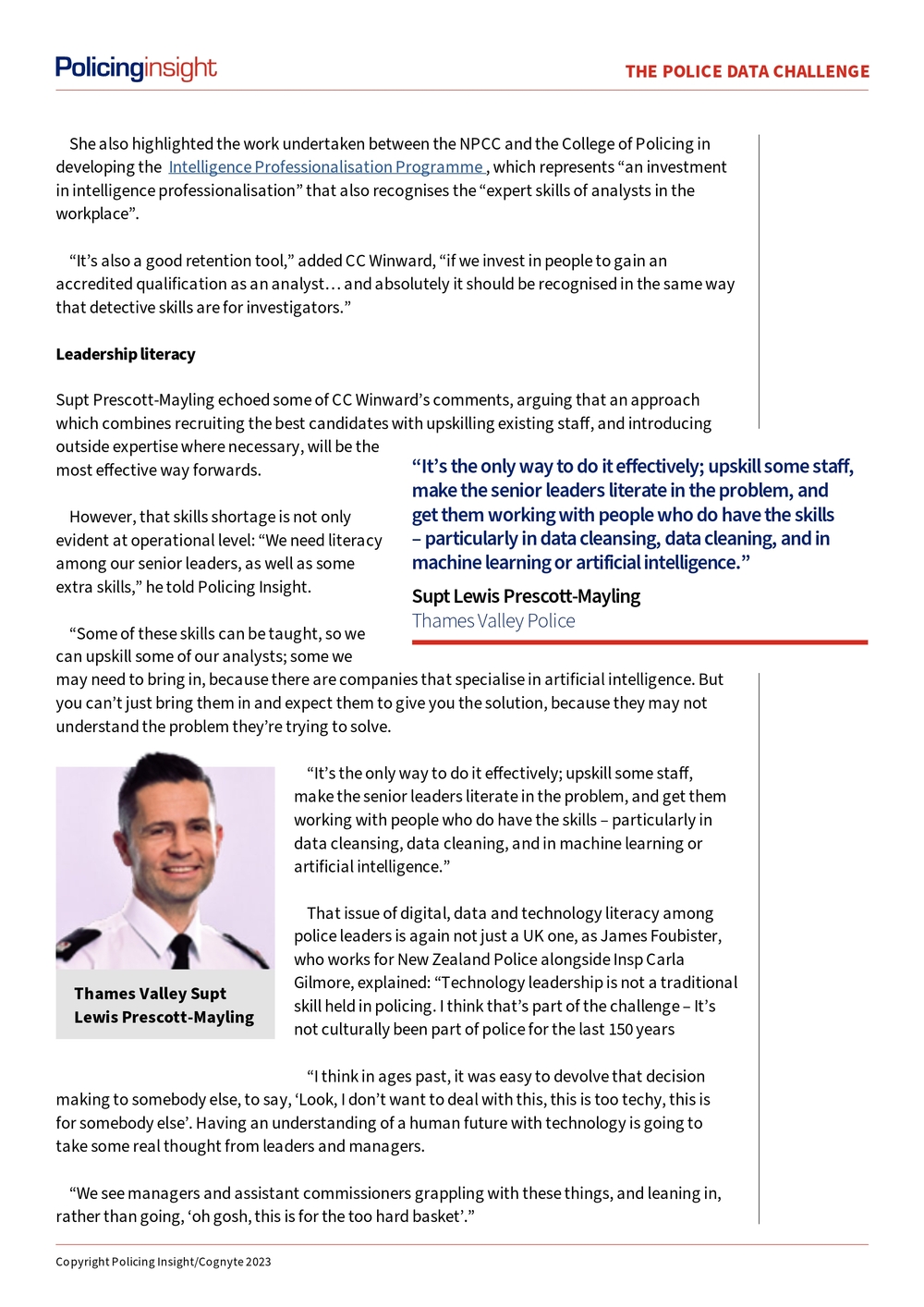
THE POLICE DATA CHALLENGE Copyright Policing Insight/Cognyte 2023She also highlighted the work undertaken between the NPCC and the College of Policing in developing the Intelligence Professionalisation Programme, which represents “an investment in intelligence professionalisation” that also recognises the “expert skills of analysts in the workplace” . “It’s also a good retention tool, ” added CC Winward, “if we invest in people to gain an accredited qualification as an analyst… and absolutely it should be recognised in the same way that detective skills are for investigators. ” Leadership literacy Supt Prescott-Mayling echoed some of CC Winward’s comments, arguing that an approach which combines recruiting the best candidates with upskilling existing staff, and introducing outside expertise where necessary, will be the most effective way forwards. However, that skills shortage is not only evident at operational level: “We need literacy among our senior leaders, as well as some extra skills, ” he told Policing Insight. “Some of these skills can be taught, so we can upskill some of our analysts; some we may need to bring in, because there are companies that specialise in artificial intelligence. But you can’t just bring them in and expect them to give you the solution, because they may not understand the problem they’re trying to solve. “It’s the only way to do it effectively; upskill some staff, make the senior leaders literate in the problem, and get them working with people who do have the skills – particularly in data cleansing, data cleaning, and in machine learning or artificial intelligence. ” That issue of digital, data and technology literacy among police leaders is again not just a UK one, as James Foubister, who works for New Zealand Police alongside Insp Carla Gilmore, explained: “Technology leadership is not a traditional skill held in policing. I think that’s part of the challenge – It’s not culturally been part of police for the last 150 years “I think in ages past, it was easy to devolve that decision making to somebody else, to say, ‘Look, I don’t want to deal with this, this is too techy, this is for somebody else’ . Having an understanding of a human future with technology is going to take some real thought from leaders and managers. “We see managers and assistant commissioners grappling with these things, and leaning in, rather than going, ‘oh gosh, this is for the too hard basket’ . ”“It’s the only way to do it effectively; upskill some staff, make the senior leaders literate in the problem, and get them working with people who do have the skills – particularly in data cleansing, data cleaning, and in machine learning or artificial intelligence. ” Supt Lewis Prescott-Mayling Thames Valley Police Thames Valley Supt Lewis Prescott-Mayling
THE POLICE DATA CHALLENGE Copyright Policing Insight/Cognyte 2023Human value Regardless of the best way to address the skills gap, there’s little doubt among police leaders and technology experts about the value of the human resource in meeting the data challenge. One example where that value has been realised is in the work of the UK’s Tackling Organised Exploitation (TOEX) programme, led by Detective Chief Supt Kate Thacker. Originally prompted by conversations between Det Ch Supt Thacker and then Norfolk Chief Constable Simon Bailey, who was the NPCC Violence and Public Protection lead, TOEX was set up to provide specialist intelligence and analytical expertise in support of forces investigating crimes involving complex organised exploitation, including county lines, modern slavery, human trafficking, and child sexual exploitation. The benefits of that analysis and intelligence expertise, and being able to access resources and data sources at a national and international scale, has seen the original pilot grow from TOEX staff in three regional organised crime units (ROCUs) two years ago, to around 150 staff embedded in every single ROCU today, identifying more than 30 organised crime groups and priority individuals, and making more than 300 safeguarding referrals. A significant part of that success is down to the skills and expertise of the staff, and for Det Ch Supt Thacker, the ‘home grown’ approach to nurturing that talent was crucial: “When it came to the development of professionals and training, we found things a bit wanting in terms of how we would want to train and develop and support our staff, so we made our own. I would boldly say we trod a new path. ”