Agentic Decision Flows
by Cognyte
Agentic Workflows Scaling Investigations & Intelligence Analysis with AI That Understands the Mission NEXYTEDecision FlowsFrom Workflows to Agentic AI Operationalizing Decision FlowsDomain-Specific Examples The Challenge
w w
Agentic Workflows NEXYTE Decision Flows The Challenge From Workflows to Agentic AI Domain-Specific Examples Operationalizing Decision Flows The ChallengeExecutive Summary Law enforcement, national security and intelligence agencies today are rarely constrained by a lack of data. They are increasingly constrained, not by access to tools, but by the ability to orchestrate them effectively and turn overwhelming volumes of information into trusted operational decisions. A single case may simultaneously draw on SIGINT, license plate records, financial transactions, OSINT, CCTV footage, digital forensics, reports and countless other sources, all spread across dozens of siloed, disconnected systems. In high-stakes investigative and intelligence environments, AI alone is not enough. AI solutions may process data faster, but speed only gets you so far. Without domain-specific investigative methods, the right tools orchestrated around those methods and proper governance controls, they fall short of the reliability, explainability and accountability required in government and public safety environments. NEXYTE Decision Flows are designed to address this challenge. Built on Cognyte's decision intelligence platform, they combine proven investigative and intelligence methodologies with agentic AI execution frameworks. NEXYTE Decision Flows automate repetitive investigative and intelligence work, adapt continuously to changes and maintain human oversight at critical decision points, accelerating intelligence and operational workflows while delivering results that are explainable, contextual, auditable and operationally actionable. The Challenge: Analysis at the Limits of Human Capacity Modern intelligence and investigation work is often hindered not by lack of data, but for the inability to fuse and analyze the data that already exists. Consider the work of analysts and investigators today. A financial crime case may involve thousands of transactions across multiple jurisdictions, nested corporate structures and dozens of associated entities. A counter-terror case may require correlating communication patterns across thousands of devices, identifying behavioral anomalies and linking multiple digital identities. At the same time, higher case volumes and lengthy investigations are creating backlogs, while the number of experienced analysts and investigators remains limited. Every step must be documented, explainable and legally defensible. Traditional analytics platforms improve data access but do not solve the core problem: turning fragmented information into trusted operational decisions at the pace modern threats demand. 2
NEXYTE Decision Flows Agentic Workflows The Challenge Domain-Specific Examples Operationalizing Decision Flows From Workflows to Agentic AI Static Workflows Strengths → Automate predefined steps → Standardize repetitive processes → Improve consistency in known scenarios Limitations → Rigid execution path → Limited adaptation to new findings → High maintenance when processes change → Human judgment sits outside the flow Generic AI Agents Strengths → Understand natural language and structured data → Support reasoning and recommendations → Enable flexible exploratory analysis Limitations → Harder to govern and validate → Can be unpredictable without boundaries → Methodology is not inherently preserved → Often optimizes tasks, not mission outcomes Moving from Workflows to Agentic AI Technology solutions have advanced investigations and intelligence analysis along multiple tracks, including expansion of access to data, which has strengthened analytics and improved how information is connected and understood. Workflow automation offered a natural next step in theory, but in practice it has seen limited adoption in intelligence and law enforcement settings. Real investigations are too dynamic, too unstructured and too domain- specific to fit predefined execution paths. When evidence evolves or a case takes an unexpected turn, rigid workflows require manual redesign or simply break down. With the advent of agentic AI, a more dynamic model is now possible. Agentic AI enables AI systems that can reason across multiple data sources, understand intent, execute multi-step tasks autonomously and adapt as conditions evolve. This is a genuine advance, but using generic agentic AI in mission-critical environments still has critical limitations including: → Lack of domain expertise - Investigations and intelligence analysis require specialized knowledge, such as how to map beneficial ownership structures, identify behavioral anomalies in communications or prioritize intelligence leads. This cannot be improvised by a generic model. → Limited governance framework - In government and public safety contexts, AI-generated findings must be explainable, auditable and legally defensible. Generic agents do not come with built-in accountability structures. → Inability to integrate with secure environments - General-purpose agents are not inherently designed to operate within classified, sovereign, or controlled environments. Static workflows present a different limitation. Their human-in-the-loop mechanism is generally restricted to go/no-go approvals, with little opportunity for analysts to add context, adjust the next steps or adapt the flow as an investigation changes. 3
w w
Agentic Workflows NEXYTE The Challenge From Workflows to Agentic AI Domain-Specific Examples Operationalizing Decision Flows Decision Flows Decision Flows: Methodology Meets Agentic AI Agencies need AI that understands their specific missions, operates within their established processes, adapts to changing circumstances and keeps analysts actively involved, while providing accountability at every step. Decision flows solve this challenge by combining investigative and intelligence methodologies with agentic AI execution. They automate repetitive tasks, reason across data as evidence evolves and surface recommendations, while preserving analyst oversight at critical decision points. This makes them fundamentally different from both static workflows and generic AI agents. What is a decision flow? A decision flow is a structured execution framework powered by agentic AI. Each one encodes the analytical steps, data sources, decision logic, governance checkpoints and human-in-the-loop review points that define how a particular type of task or investigation should be conducted. Unlike static workflows, decision flows adapt dynamically as new data emerges or investigative paths shift. Unlike generic AI agents, they are guided by domain-specific methodologies designed for specific missions. Automation Repetitive investigative tasks are automated, significantly reducing execution time.Domain-Specific Intelligence Advanced agents trained specifically for intelligence and security domains.T ransparency and Explainability Human-in-the-loop oversight with traceable reasoning at every step.The Benefits of Decision Flows 4
w w
Agentic Workflows Decision Flows The Challenge From Workflows to Agentic AI Domain-Specific Examples Operationalizing Decision Flows NEXYTE NEXYTE Decision Flows reason against a live and holistic intelligence view generated by NEXYTE. This provides a structured environment where entities, relationships, events and patterns are already resolved and connected. The result? Faster, more accurate and more explainable outputs grounded in full operational context. Within NEXYTE, AI engines perform enrichment across every data type, including text, audio, images and video, with capabilities such as translation, speech-to-text transcription, OCR, pattern recognition and anomaly detection. ML models analyze the fused data to detect suspicious indicators, surface similarities and identify behavioral clusters. NEXYTE also includes a GenAI co-pilot: an on-premises natural language interface trained on intelligence data and operational best practices. Analysts can query the platform in natural language and receive structured outputs, including reasoning steps, results and derived insights. NEXYTE Decision Flows NEXYTE Decision Flows provide unique benefits by operating on top of a full decision intelligence platform. NEXYTE fuses structured and unstructured data from internal and external sources into a unified data model. It then resolves entities and maps relationships across the data. Unlike traditional workflows that require users to select and initiate a predefined process, NEXYTE can understand the analyst's mission intent and investigation context and recommend the best-fit Decision Flow. The recommendation takes into account the investigation objective, available context and identified intelligence gaps, helping analysts apply the right methodology from the outset. Each Decision Flow can draw on NEXYTE's full capabilities depending on what the mission requires: data fusion, entity resolution, graph analytics, pattern recognition, anomaly detection, OSINT enrichment, risk scoring and more. 5
w w
Agentic Workflows Decision Flows The Challenge From Workflows to Agentic AI Domain-Specific Examples Operationalizing Decision Flows NEXYTE From data to action: turning information into mission-ready outcomesData Processing Gather data from multiple sources in structured and unstructured formatsData Fusion Fuse data, enrich context and reveal relationships to understand the full pictureAnalytics Organize, search and analyze data to uncover patterns and insightsDecision Flows Apply proven methodologies with agentic AI to automate steps, adapt to new data and recommend the next best actionOperational Decisions Deliver trusted, explainable and actionable decisions that drive real-world outcomes01 02 03 04 05NEXYTE’s Decision Intelligence Framework transforms raw data into trusted operational decisions through five connected stages. Agentic decision flows sit at the center of this process, applying proven investigative methodologies and orchestrating AI models and agents to accelerate analysis. NEXYTE Decision Intelligence Framework 6
w w
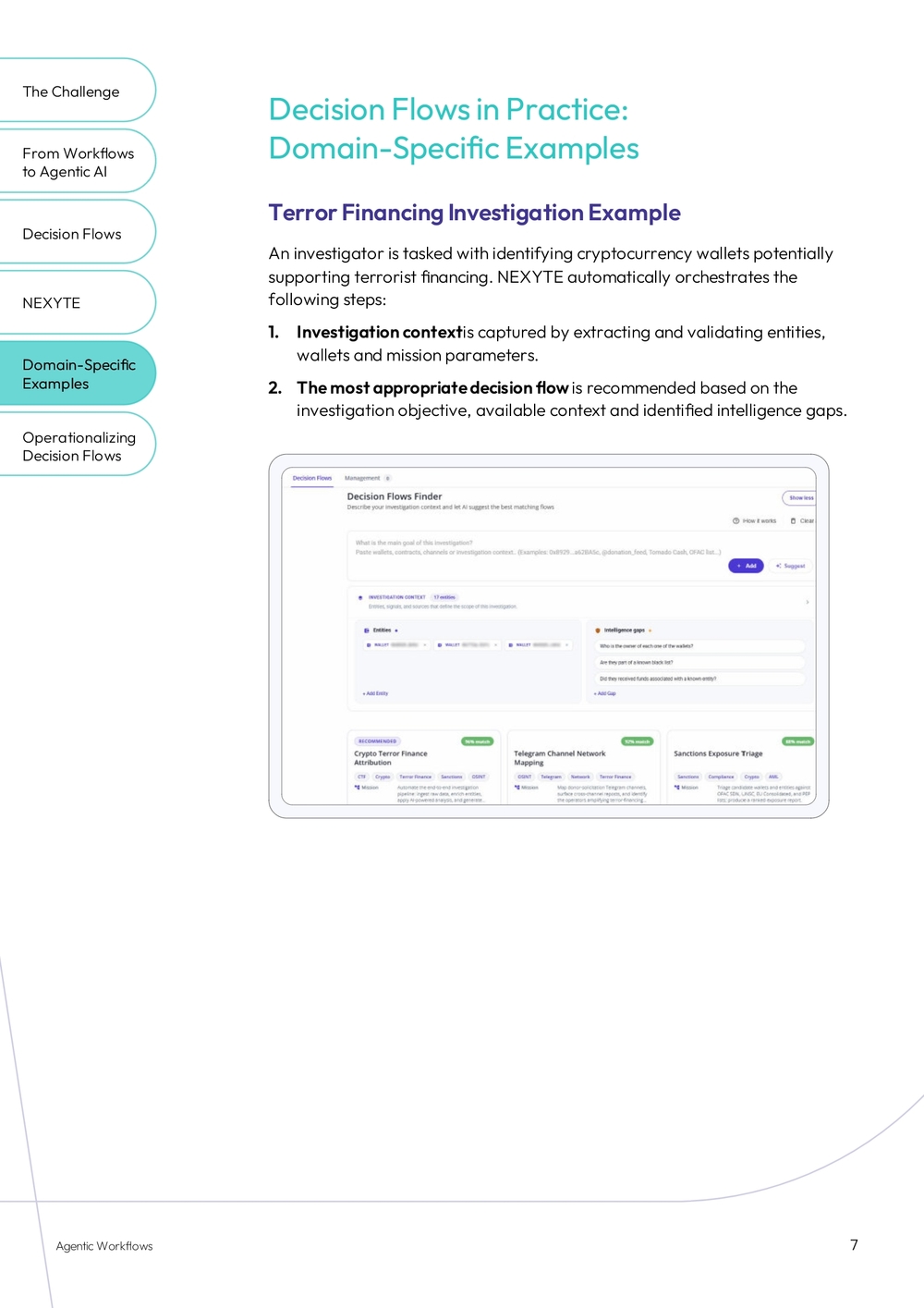
Agentic Workflows NEXYTE Decision Flows The Challenge From Workflows to Agentic AI Domain-Specific Examples Operationalizing Decision Flows Domain-Specific Examples Decision Flows in Practice: Domain-Specific Examples T error Financing Investigation Example An investigator is tasked with identifying cryptocurrency wallets potentially supporting terrorist financing. NEXYTE automatically orchestrates the following steps:
- Investigation context is captured by extracting and validating entities, wallets and mission parameters.
- The most appropriate decision flow is recommended based on the investigation objective, available context and identified intelligence gaps. 7
w w
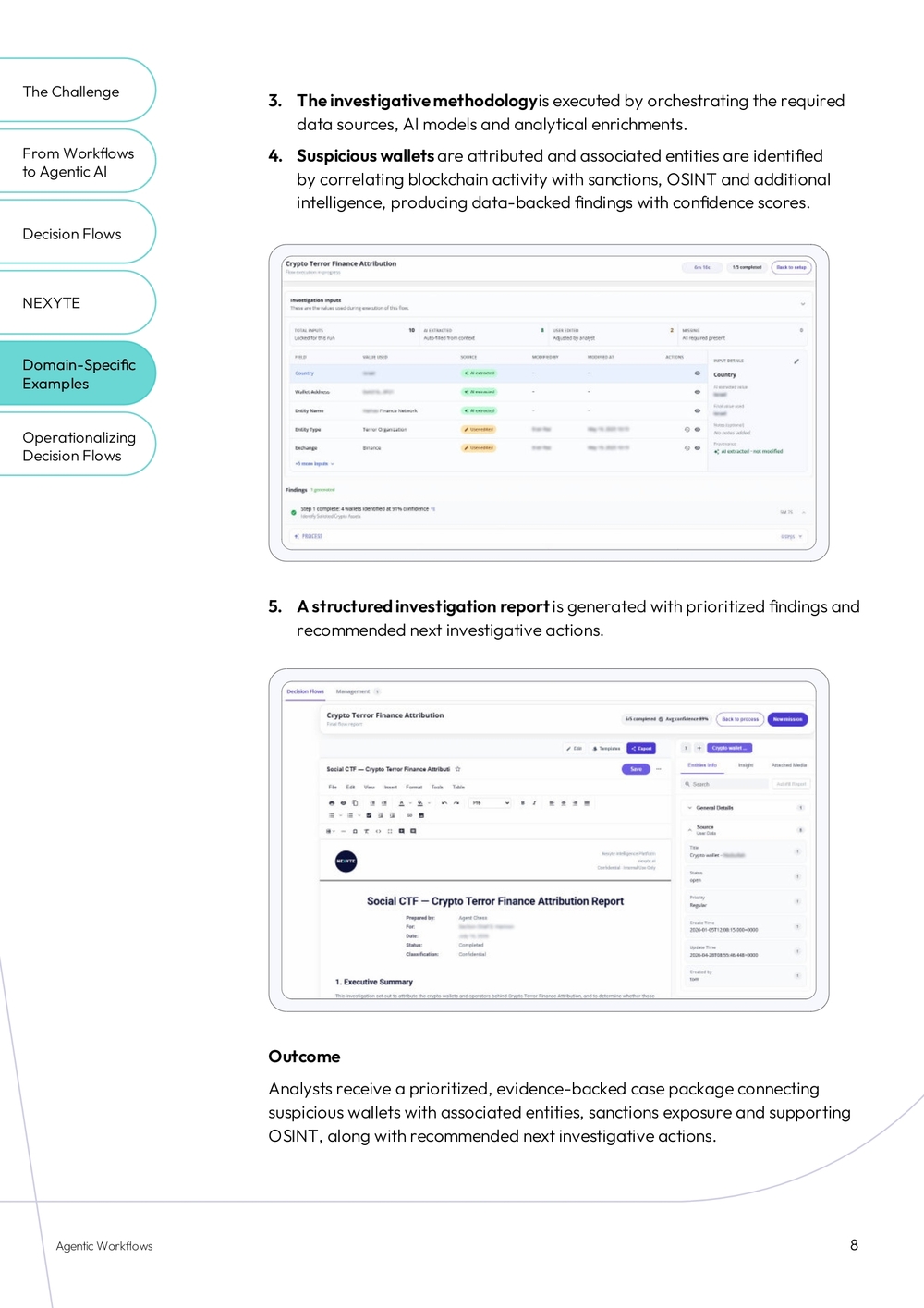
Agentic Workflows NEXYTE Decision Flows The Challenge From Workflows to Agentic AI Domain-Specific Examples Operationalizing Decision Flows Domain-Specific Examples 3. The investigative methodology is executed by orchestrating the required data sources, AI models and analytical enrichments. 4. Suspicious wallets are attributed and associated entities are identified by correlating blockchain activity with sanctions, OSINT and additional intelligence, producing data-backed findings with confidence scores. 5. A structured investigation report is generated with prioritized findings and recommended next investigative actions. Outcome Analysts receive a prioritized, evidence-backed case package connecting suspicious wallets with associated entities, sanctions exposure and supporting OSINT, along with recommended next investigative actions. 8
w w
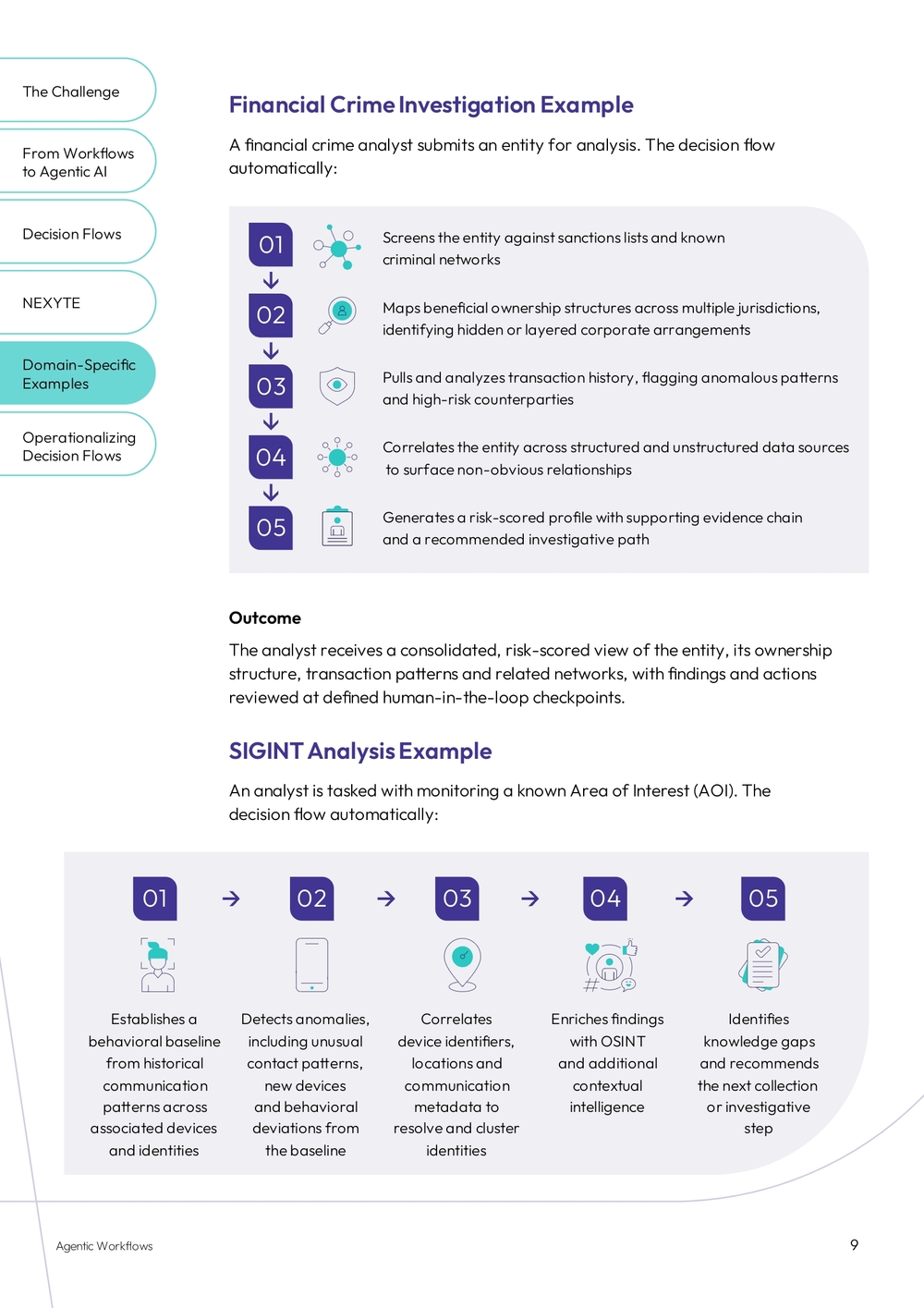
Agentic Workflows NEXYTE Decision Flows The Challenge From Workflows to Agentic AI Operationalizing Decision Flows Domain-Specific Examples Financial Crime Investigation Example A financial crime analyst submits an entity for analysis. The decision flow automatically: SIGINT Analysis Example An analyst is tasked with monitoring a known Area of Interest (AOI). The decision flow automatically:Outcome The analyst receives a consolidated, risk-scored view of the entity, its ownership structure, transaction patterns and related networks, with findings and actions reviewed at defined human-in-the-loop checkpoints.Screens the entity against sanctions lists and known criminal networks Maps beneficial ownership structures across multiple jurisdictions, identifying hidden or layered corporate arrangements Pulls and analyzes transaction history, flagging anomalous patterns and high-risk counterparties Correlates the entity across structured and unstructured data sources to surface non-obvious relationships Generates a risk-scored profile with supporting evidence chain and a recommended investigative path01 0102 0203 0304 0405 05 Establishes a behavioral baseline from historical communication patterns across associated devices and identitiesDetects anomalies, including unusual contact patterns, new devices and behavioral deviations from the baselineCorrelates device identifiers, locations and communication metadata to resolve and cluster identitiesEnriches findings with OSINT and additional contextual intelligenceIdentifies knowledge gaps and recommends the next collection or investigative step 9
w w
Agentic Workflows NEXYTE Decision Flows The Challenge From Workflows to Agentic AI Domain-Specific Examples Operationalizing Decision Flows Operationalizing Decision FlowsOutcome The analyst receives an updated view of anomalous communication activity, resolved device identities and remaining intelligence gaps, helping determine the next collection or investigative step. Putting Decision Flows into Operation The Decision Flow Center is NEXYTE's centralized library of ready-to-deploy decision flows, each designed for a specific mission objective. When an investigator defines an objective, NEXYTE recommends relevant decision flows based on the mission type, available data and desired outcome. Selecting a flow initiates full orchestration: the platform queries relevant data sources, runs required enrichments, applies analytical models, surfaces supporting evidence and automatically flags points requiring human review. The operating framework remains consistent - the selected methodology and execution path adapt to the mission and environment. NEXYTE Decision Flows are available across multiple domains and investigation types, including: → Financial crime investigations → Law enforcement → Border and maritime security → Organized crime and fraud → National security and counter-terror Scaling Institutional Expertise Every agency faces a version of the same problem: expertise does not scale. It resides in experienced personnel, is difficult to transfer across teams and is lost to attrition and organizational change. The most effective investigators and analysts carry years of accumulated expertise: how to approach a specific investigation type, which leads to prioritize and what strategies are most effective. This knowledge is rarely documented. Decision flows change this dynamic. By encoding expert investigative methodologies into structured flows, agencies transform individual expertise into organizational infrastructure. A junior analyst executing a decision flow built on expert tradecraft performs consistently with established methodology from day one. 10
w w
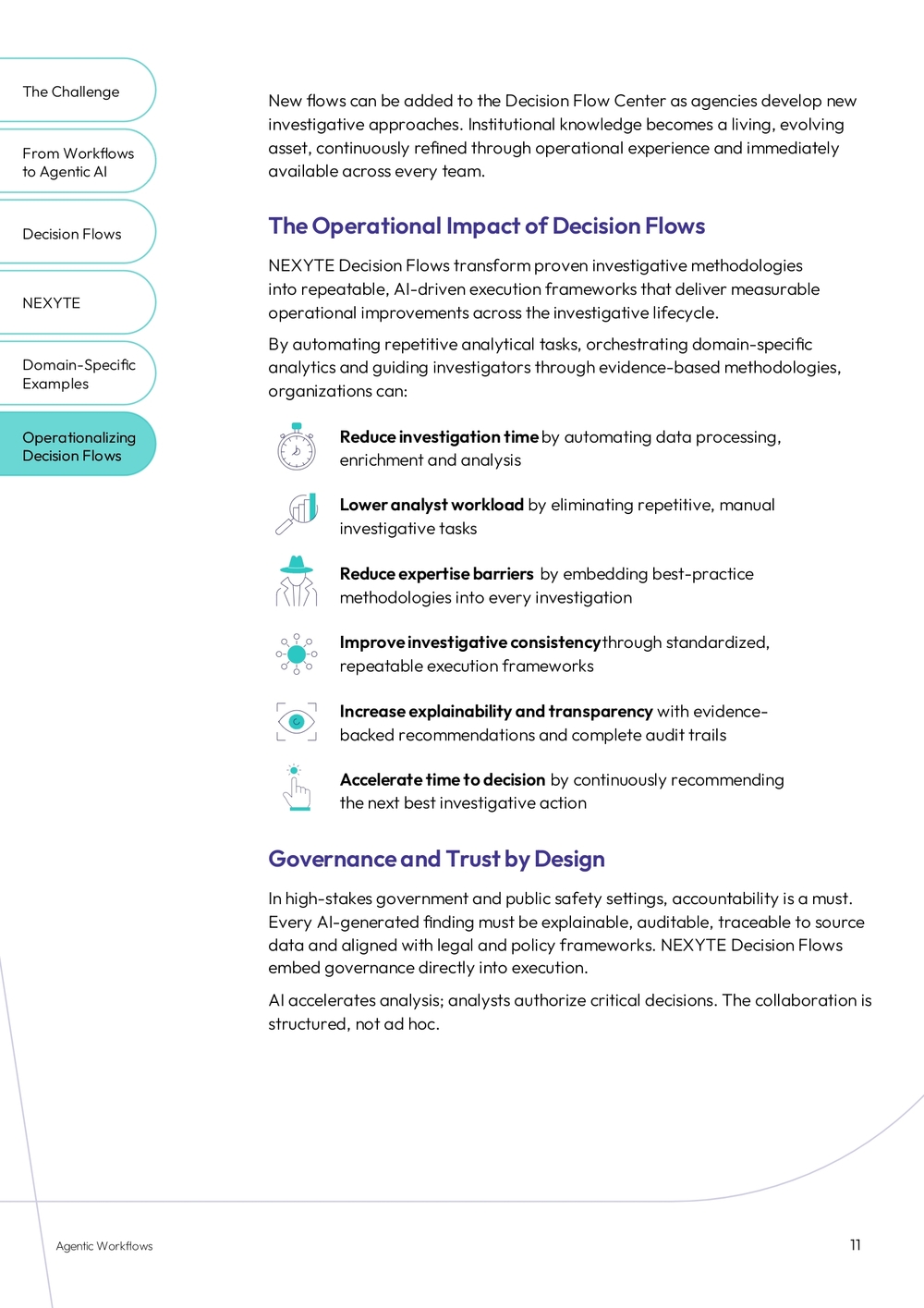
Agentic Workflows NEXYTE Decision Flows The Challenge From Workflows to Agentic AI Domain-Specific Examples Operationalizing Decision Flows Operationalizing Decision FlowsNew flows can be added to the Decision Flow Center as agencies develop new investigative approaches. Institutional knowledge becomes a living, evolving asset, continuously refined through operational experience and immediately available across every team. The Operational Impact of Decision Flows NEXYTE Decision Flows transform proven investigative methodologies into repeatable, AI-driven execution frameworks that deliver measurable operational improvements across the investigative lifecycle. By automating repetitive analytical tasks, orchestrating domain-specific analytics and guiding investigators through evidence-based methodologies, organizations can: Reduce investigation time by automating data processing, enrichment and analysis Lower analyst workload by eliminating repetitive, manual investigative tasks Reduce expertise barriers by embedding best-practice methodologies into every investigation Improve investigative consistency through standardized, repeatable execution frameworks Increase explainability and transparency with evidence- backed recommendations and complete audit trails Accelerate time to decision by continuously recommending the next best investigative action Governance and T rust by Design In high-stakes government and public safety settings, accountability is a must. Every AI-generated finding must be explainable, auditable, traceable to source data and aligned with legal and policy frameworks. NEXYTE Decision Flows embed governance directly into execution. AI accelerates analysis; analysts authorize critical decisions. The collaboration is structured, not ad hoc. 11
NEXYTE Decision Flows The Challenge From Workflows to Agentic AI Domain-Specific Examples Operationalizing Decision Flows About Cognyte Cognyte, a global leader in investigative analytics solutions, helps government agencies and other organizations uncover mission- critical insights and make smarter, faster decisions with Actionable Intelligence for a Safer World®. Use of these products or certain features may be subject to applicable legal regulation. The user should familiarize itself with any applicable restrictions before use. These products are intended only for lawful users. Not all features may be available in all jurisdictions and not all functionalities may be available in all configurations. Unauthorized use, duplication, or modification of this document in whole or in part without the prior written consent of Cognyte is strictly prohibited. By providing this document, Cognyte is not making any representations regarding the correctness or completeness of its contents and reserves the right to alter this document at any time without notice. Features listed in this document are subject to change. Contact your Cognyte representative for current product features and specifications. 2026 Cognyte cognyte.comExplainability Human-in-the- Loop OversightAuditability Every recommendation includes the full audit trail behind it. Analysts can trace any finding back to the specific data that supports it.Decision flows define explicit checkpoints where human review is required before proceeding.Every action orchestrated by a decision flow is logged, creating a complete accountability chain. Conclusion The future of investigations and intelligence analysis will not be shaped solely by the volume agencies process or the sophistication of the AI models they use. It will depend on how effectively organizations can apply expert methodology, govern AI responsibly and turn complex data into trusted, actionable outcomes. NEXYTE Decision Flows bring these capabilities together by combining agentic AI, proven investigative methodologies and the foundation of a decision intelligence platform into a repeatable execution framework that helps organizations investigate faster and act with greater precision. Learn More See how Cognyte helps tackle financial crimeSee how Cognyte's financial investigation solution helps agencies uncover hidden financial networksDiscover a practical framework to expand OSINT beyond web intelligenceBrochure Demo Report