The Police Data Challenge
by Cognyte
THE POLICE DATA CHALLENGE Copyright Policing Insight/Cognyte 2023 There’s little doubt that the swift and significant advances in technology over recent years have led to huge increases in the volume and range of data that is potentially available to police to develop intelligence and aid investigations. But with those advances come new challenges. The sheer scale of the data that can be gathered is almost unimaginable, so extracting relevant information is akin to looking for the proverbial needle in a haystack. The equally vast range of data sources – particularly from unstructured formats such as text documents, audio files, images and video – means that not only can extraction be a much more complex process, but collating and cleaning consistent data that can be analysed and shared across police forces and agencies presents whole new areas of difficulty. And while law enforcement can use those technological advances to help meet some of those challenges, the current speed of change means that new technology can soon become out of date, as can the skillsets required to leverage the maximum benefits from the software and hardware. That pace of evolution has also prompted concerns from The police data challenge: Complexity, scale, and the search for the ‘single source of truth’ The exponential growth in data sources offers policing significant opportunities for investigating and intelligence gathering, but brings with it new obstacles around the scale, complexity and consistency of data; in the first in a series of five features looking at the police use of data, Policing Insight’s Keith Potter looks at some of those key challenges at a force and national level. The ‘Police Data Challenge’ is an independent series researched and written by Policing Insight and commissioned by Cognyte. Policing Insight is the leading platform to keep up with the latest in progressive policing. It is where the global police and criminal justice community both consume and share knowledge, opinion and analysis. Cognyte is a market leader in investigative analytics software that empowers a variety of government and other organizations with Actionable Intelligence for a Safer World™. Find out more at www.cognyte.com/nexyte. Keith Potter is the editor of Policing Insight
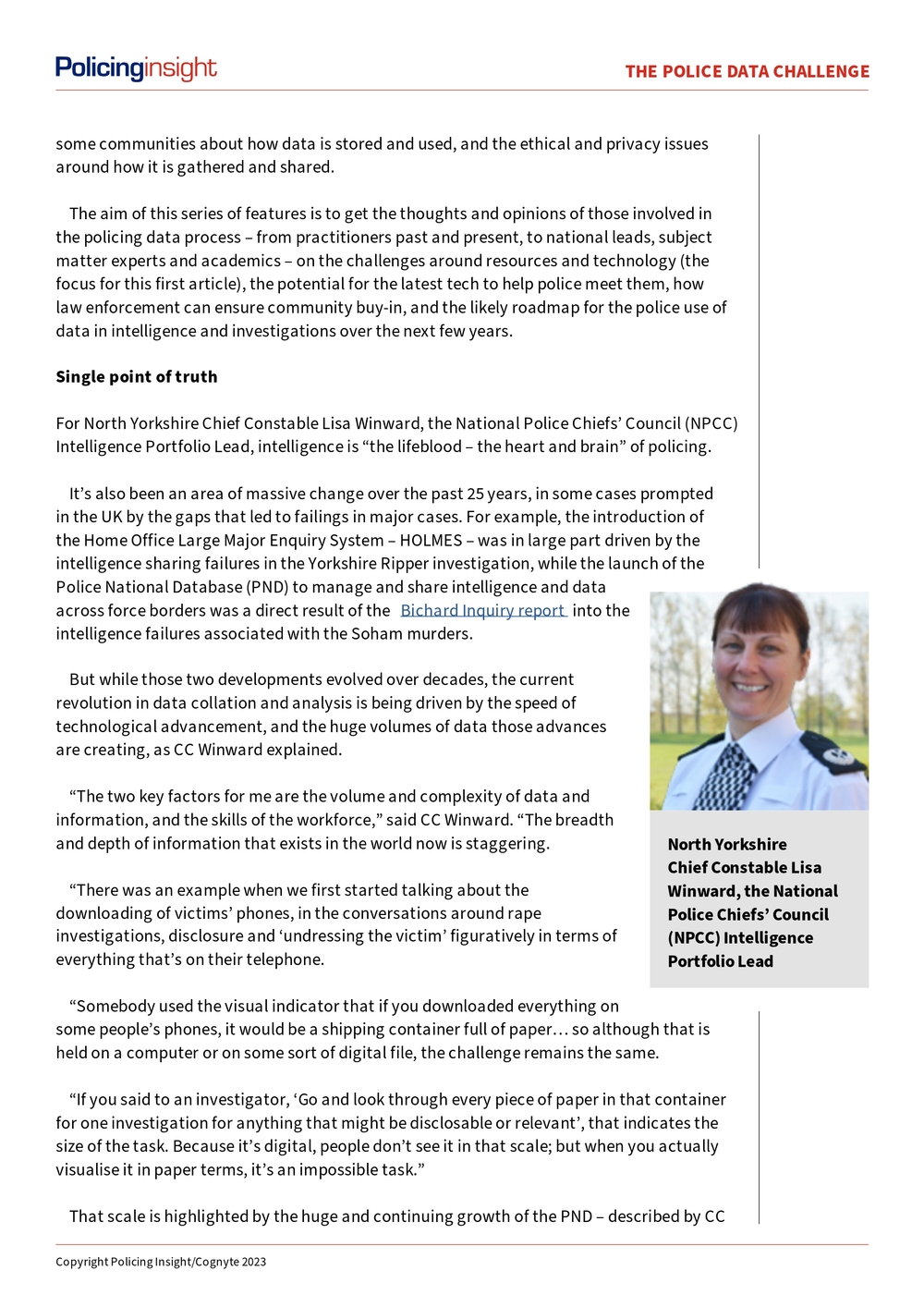
THE POLICE DATA CHALLENGE Copyright Policing Insight/Cognyte 2023some communities about how data is stored and used, and the ethical and privacy issues around how it is gathered and shared. The aim of this series of features is to get the thoughts and opinions of those involved in the policing data process – from practitioners past and present, to national leads, subject matter experts and academics – on the challenges around resources and technology (the focus for this first article), the potential for the latest tech to help police meet them, how law enforcement can ensure community buy-in, and the likely roadmap for the police use of data in intelligence and investigations over the next few years. Single point of truth For North Yorkshire Chief Constable Lisa Winward, the National Police Chiefs’ Council (NPCC) Intelligence Portfolio Lead, intelligence is “the lifeblood – the heart and brain” of policing. It’s also been an area of massive change over the past 25 years, in some cases prompted in the UK by the gaps that led to failings in major cases. For example, the introduction of the Home Office Large Major Enquiry System – HOLMES – was in large part driven by the intelligence sharing failures in the Yorkshire Ripper investigation, while the launch of the Police National Database (PND) to manage and share intelligence and data across force borders was a direct result of the Bichard Inquiry report into the intelligence failures associated with the Soham murders. But while those two developments evolved over decades, the current revolution in data collation and analysis is being driven by the speed of technological advancement, and the huge volumes of data those advances are creating, as CC Winward explained. “The two key factors for me are the volume and complexity of data and information, and the skills of the workforce, ” said CC Winward. “The breadth and depth of information that exists in the world now is staggering. “There was an example when we first started talking about the downloading of victims’ phones, in the conversations around rape investigations, disclosure and ‘undressing the victim’ figuratively in terms of everything that’s on their telephone. “Somebody used the visual indicator that if you downloaded everything on some people’s phones, it would be a shipping container full of paper… so although that is held on a computer or on some sort of digital file, the challenge remains the same. “If you said to an investigator, ‘Go and look through every piece of paper in that container for one investigation for anything that might be disclosable or relevant’ , that indicates the size of the task. Because it’s digital, people don’t see it in that scale; but when you actually visualise it in paper terms, it’s an impossible task. ” That scale is highlighted by the huge and continuing growth of the PND – described by CC North Yorkshire Chief Constable Lisa Winward, the National Police Chiefs’ Council (NPCC) Intelligence Portfolio Lead
THE POLICE DATA CHALLENGE Copyright Policing Insight/Cognyte 2023Winward as the “single point of truth” for police intelligence and data, one which, rather than being a data source in itself, acts as a gateway into vast pots of data that come “down the tube every day” from forces and other agencies. The figures are astounding, as Vicky Hough, NPCC Intelligence Portfolio Staff Officer and herself a former analyst, explained: “The PND obviously connects not only intelligence but crime custody data, domestic violence etc, and there are currently 5.8 billion searchable records, and 99.9 million intelligence reports. “That doesn’t include all the mobile devices that have been seized – the downloads and the content of that – because you couldn’t cope with that. So we’re relying on people in specialist positions extracting the information and the intelligence, and putting it onto the PND, which gives us that connectivity. ” And policing is not the only source of data for the PND – 55 agencies and 250 source systems also feed into database. However, alongside managing the scale of that data resource, policing at a national level faces other key challenges – ensuring that data and intelligence obtained at local force and agency level continues to be fed into the PND in a usable format, regardless of the systems that forces employ, and that once there, it is accessible to all those frontline analysts, officers and specialists who need it. “The task for us, at a national level, is to coalesce all of the chief constables on this being the single point of truth, ” CC Winward told Policing Insight. “So where are the forces? We don’t want to reduce the amount of innovation that’s going on. We don’t want to quell some of that excellent, best practice. But if somebody has a fantastic system that gathers some great data, we want it to come down the tube into the PND as opposed to it being a standalone system. “It’s not about stopping other systems existing, but how do we make sure those systems can speak to the PND so that we still have the single point of truth?” Clean and consistent The PND is currently the established data sharing model for UK policing at a national scale, and work is ongoing to explore how analytical tools and the use of artificial intelligence (AI) – technology that we will look at in a later feature in this series – can help to leverage the maximum potential of the database. That’s not to say, however, that policing is invariably and inexorably linked to the PND. The Home Office National Law Enforcement Data Programme (NLEDP) was set up in 2016, initially to replace both the Police National Computer (PNC) and the PND with a new Law Enforcement Data Service (LEDS).“The two key factors for me are the volume and complexity of data and information, and the skills of the workforce. The breadth and depth of information that exists in the world now is staggering. ” CC Lisa Winward NPCC Intelligence Portfolio Lead
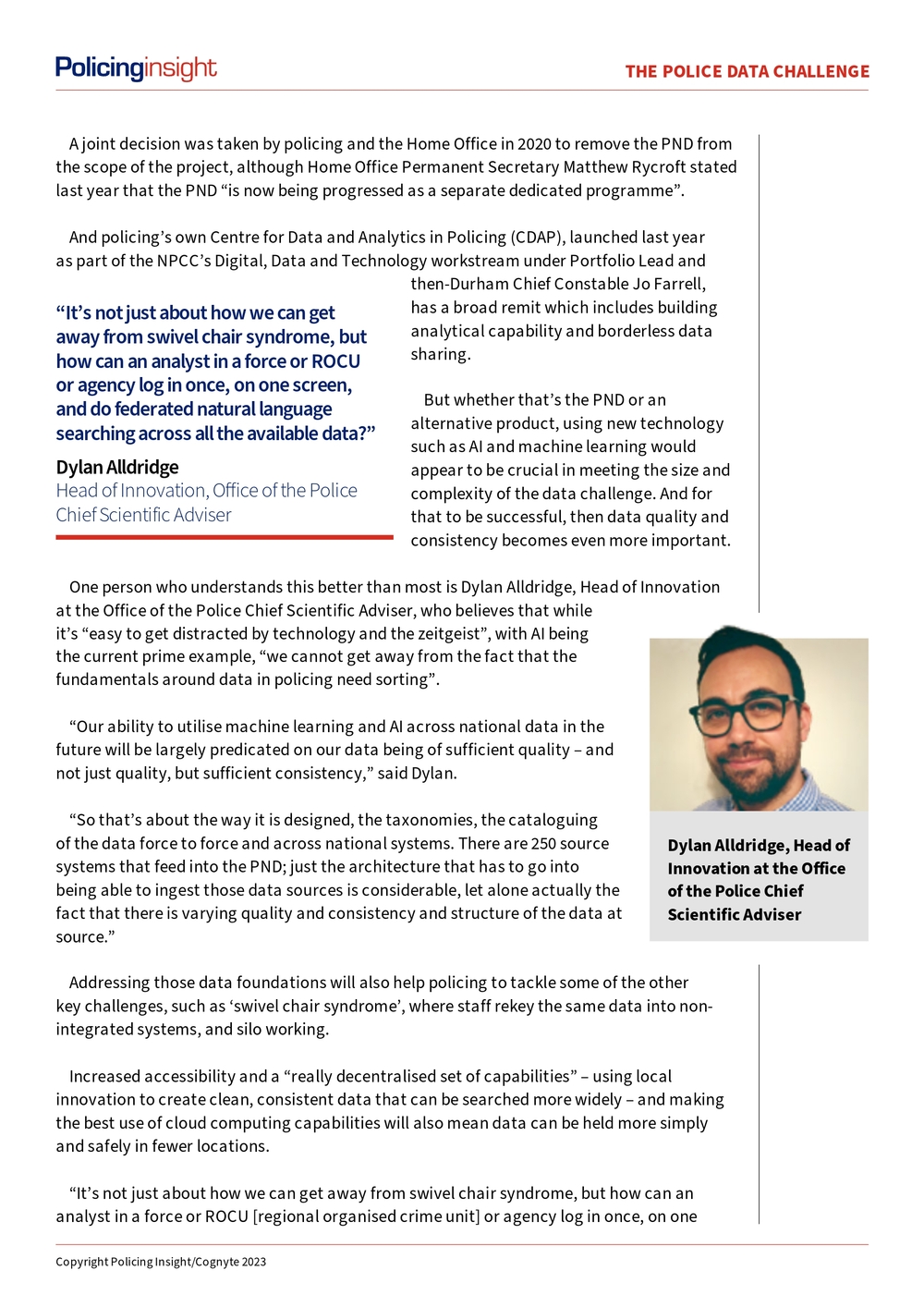
THE POLICE DATA CHALLENGE Copyright Policing Insight/Cognyte 2023A joint decision was taken by policing and the Home Office in 2020 to remove the PND from the scope of the project, although Home Office Permanent Secretary Matthew Rycroft stated last year that the PND “is now being progressed as a separate dedicated programme” . And policing’s own Centre for Data and Analytics in Policing (CDAP), launched last year as part of the NPCC’s Digital, Data and Technology workstream under Portfolio Lead and then-Durham Chief Constable Jo Farrell, has a broad remit which includes building analytical capability and borderless data sharing. But whether that’s the PND or an alternative product, using new technology such as AI and machine learning would appear to be crucial in meeting the size and complexity of the data challenge. And for that to be successful, then data quality and consistency becomes even more important. One person who understands this better than most is Dylan Alldridge, Head of Innovation at the Office of the Police Chief Scientific Adviser, who believes that while it’s “easy to get distracted by technology and the zeitgeist” , with AI being the current prime example, “we cannot get away from the fact that the fundamentals around data in policing need sorting” . “Our ability to utilise machine learning and AI across national data in the future will be largely predicated on our data being of sufficient quality – and not just quality, but sufficient consistency, ” said Dylan. “So that’s about the way it is designed, the taxonomies, the cataloguing of the data force to force and across national systems. There are 250 source systems that feed into the PND; just the architecture that has to go into being able to ingest those data sources is considerable, let alone actually the fact that there is varying quality and consistency and structure of the data at source. ” Addressing those data foundations will also help policing to tackle some of the other key challenges, such as ‘swivel chair syndrome’ , where staff rekey the same data into non- integrated systems, and silo working. Increased accessibility and a “really decentralised set of capabilities” – using local innovation to create clean, consistent data that can be searched more widely – and making the best use of cloud computing capabilities will also mean data can be held more simply and safely in fewer locations. “It’s not just about how we can get away from swivel chair syndrome, but how can an analyst in a force or ROCU [regional organised crime unit] or agency log in once, on one “It’s not just about how we can get away from swivel chair syndrome, but how can an analyst in a force or ROCU or agency log in once, on one screen, and do federated natural language searching across all the available data?” Dylan Alldridge Head of Innovation, Office of the Police Chief Scientific Adviser Dylan Alldridge, Head of Innovation at the Office of the Police Chief Scientific Adviser
THE POLICE DATA CHALLENGE Copyright Policing Insight/Cognyte 2023screen, and do federated natural language searching across all the available data?” added Dylan. “They don’t need to know that there’s plumbing pulling that from 150 different places; what they’re getting back is that single view of the information. “Data is also expensive to move and hold, and every time you move it you obviously generate risks, so from a SIRO’s [senior information risk owner’s] perspective, the fewer places that data is kept the better. ” Global challenge It’s worth remembering that problems such as data cleansing and silo working are not solely an issue for policing in the UK (or just for policing, as opposed to other sectors or organisations). For example, New Zealand Police is often to be found at the cutting edge of many technological advances, but specialists within the force still recognise both the difficulties of sourcing intelligence from unstructured, ‘uncleansed’ data, and the dangers of data sitting in isolated pots within a larger system, as well as the opportunities for new technology to address some of those problems. James Foubister, who works as a Principal Advisor alongside the force’s Manager for Emerging Tech, Inspector Carla Gilmore, told Policing Insight that some of the biggest data challenges to date have been around connecting those data pots up, and accessing the right information from uncleansed data – both areas where new technology could make the processes significantly more efficient. “Generating a result based on a query is one thing; generating a real answer is different. When you query data you’re not actually looking for more data, you’re looking for an answer, ” said James. “There’s not one single system in New Zealand Police; we’ve got lots of disparate data sources, and being able to connect those up in a holistic environment, I think, is the ‘one team, one dream’ of all policing agencies as far as I know. “There was a project that I worked on where I came up with the tagline ‘first, fast, and federated’ . We needed to be the first place you’d go to for 90% of your results; we needed it to be a fast result; and it needed to be a federated result, so that you’re getting an answer from as comprehensive a source as you can. “When an executive says, ‘What are we doing about X?” , and you say, ‘Right, give me a moment, sir, I need to go and find this information in our holdings’ , you want that search, that results set, and the answer you give based on those results to be as comprehensive as possible. ” Massive disconnect If these challenges are not unique, they are also not new. Former West Midlands Police “We’ve got lots of disparate data sources, and being able to connect those up in a holistic environment is the ‘one team, one dream’ of all policing agencies as far as I know. ” James Foubister New Zealand Police
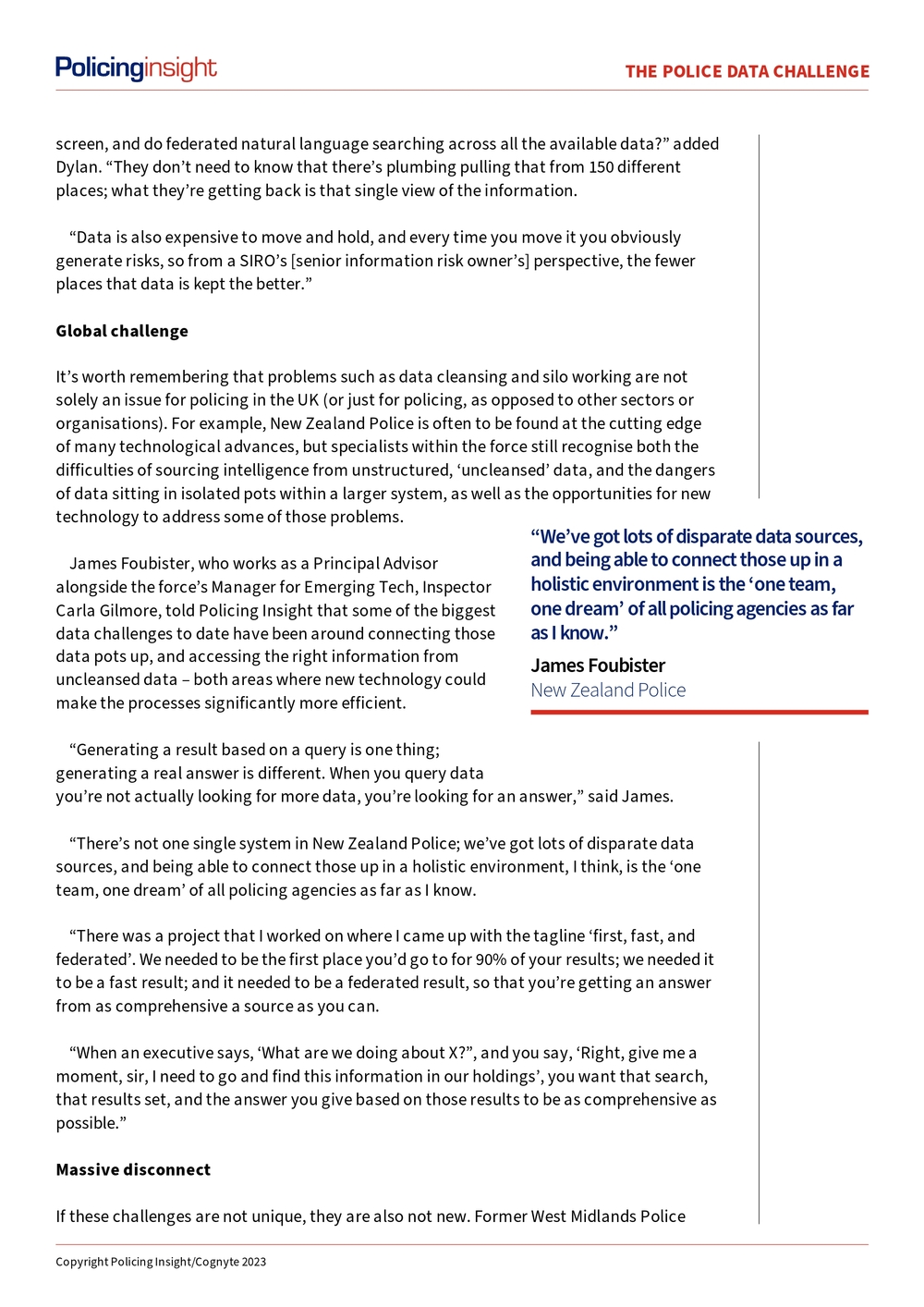
THE POLICE DATA CHALLENGE Copyright Policing Insight/Cognyte 2023(WMP) Superintendent Iain Donnelly played a leading role in the development of the National Data Analytics Solution (NDAS), a project that demonstrates the capability to use advanced data analytics to provide actionable insights from police datasets. The foundation phase of the project (which is run by WMP on behalf of the Home Office) focused on gun and knife crime, modern slavery, and workforce wellbeing. “Certainly the thinking was – and still is – that if we can harness a lot of this data that sits across policing in lots of different pots and silos and then use the latest thinking around machine learning to make sense of massive datasets and extract insights from them, it’s a complete no-brainer, ” said Iain. “Why wouldn’t you want to do that? But like everything else in life, until you actually start doing something, you don’t realise just how complicated it is, both from a technical point of view and also from a governance and ethical point of view. ” For Iain, while there were obvious technical challenges – for example, identifying and extracting ‘key predictive indicators’ from the 600 million lines of data supplied by three forces – the technology was not the only challenge. “We had £4.5million Police Innovation Fund allotted money to do this, and most of that was spent on very expensive data scientists, data engineers, project managers, etc. We had the best people – it was very, very expensive, but they were very, very good; this stuff doesn’t come cheap, ” explained Iain. “The second big hurdle we came up against was a massive reluctance on the part of forces to give us the data. At the end of that 12-month foundation phase, we had data from only three of the seven forces involved – the other four point-blank refused to give us data. “There’s a massive disconnect between the strategic stakeholders at chief officer rank, who say ‘Yes, we want to do this’ , and then as soon as the project starts, you get the local information security, information management and the local IT people involved, and you can have any answer you want as long as it’s ‘no’ . “They were citing GDPR issues… a lot of that is driven by fear, fear of being fined by the Information Commissioner, and they were super-nervous about falling foul of the new GDPR legislation that at the time nobody really understood. “Another big issue is that a lot of the use of police cutting-edge technology gets misrepresented by certain parts of the media as being ‘Big Brother’ . The media will misrepresent what you’re trying to do and scare everyone with Doomsday-type scenarios about police misusing our data, targeting young black men, further criminalising certain sections of the public, etc, when what you’re trying to do is actually a very pure thing. ”Former West Midlands Police Superintendent Iain Donnelly
THE POLICE DATA CHALLENGE Copyright Policing Insight/Cognyte 2023The impact of legislation While there maybe issues around data ownership and risk aversion when it comes to data sharing – which is crucial if the in-force analyst highlighted by Dylan Alldridge is really to have that “single view” of all the information pulled in from a 150 different places – it’s not only advances in technology and changes in attitude that will play a part; legislation may also be key. Thames Valley Supt Lewis Prescott-Mayling is well aware of some of the statutory duties on police forces and other agencies around data sharing, having played a lead role in establishing the Thames Valley Together platform as part of his work with the force’s Violence Reduction Unit (VRU). The platform aims to overcome many of the barriers to sharing information across organisational boundaries by allowing local authorities, police, HM Prisons & Probation and wider partners to share information securely, with the appropriate levels of control. The system helps partners to develop plans to address violence and its causes; it has been recognised as national best practice, and the Home Office is supporting its wider roll-out to other VRUs across the country. While the focus is more around safeguarding and prevention than crime investigation, Supt Prescott-Mayling – who is now the force’s Strategic Lead for tackling serious violence, and the Research and Innovation Lead for Policing Chief Scientific Adviser Prof Paul Taylor – believes the new duties as well as pressure from inspectorates could help to bring about real change. “Fundamentally we should be sharing and bringing this data together across the partnership anyway – we’re required to do that under the Crime and Disorder Act obligations – but we now have a new legal duty to be sharing that data under the Police, Crime, Courts and Sentencing Act that went live in this year, ” he told Policing Insight. “That’s actually a legal obligation on us as a police force to share data specifically on risk and protective factors for violence. That approach came out of the Serious Violence Strategy from 2018; it’s also all over the Police Foundation Strategic Review , and in the latest HMICFRS report on how well the police tackle youth violence. They’re all making the same point really, that we need to share data better to understand risk and need. “Quite often people decide, right, we’re going to share some information to do a strategic needs assessment – perhaps a joint strategic needs assessment – and we’ll probably extract that data via some extraction logic tool. We’ll do it, all of our analysts will do it across the Thames Valley Supt Lewis Prescott-Mayling “What we should be doing is building data – data pipelines particularly – by leveraging some of the Azure-based or cloud-based technology” Supt Lewis Prescott-Mayling Thames Valley

THE POLICE DATA CHALLENGE Copyright Policing Insight/Cognyte 2023different agencies, and we’ll email each other a load of Excel tables, and we’ll try and stick them together into a report. “The problem again and again with that is it’s not reproducible or sustainable, it’s not the modern way of working. We will look back, probably in a year or two from now, and laugh that we were doing this because it is ridiculous, it’s inefficient, it’s inaccurate, and it’s not sustainable. What we should be doing is building data – data pipelines particularly – by leveraging some of the Azure-based or cloud-based technology. “We should be making that product, whatever it is, as reproducible as possible, so that we can look at the things that are in our strategic needs assessment at any point in the year – not just once a year, by which time that report is out of date anyway. There could be live time metrics we’re able to see and visualise in dashboards; and making that a bit more real, how we do that is with taking data from source systems. ” Alongside technological advances, changing attitudes and new legislation, suppliers themselves also have a crucial role to play in meeting the data challenges. Iain Donnelly, who is now an adviser to technology companies working with law enforcement and intelligence agencies, believes the procurement process can also act as a barrier to ensuring that the most up-to-date technology is available to police in relation to data collation, extraction and analysis. “Having been in the police most of my working life, and to now be seeing it from the perspective of a supplier, it can be incredibly frustrating trying to deal with policing, ” he told Policing Insight. “The decision-making process is painfully slow and massively risk-averse when it comes to innovation, with far too many layers of governance to have to try and work through within every single force. As soon as there’s procurement, information security people, the IT department, everyone wants to line up in order to say no. That’s what it feels like. ” More small suppliers Iain would advocate increasing the proportion of policing IT spend with a wider range of smaller suppliers – rather than always defaulting to the “big players” – and also encouraging suppliers themselves to build partnerships that deliver products which offer solutions to a wider range of data challenges. However the spend is spread out, it seems that local, force-level innovation and regional collaborations, which feed into a federated “single source” of information and intelligence, will be crucial to tackling the scale and complexity of data in investigations of the future. A key issue in delivering this – and one which we will look at in a future article in this series – is the where the human resource sits in meeting these data challenges.