Decoding and Disrupting Illicit Hawala Network
by Cognyte
Decoding and Disrupting Illicit Hawala Networks with Decision Intelligence How Decision Intelligence Can Help Executive Summary Key Decision Intelligence Capabilities Financial Crime Investigation Solution The Hawala Problem What is Hawala? 4 5 6 1 2 3
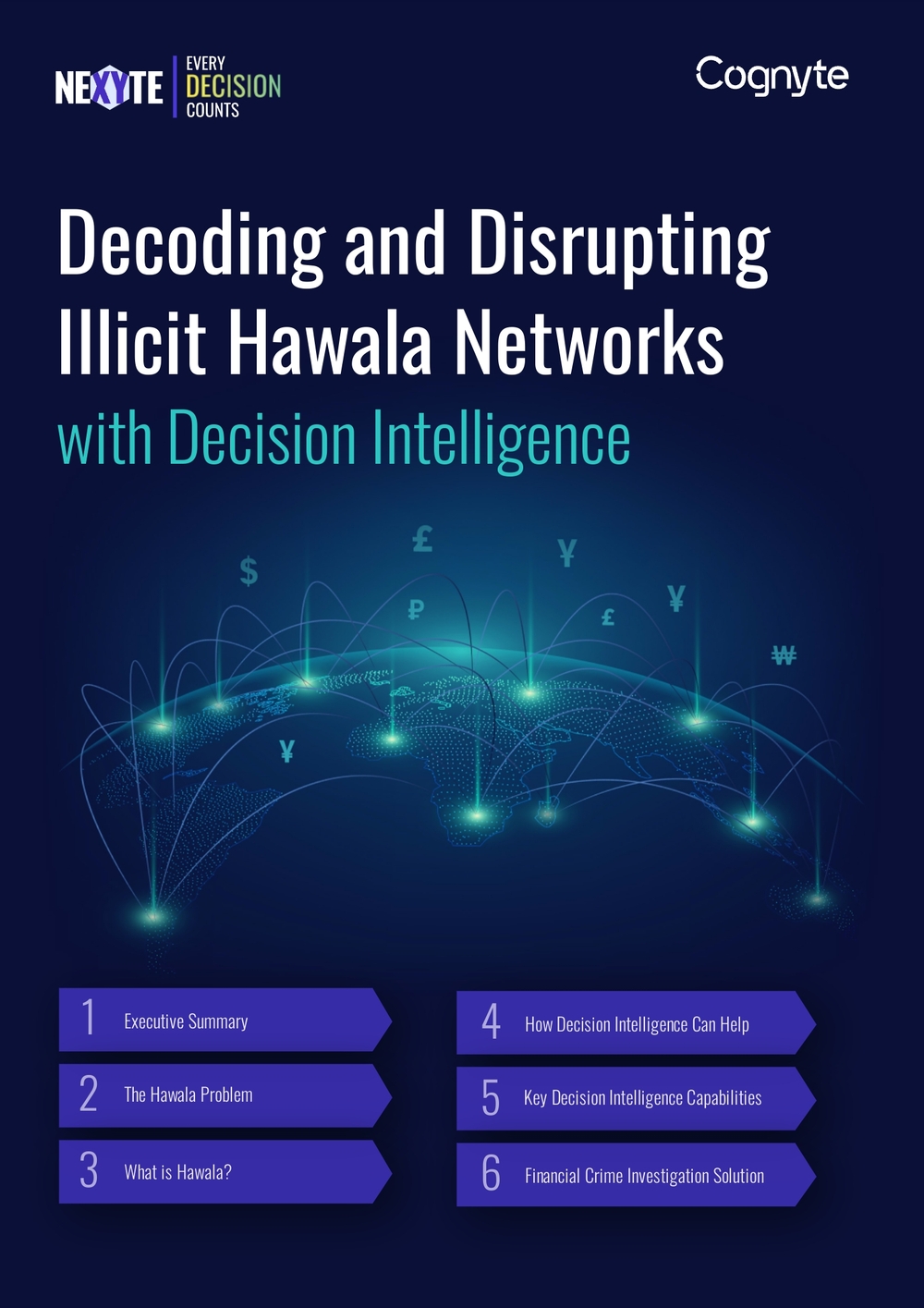
Executive Summary In this report we explore the Hawala financial system, why it poses a unique and elusive challenge for law enforcement authorities. We then look at how the capabilities of decision intelligence platforms can mitigate the significant difficulties involved in investigating Hawala networks and stopping the criminals and terrorists who take advantage of them. These capabilities include: Entity resolution Unified investigative workspace Advanced search and alerts Visual link analysis Automated risk scoring 1 Executive Summary 6 Financial Crime Investigation Solution2 The Hawala Problem 4 How Decision Intelligence Can Help 5 Key Decision Intelligence Capabilities 3 What is Hawala? 2
In today's high-tech era, criminals often leave digital footprints that aid law enforcement and financial regulators in investigations. Ironically, it's the offline, low-tech crimes that confound authorities the most. This is evident in the recent surge in illicit use of the Hawala system. Criminals and terror groups increasingly take advantage of this centuries-old money transfer system to evade authorities. Despite their best efforts, law enforcement agencies struggle to combat the illicit movement of funds via the Hawala system, due to its decentralized, unregulated, and low-tech nature.
Transactions are typically recorded in paper notebooks with cryptic codes and token numbers denoting transactions between anonymized parties, offering little to work with investigators. However, there is a global push for urgent action against Hawala activity in both developed and undeveloped countries, especially in Europe, where waves of immigration have changed local demographics. Law enforcement is contending with a surge in money laundering and terror funding via Hawala networks, as well as the popularity of the Hawala system among criminal and terror groups. This has prompted law enforcement to seek new technologies, including AI- driven decision intelligence solutions, to extract meaningful insights from the low-tech data sources associated with the Hawala system. The Urgent Need for Better Investigative Tools for Hawala 1 Executive Summary 6 Financial Crime Investigation Solution2 The Hawala Problem 4 How Decision Intelligence Can Help 5 Key Decision Intelligence Capabilities 3 What is Hawala? 2 The Hawala Problem 4 How Decision Intelligence Can Help 3
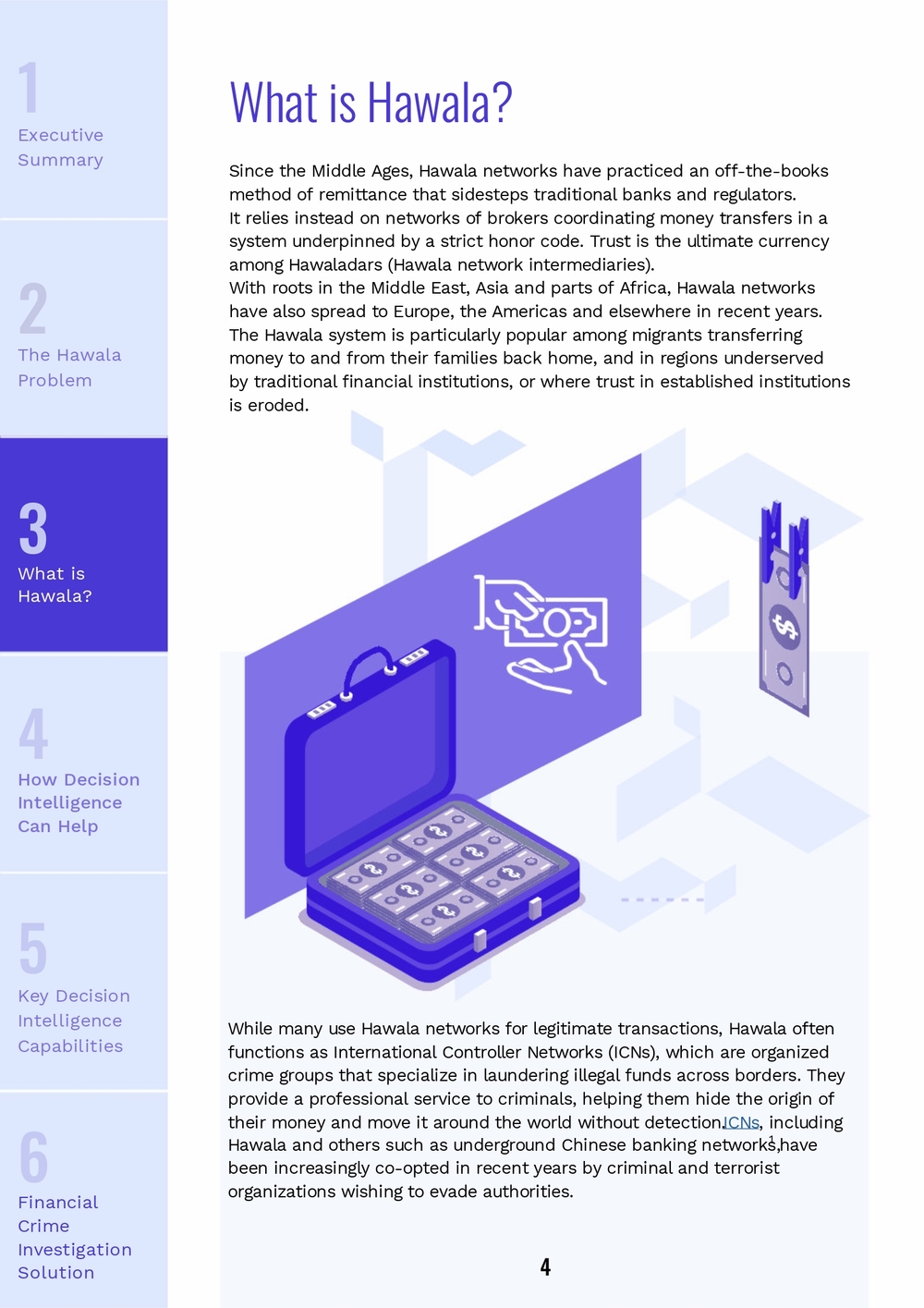
What is Hawala? While many use Hawala networks for legitimate transactions, Hawala often functions as International Controller Networks (ICNs), which are organized crime groups that specialize in laundering illegal funds across borders. They provide a professional service to criminals, helping them hide the origin of their money and move it around the world without detection. ICNs, including Hawala and others such as underground Chinese banking networks,1 have been increasingly co-opted in recent years by criminal and terrorist organizations wishing to evade authorities. Since the Middle Ages, Hawala networks have practiced an off-the-books method of remittance that sidesteps traditional banks and regulators. It relies instead on networks of brokers coordinating money transfers in a system underpinned by a strict honor code. Trust is the ultimate currency among Hawaladars (Hawala network intermediaries). With roots in the Middle East, Asia and parts of Africa, Hawala networks have also spread to Europe, the Americas and elsewhere in recent years. The Hawala system is particularly popular among migrants transferring money to and from their families back home, and in regions underserved by traditional financial institutions, or where trust in established institutions is eroded. 1 Executive Summary 6 Financial Crime Investigation Solution2 The Hawala Problem 4 How Decision Intelligence Can Help 5 Key Decision Intelligence Capabilities 3 What is Hawala? 4
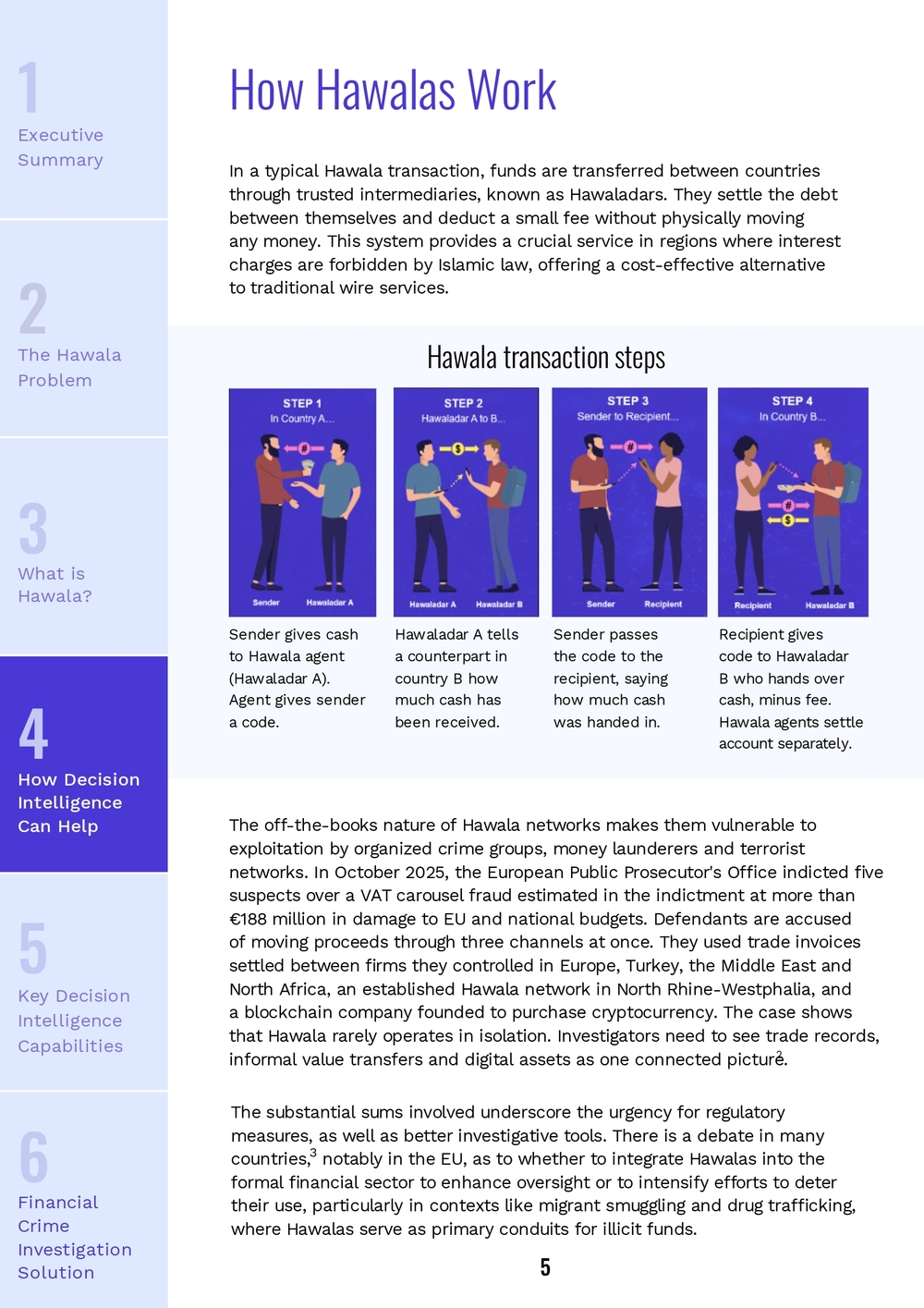
How Hawalas Work In a typical Hawala transaction, funds are transferred between countries through trusted intermediaries, known as Hawaladars. They settle the debt between themselves and deduct a small fee without physically moving any money. This system provides a crucial service in regions where interest charges are forbidden by Islamic law, offering a cost-effective alternative to traditional wire services. The substantial sums involved underscore the urgency for regulatory measures, as well as better investigative tools. There is a debate in many countries,3 notably in the EU, as to whether to integrate Hawalas into the formal financial sector to enhance oversight or to intensify efforts to deter their use, particularly in contexts like migrant smuggling and drug trafficking, where Hawalas serve as primary conduits for illicit funds. Hawala transaction steps 5The off-the-books nature of Hawala networks makes them vulnerable to exploitation by organized crime groups, money launderers and terrorist networks. In October 2025, the European Public Prosecutor's Office indicted five suspects over a VAT carousel fraud estimated in the indictment at more than €188 million in damage to EU and national budgets. Defendants are accused of moving proceeds through three channels at once. They used trade invoices settled between firms they controlled in Europe, Turkey, the Middle East and North Africa, an established Hawala network in North Rhine-Westphalia, and a blockchain company founded to purchase cryptocurrency. The case shows that Hawala rarely operates in isolation. Investigators need to see trade records, informal value transfers and digital assets as one connected picture.2Sender gives cash to Hawala agent (Hawaladar A). Agent gives sender a code.Hawaladar A tells a counterpart in country B how much cash has been received.Sender passes the code to the recipient, saying how much cash was handed in.Recipient gives code to Hawaladar B who hands over cash, minus fee. Hawala agents settle account separately. 1 Executive Summary 6 Financial Crime Investigation Solution2 The Hawala Problem 4 How Decision Intelligence Can Help 5 Key Decision Intelligence Capabilities 3 What is Hawala? 2 The Hawala Problem 4 How Decision Intelligence Can Help
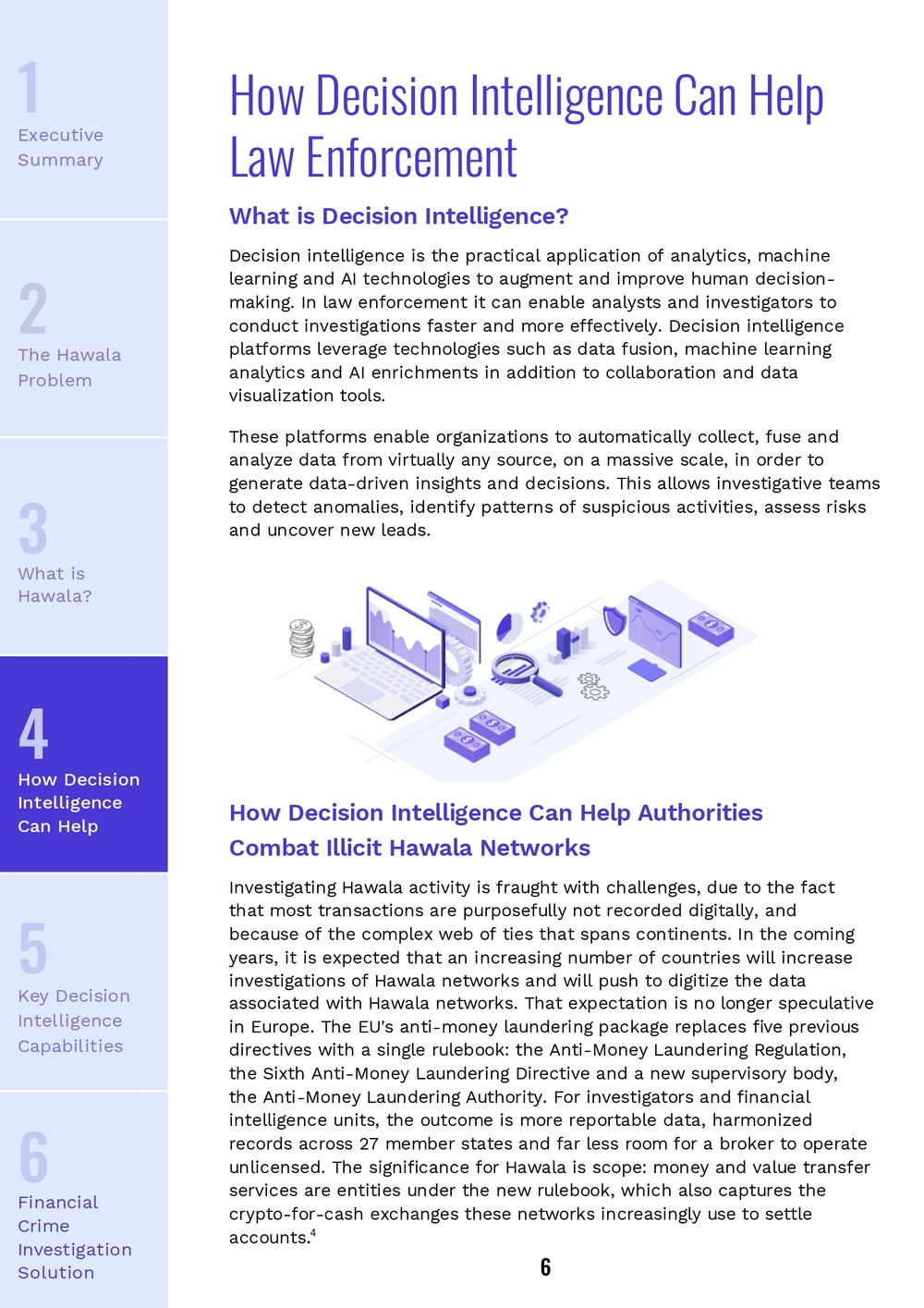
How Decision Intelligence Can Help Law Enforcement What is Decision Intelligence? Decision intelligence is the practical application of analytics, machine learning and AI technologies to augment and improve human decision- making. In law enforcement it can enable analysts and investigators to conduct investigations faster and more effectively. Decision intelligence platforms leverage technologies such as data fusion, machine learning analytics and AI enrichments in addition to collaboration and data visualization tools. These platforms enable organizations to automatically collect, fuse and analyze data from virtually any source, on a massive scale, in order to generate data-driven insights and decisions. This allows investigative teams to detect anomalies, identify patterns of suspicious activities, assess risks and uncover new leads. How Decision Intelligence Can Help Authorities Combat Illicit Hawala Networks Investigating Hawala activity is fraught with challenges, due to the fact that most transactions are purposefully not recorded digitally, and because of the complex web of ties that spans continents. In the coming years, it is expected that an increasing number of countries will increase investigations of Hawala networks and will push to digitize the data associated with Hawala networks. That expectation is no longer speculative in Europe. The EU's anti-money laundering package replaces five previous directives with a single rulebook: the Anti-Money Laundering Regulation, the Sixth Anti-Money Laundering Directive and a new supervisory body, the Anti-Money Laundering Authority. For investigators and financial intelligence units, the outcome is more reportable data, harmonized records across 27 member states and far less room for a broker to operate unlicensed. The significance for Hawala is scope: money and value transfer services are entities under the new rulebook, which also captures the crypto-for-cash exchanges these networks increasingly use to settle accounts.4 6 1 Executive Summary 6 Financial Crime Investigation Solution2 The Hawala Problem 4 How Decision Intelligence Can Help 5 Key Decision Intelligence Capabilities 3 What is Hawala?
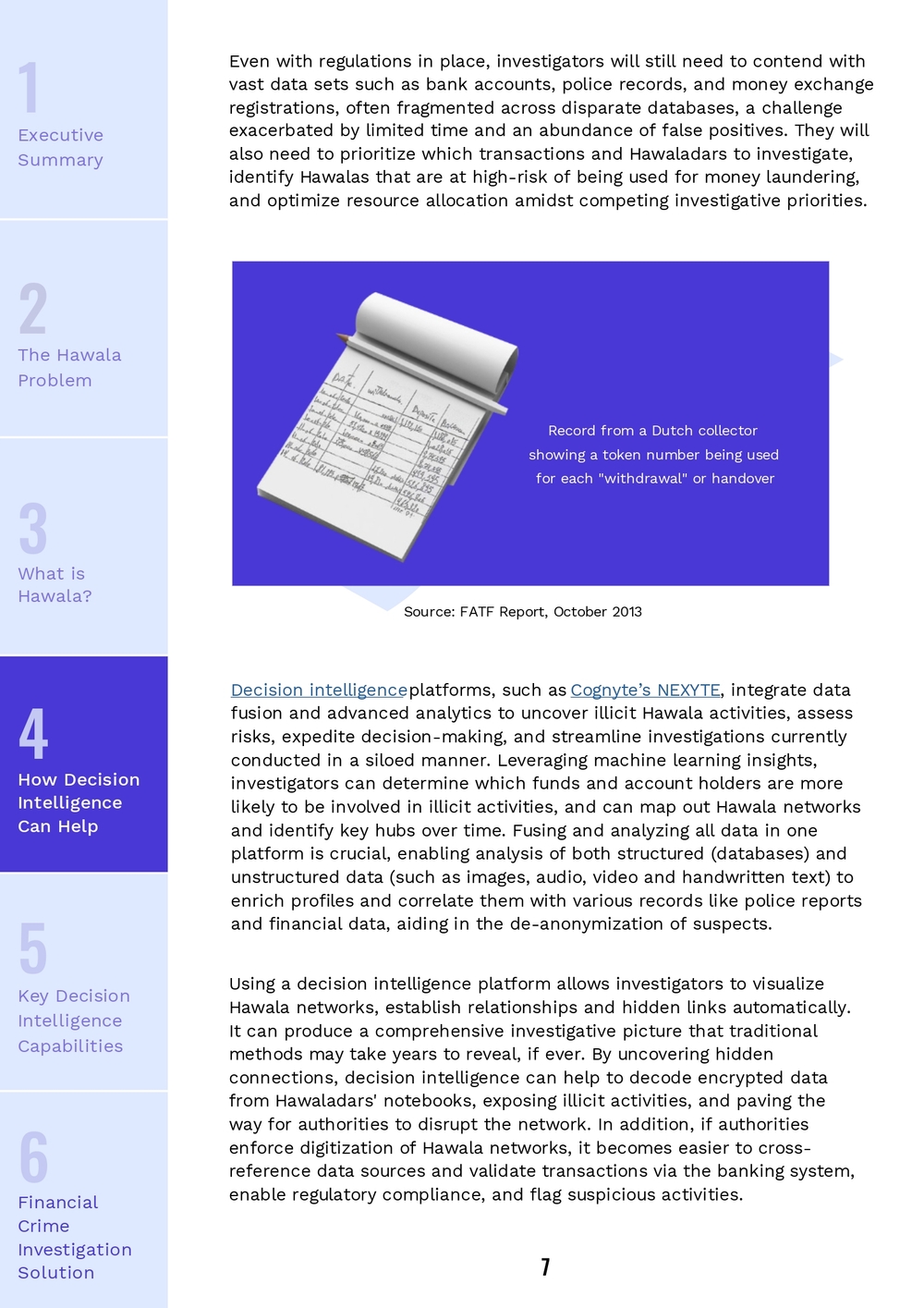
Decision intelligence platforms, such as Cognyte’s NEXYTE, integrate data fusion and advanced analytics to uncover illicit Hawala activities, assess risks, expedite decision-making, and streamline investigations currently conducted in a siloed manner. Leveraging machine learning insights, investigators can determine which funds and account holders are more likely to be involved in illicit activities, and can map out Hawala networks and identify key hubs over time. Fusing and analyzing all data in one platform is crucial, enabling analysis of both structured (databases) and unstructured data (such as images, audio, video and handwritten text) to enrich profiles and correlate them with various records like police reports and financial data, aiding in the de-anonymization of suspects. Even with regulations in place, investigators will still need to contend with vast data sets such as bank accounts, police records, and money exchange registrations, often fragmented across disparate databases, a challenge exacerbated by limited time and an abundance of false positives. They will also need to prioritize which transactions and Hawaladars to investigate, identify Hawalas that are at high-risk of being used for money laundering, and optimize resource allocation amidst competing investigative priorities. Record from a Dutch collector showing a token number being used for each "withdrawal" or handover Source: FATF Report, October 2013 Using a decision intelligence platform allows investigators to visualize Hawala networks, establish relationships and hidden links automatically. It can produce a comprehensive investigative picture that traditional methods may take years to reveal, if ever. By uncovering hidden connections, decision intelligence can help to decode encrypted data from Hawaladars' notebooks, exposing illicit activities, and paving the way for authorities to disrupt the network. In addition, if authorities enforce digitization of Hawala networks, it becomes easier to cross- reference data sources and validate transactions via the banking system, enable regulatory compliance, and flag suspicious activities.
7 1 Executive Summary 6 Financial Crime Investigation Solution2 The Hawala Problem 2 The Hawala Problem 4 How Decision Intelligence Can Help 4 How Decision Intelligence Can Help 5 Key Decision Intelligence Capabilities 3 What is Hawala?
The following decision intelligence capabilities can accelerate investigations of Hawala networks: Key Decision Intelligence Capabilities for Combating Illicit Hawala Networks
Unified investigative workspace A decision intelligence platform fuses all available data sources, no matter the format or type, to provide a single, unified view for the entire organization. Data from lawful interception, web content and information gathered from informants, as well as other unstructured data, is fused in the decision intelligence platform. This allows investigators to easily access all relevant information, and apply AI and machine learning tools to visualize and analyze the data. 1 Fused data sources from a decision intelligence platform 8 1 Executive Summary 6 Financial Crime Investigation Solution2 The Hawala Problem 4 How Decision Intelligence Can Help 5 Key Decision Intelligence Capabilities 3 What is Hawala?
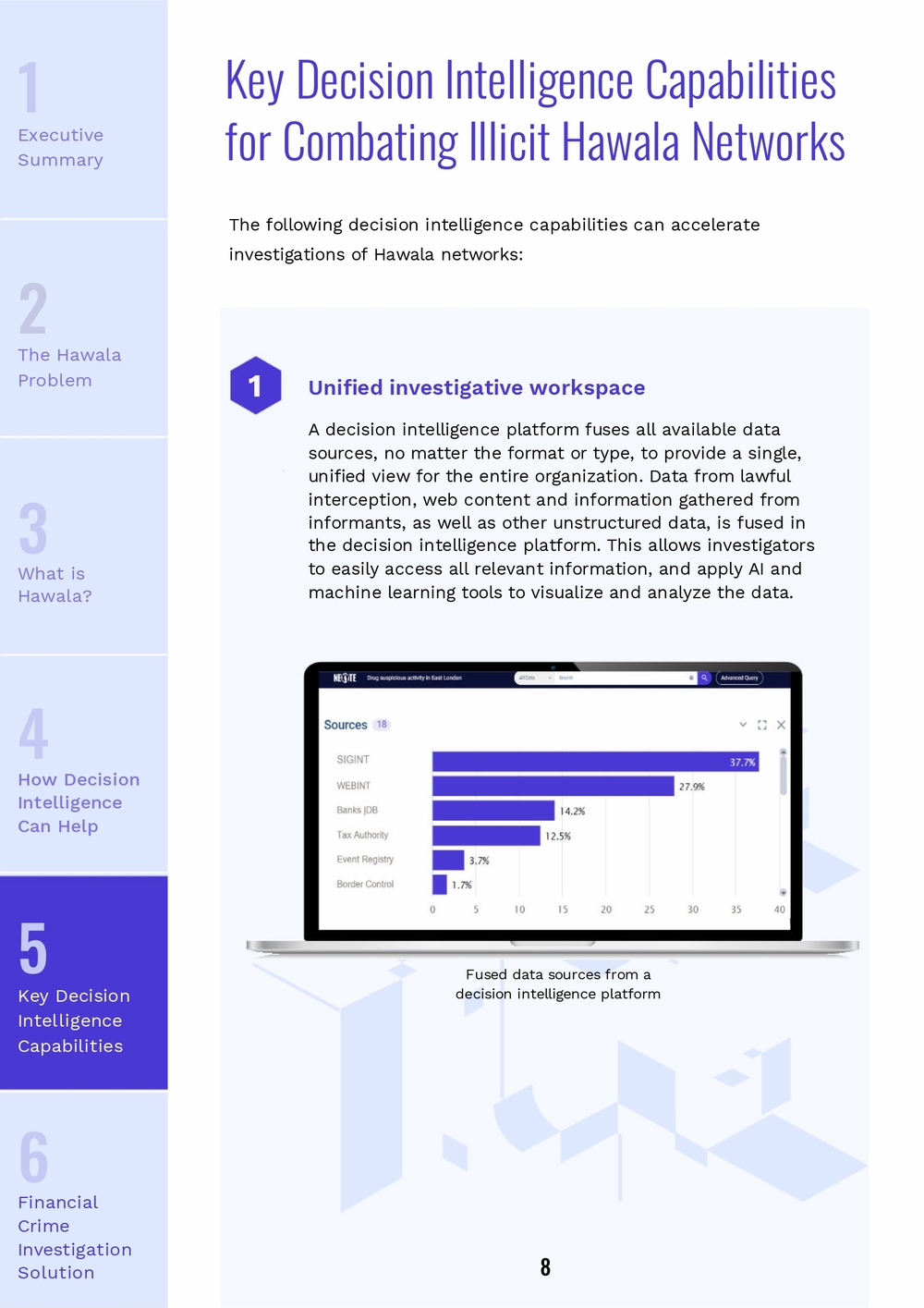
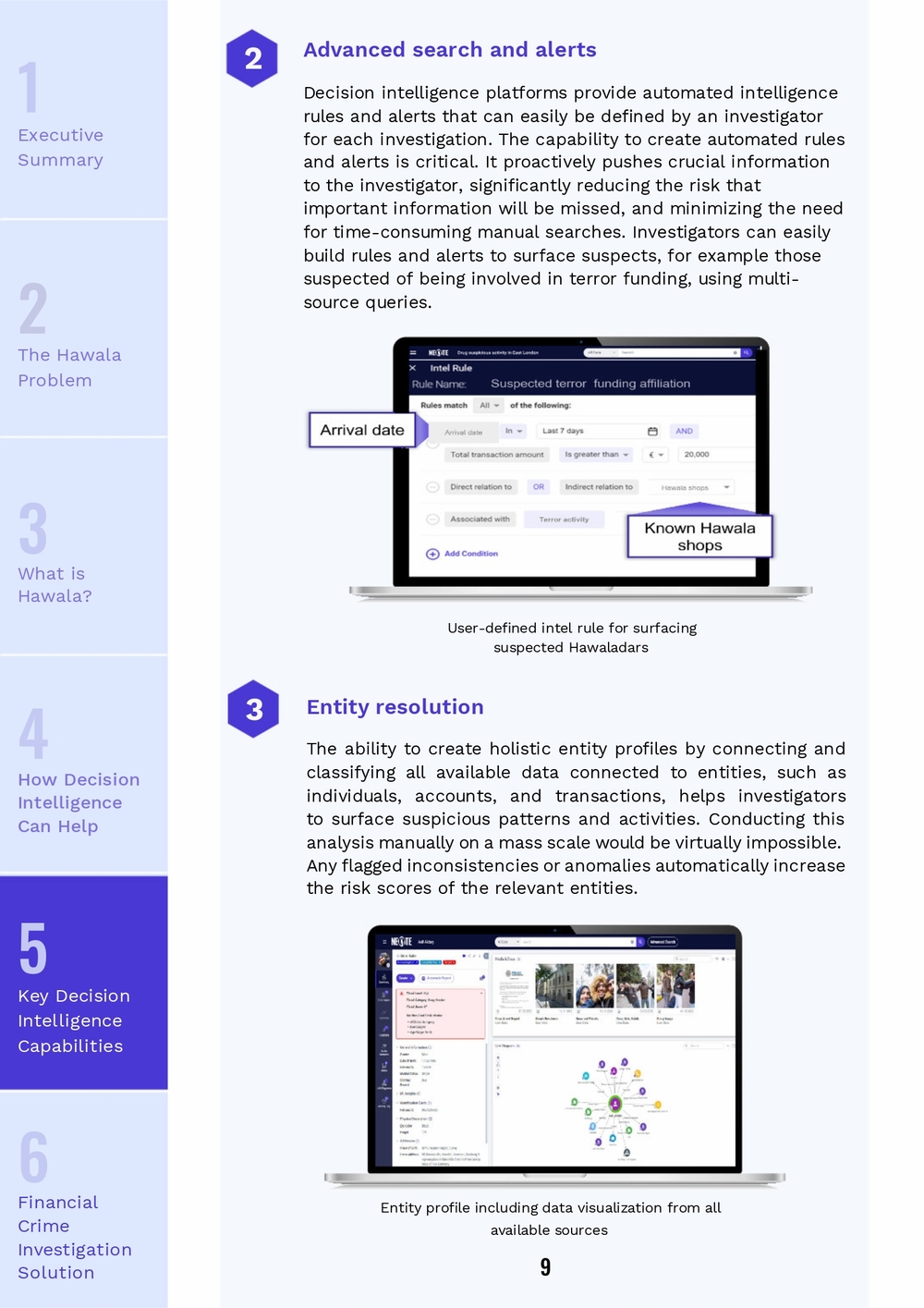
Advanced search and alerts Decision intelligence platforms provide automated intelligence rules and alerts that can easily be defined by an investigator for each investigation. The capability to create automated rules and alerts is critical. It proactively pushes crucial information to the investigator, significantly reducing the risk that important information will be missed, and minimizing the need for time-consuming manual searches. Investigators can easily build rules and alerts to surface suspects, for example those suspected of being involved in terror funding, using multi- source queries.
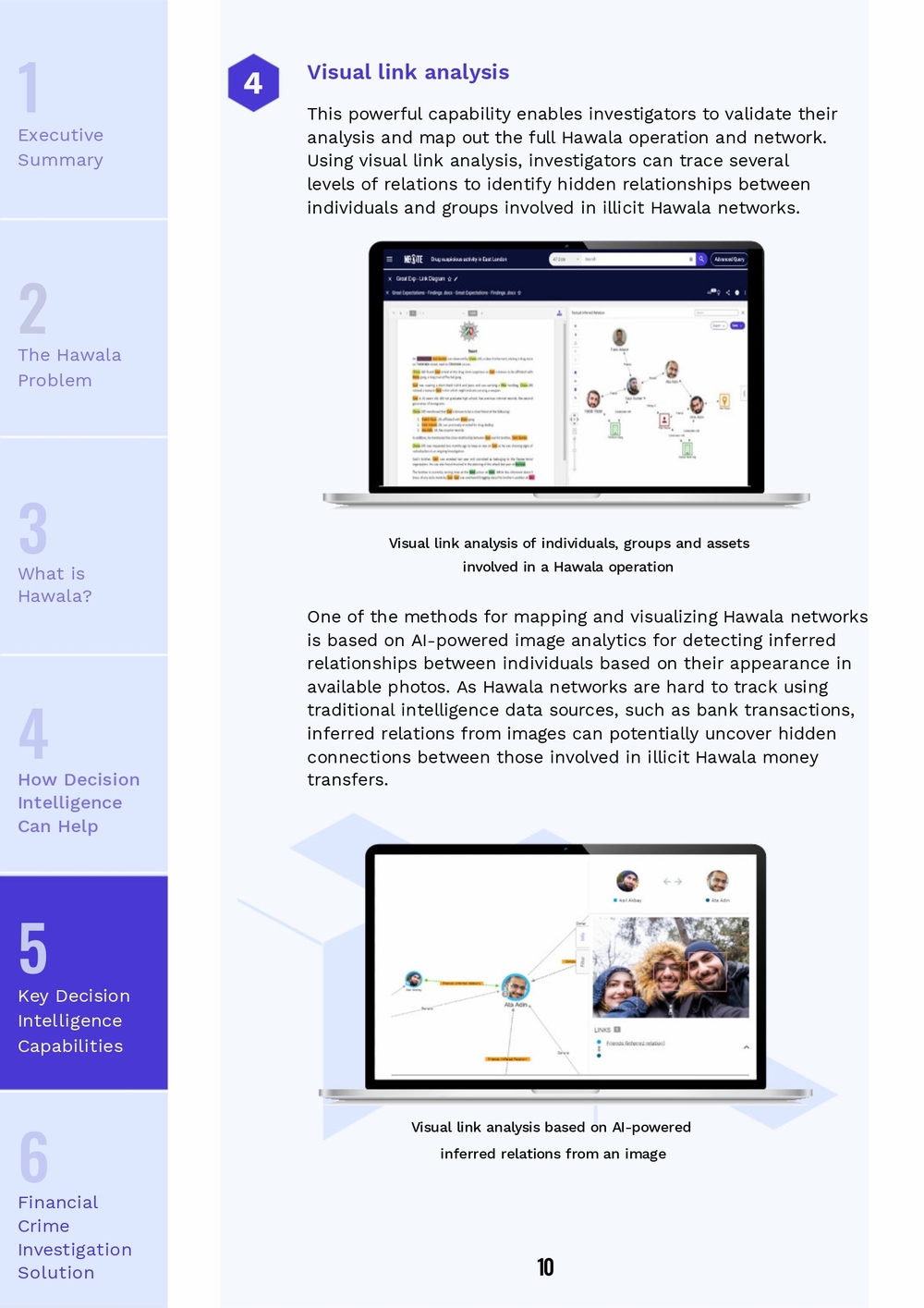
Entity resolution The ability to create holistic entity profiles by connecting and classifying all available data connected to entities, such as individuals, accounts, and transactions, helps investigators to surface suspicious patterns and activities. Conducting this analysis manually on a mass scale would be virtually impossible. Any flagged inconsistencies or anomalies automatically increase the risk scores of the relevant entities. 2
3
Entity profile including data visualization from all available sources User-defined intel rule for surfacing suspected Hawaladars 9 1 Executive Summary 6 Financial Crime Investigation Solution2 The Hawala Problem 2 The Hawala Problem 4 How Decision Intelligence Can Help 4 How Decision Intelligence Can Help 5 Key Decision Intelligence Capabilities 3 What is Hawala?
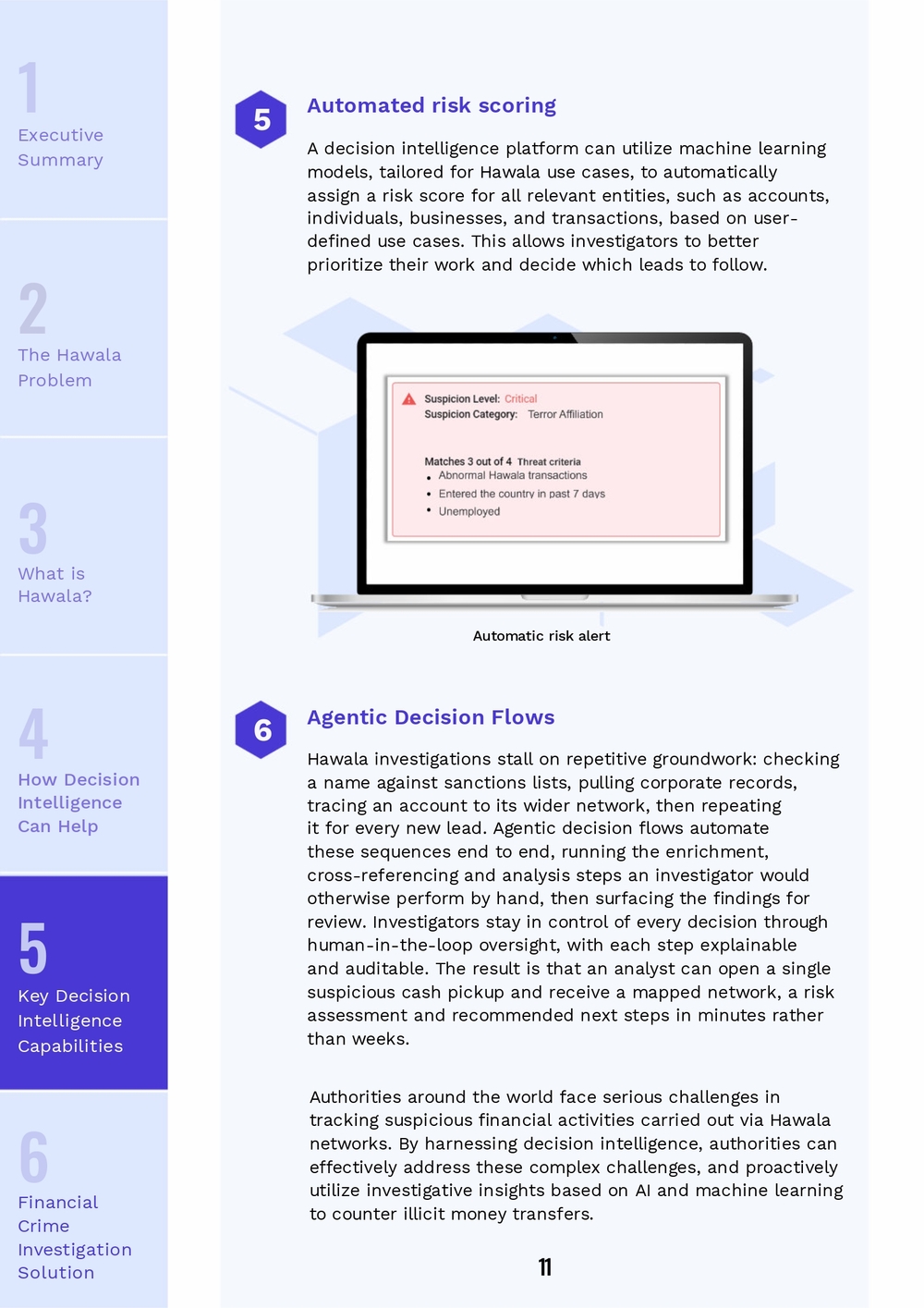
Visual link analysis This powerful capability enables investigators to validate their analysis and map out the full Hawala operation and network. Using visual link analysis, investigators can trace several levels of relations to identify hidden relationships between individuals and groups involved in illicit Hawala networks.
Visual link analysis of individuals, groups and assets involved in a Hawala operation
One of the methods for mapping and visualizing Hawala networks is based on AI-powered image analytics for detecting inferred relationships between individuals based on their appearance in available photos. As Hawala networks are hard to track using traditional intelligence data sources, such as bank transactions, inferred relations from images can potentially uncover hidden connections between those involved in illicit Hawala money transfers.
Visual link analysis based on AI-powered inferred relations from an image
4 10 1 Executive Summary 6 Financial Crime Investigation Solution2 The Hawala Problem 4 How Decision Intelligence Can Help 5 Key Decision Intelligence Capabilities 3 What is Hawala?
Automated risk scoring A decision intelligence platform can utilize machine learning models, tailored for Hawala use cases, to automatically assign a risk score for all relevant entities, such as accounts, individuals, businesses, and transactions, based on user- defined use cases. This allows investigators to better prioritize their work and decide which leads to follow.
Agentic Decision Flows Hawala investigations stall on repetitive groundwork: checking a name against sanctions lists, pulling corporate records, tracing an account to its wider network, then repeating it for every new lead. Agentic decision flows automate these sequences end to end, running the enrichment, cross-referencing and analysis steps an investigator would otherwise perform by hand, then surfacing the findings for review. Investigators stay in control of every decision through human-in-the-loop oversight, with each step explainable and auditable. The result is that an analyst can open a single suspicious cash pickup and receive a mapped network, a risk assessment and recommended next steps in minutes rather than weeks.
Authorities around the world face serious challenges in tracking suspicious financial activities carried out via Hawala networks. By harnessing decision intelligence, authorities can effectively address these complex challenges, and proactively utilize investigative insights based on AI and machine learning to counter illicit money transfers. 5
6 Automatic risk alert 11 1 Executive Summary 6 Financial Crime Investigation Solution2 The Hawala Problem 2 The Hawala Problem 4 How Decision Intelligence Can Help 4 How Decision Intelligence Can Help 5 Key Decision Intelligence Capabilities 3 What is Hawala?
Financial Crime Investigation Solution Built for financial intelligence, law enforcement, regulatory and national security environments Financial investigation teams face fragmented data, siloed solutions, and growing workloads. NEXYTE combines organizational data with pre-integrated commercial financial data and open-source intelligence, delivering immediate investigative context from day one. Built on AI models trained for financial crime investigations, it helps analysts uncover anomalies, trace transactions, expose hidden networks, and make faster, evidence-based decisions through agentic decision workflows. Learn more , is a global leader in AI-powered investigative analytics solutions that deliver Actionable Intelligence for a Safer World®. Cognyte’s solutions empower law enforcement, national security and military intelligence agencies, as well as other organizations, in navigating an increasingly complex threat landscape. Cognyte helps customers make sense of complex, multi-source data to help identify, assess and mitigate risks across dynamic environments, supporting informed, mission-critical investigations and operations. Hundreds of customers worldwide rely on Cognyte’s intelligence platform to uncover insights and reveal what matters, across fragmented data and organizational silos, enabling confident decision-making in high- stakes environments. Learn more at www.cognyte.com. About Cognyte
- https://www.vice.com/en/article/pkax5k/money-laundering-organized-crime
- https://www.eppo.europa.eu/media/news/investigation-goliath-five-indicted-eur188-million-vat- fraud-and-hawala-money-laundering-2025-10-31_en
- https://www.fatf-gafi.org/content/dam/fatf-gafi/reports/Role-of-hawala-and-similar-in-ml-tf.pdf
- https://www.europarl.europa.eu/doceo/document/E-9-2020-003382-ASW_EN.pdf References 12How an Intelligence Agency Modernized Its Operations with a Decision Intelligence Platform Case Study >> Learn how a Tier-1 Military Agency Leverages Cognyte to Disrupt Terror Financin Case Study >> 1 Executive Summary 6 Financial Crime Investigation Solution2 The Hawala Problem 4 How Decision Intelligence Can Help 5 Key Decision Intelligence Capabilities 3 What is Hawala?