NEXYTE: Lawful Interception Case Study | Cognyte
by Cognyte
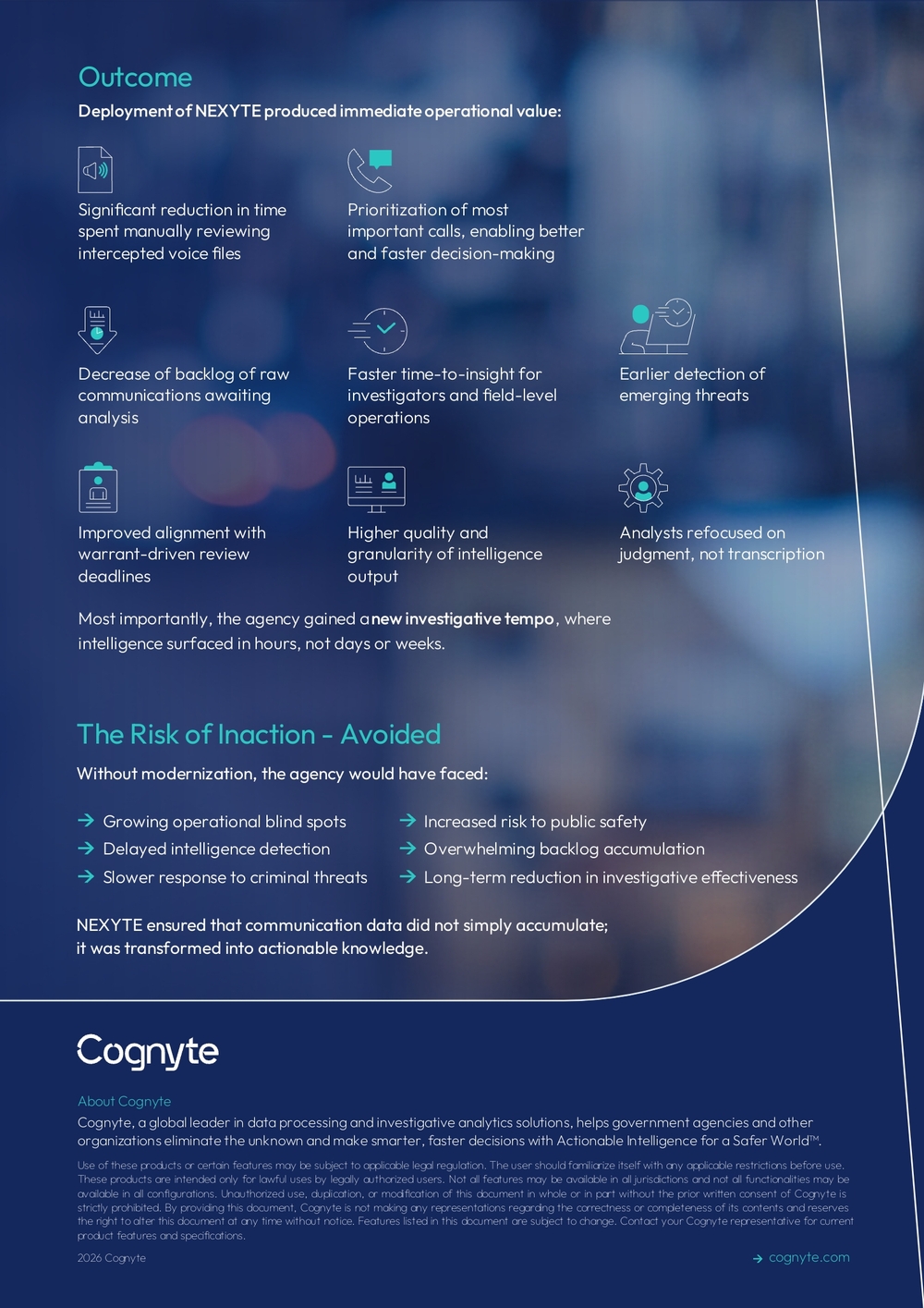
How a Large European Police Force Uses NEXYTE to Generate Actionable Insights from Lawful Interception Data
Executive Summary
Lawful interception remains one of the most critical investigative tools for law enforcement, enabling insight into criminal networks, extremist entities and hostile threats. Yet the operational reality of modern communications has fundamentally changed. A large European police department, tasked with combating organized crime, terrorism and transnational criminal activity, found itself overwhelmed by the volume, linguistic diversity and encrypted nature of lawfully intercepted communications generated by its interception systems.
To maintain operational agility and meet strict legal and time constraints tied to interception warrants, the agency deployed Cognyte's NEXYTE to analyze and automate content analytics across intercepted data at scale. By applying AI-driven voice biometrics, transcription, translation, entity extraction and LLM-based summarization and fusing these results with digital forensics and OSINT, the agency transformed how intercepted communications were analyzed, enabling a faster, more precise and intelligence-rich capability.
NEXYTE didn't simply accelerate analysis; it changed how the agency uses data in daily operations, allowing analysts to focus on intelligence, not manual review.
Challenges
Increasing linguistic diversity of communications
The agency saw a significant rise in communications recorded in multiple languages, dialects and hybrid slang, driven by demographic evolution and globalized criminal networks.
Manual processes were insufficient because:
- Each intercepted audio source often required different linguistic expertise
- Trained linguists were limited
- Multilingual content was analyzed too slowly to be operationally actionable
Encryption limiting message content
End-to-end encryption and secure messaging platforms increasingly prevented extraction of message content:
- Some intercepted audio revealed only minimal contextual clarity
- Metadata existed, but content insight did not
- Analysts could see "who communicated with whom", but not "what was communicated or why"
This created a dependency on inference rather than factual content.
Flat staffing vs. exponential data growth
Despite data volume increasing year-on-year:
- The number of trained analysts remained static
- Voice files, transcripts and metadata accumulated faster than processing capacity
- Backlog increased
- Review windows tied to legal warrants were at risk of being exceeded
- Operational risk increased
- Intelligence latency became a threat to public safety
The Operational Imperative
The department's leadership faced a strategic reality: scaling the human workforce was not viable; scaling intelligence capability was essential.
They required a solution that could:
- Accelerate interpretation of intercepted data
- Automatically process multilingual communications
- Restore context despite partial visibility due to encryption
- Eliminate manual transcription bottlenecks
- And provide instant visibility into entities, relationships and behavioral signals
NEXYTE was selected to support this shift by enabling advanced analytics on lawfully intercepted data produced by the agency's existing systems.
Solution
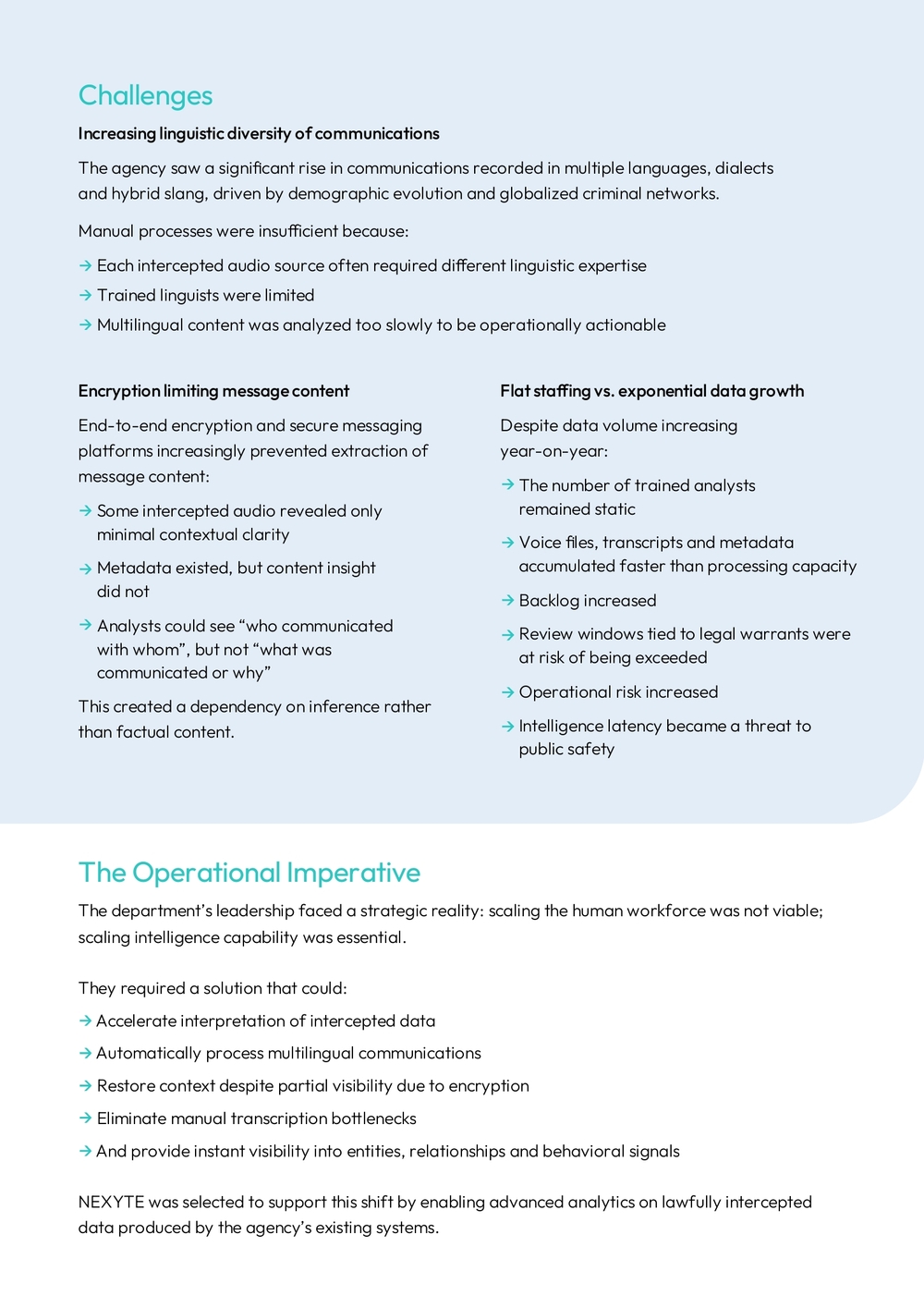
The police force deployed Cognyte's NEXYTE above its existing lawful interception systems. NEXYTE ingested content and metadata generated by those systems, including real-time and historical intercepted communications across multiple channels and applied advanced analytics, including:
-
Voice biometric identification and speaker clustering Identifying individuals and recurring voices across recordings — even when anonymous
-
Multilingual Speech-to-Text (STT) Automated transcription for diverse accents and dialects
-
Automated translation of transcriptions Allowing analysts to review content in their operational language
-
AI-powered entity extraction Automatic detection of people, organizations, relationships, locations and behavioral patterns
-
LLM-based summarization of voice communications Generating instant structured summaries of long conversations (that matches data protection and fairness acts, including GDPR)
Crucially, NEXYTE also functioned as a fusion-centric investigative platform, correlating lawful interception analysis outputs with:
- OSINT
- Device forensics
- Criminal records
- CDR data
- Geo-data
- Law enforcement archives and informant-based intelligence
This expanded intercepted communication into a contextualized intelligence picture, revealing intent, network structure and operational risk indicators.
Outcome
Deployment of NEXYTE produced immediate operational value:
- Significant reduction in time spent manually reviewing intercepted voice files
- Decrease of backlog of raw communications awaiting analysis
- Earlier detection of emerging threats
- Higher quality and granularity of intelligence output
- Prioritization of most important calls, enabling better and faster decision-making
- Faster time-to-insight for investigators and field-level operations
- Improved alignment with warrant-driven review deadlines
- Analysts refocused on judgment, not transcription
Most importantly, the agency gained a new investigative tempo, where intelligence surfaced in hours, not days or weeks.
The Risk of Inaction - Avoided
Without modernization, the agency would have faced:
- Growing operational blind spots
- Delayed intelligence detection
- Slower response to criminal threats
- Increased risk to public safety
- Overwhelming backlog accumulation
- Long-term reduction in investigative effectiveness
NEXYTE ensured that communication data did not simply accumulate; it was transformed into actionable knowledge.